Category
page 1Seaweeds

seaweed
thumb|upright|Ascophyllum nodosum exposed to the sun in [[Nova Scotia, Canada|alt=Photo of seaweed with small swollen areas at the end of each frond]]
thumb|Dead man's fingers (Codium fragile) off the [[Massachusetts coast in the United States|alt=Photo of detached seaweed frond lying on sand]]
right|thumb|The top of a kelp forest in [[Otago, New Zealand|alt=Photo of seaweed with the tip floating at the surface]]
Seaweed, or macroalgae, refers to thousands of species of macroscopic, multicellular, marine algae. The term includes some types of Rhodophyta (red), Phaeophyta (brown) and Chlorophyt

kelp
Kelps are large brown algae or seaweeds that make up the order Laminariales. There are about 30 genera. Despite its appearance and use of photosynthesis in chloroplasts, kelp is not a plant but a stramenopile.

Porphyra
Porphyra is a genus of coldwater seaweeds that grow in cold, shallow seawater. More specifically, it belongs to red algae phylum of laver species (from which comes laverbread), comprising approximately 70 species. It grows in the intertidal zone, typically between the upper intertidal zone and the splash zone in cold waters of temperate oceans. In East Asia, it is used to produce the sea vegetable products nori (in Japan) and gim (in Korea). There are considered to be 60–70 species of Porphyra worldwide and seven around Britain and Ireland, where it has been traditionally used to produce edibl

Gracilaria
Gracilaria, also known as Irish moss or ogonori, is a genus of red algae in the family Gracilariaceae. It is notable for its economic importance as an agarophyte meaning that it is used to make agar, as well as its use as a food for humans and various species of shellfish. Various species in the genus are cultivated among Asia, South America, Africa and Oceania. They produce over 90% of the world's agar.
.jpg)
Pyropia
Pyropia is a genus of red algae in the family Bangiaceae. It is found around the world in intertidal zones and shallow water. The genus has folding frond-like blades which are either red, brown or green. Some Pyropia species are used to create nori, and are thus important subjects for aquaculture.
Gim
Korean edible seaweed
seaweed farming
farming of aquatic seaweed

Asparagopsis taxiformis
species of alga
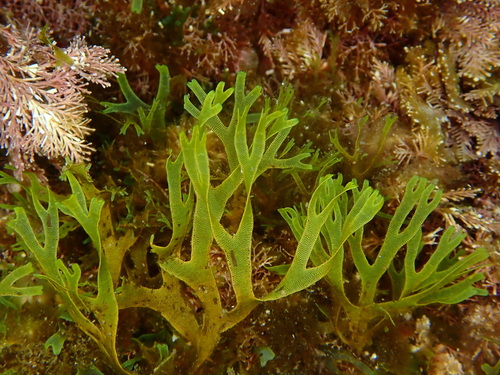
Dictyota
Dictyota is a genus of brown seaweed in the family Dictyotaceae. Species are predominantly found in tropical and subtropical seas, and are known to contain numerous chemicals (diterpenes) which have potential medicinal value. As at the end of 2017, some 237 different diterpenes had been identified from across the genus.

Dictyotaceae
Dictyotaceae is large family of brown algae (class Phaeophyceae). It is the only family in the monotypic order Dictyotales (). Members of this family generally prefer warmer waters than other brown algae and are prevalent in tropical and subtropical waters thanks to their many chemical defenses to ward off grazers. They display an isomorphic haplodiploid life cycle and are characterized by vegetative growth through a single apical cell. One genus in this family, Padina, is the only calcareous member of the brown algae. Lobophora variegata (= Pocockiella varieagata) often presents a beautiful b
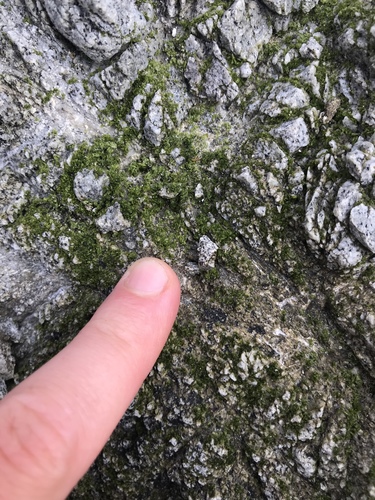
Prasiola crispa
species of seaweed
Artificial seawater
mixture of dissolved mineral salts (and sometimes vitamins) that simulates seawater

Furcellaria
Furcellaria is a genus of red algae. It is a monotypic genus, the only species being Furcellaria lumbricalis, which has commercial importance as a raw material for carrageenan production. It is mainly harvested from the waters of Denmark and Canada.
kelp noodles
Food
Entwisleia
Entwisleia is a monotypic genus in the red algae family, Entwisleiaceae. There is just one species (the type species) in this genus,
Entwisleia bella, from south-eastern Tasmania and represents both a new family and a new order (Entwisleiales) in the Nemaliophycidae.