Category
page 1Secretion

earwax
Earwax, also known by the medical term cerumen, is a waxy substance secreted in the ear canal of humans and other mammals. Earwax can be many colors, including brown, orange, red, yellowish, and gray. Earwax protects the skin of the human ear canal, assists in cleaning and lubrication, and provides protection against bacteria, fungi, particulate matter, and water.
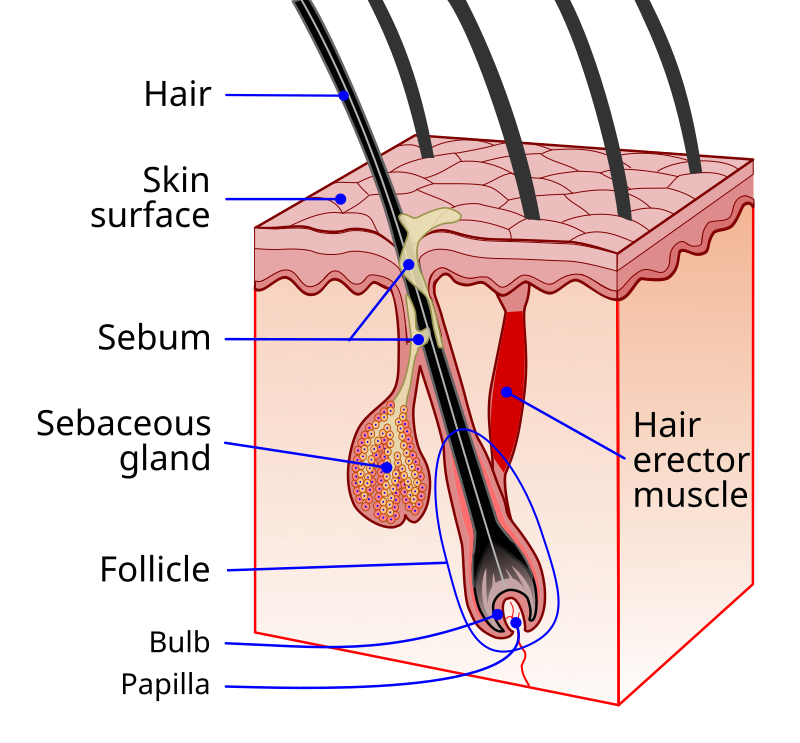
sebaceous gland
microscopic exocrine gland in the skin that secretes an oily or waxy matter, called sebum, to lubricate and waterproof the skin and hair of mammals

secretion
thumb|440px
type III protein secretion system complex
complex that carries out protein secretion in the bacterial type III secretion system
bacterial secretion system
in gram negative bacteria, multiprotein complexes that move pathogen proteins across the cell envelope
Sec61
Sec61, termed SecYEG in prokaryotes, is a membrane protein complex found in all domains of life. As the core component of the translocon, it transports proteins to the endoplasmic reticulum in eukaryotes and out of the cell in prokaryotes. It is a doughnut-shaped pore through the membrane with 3 different subunits (heterotrimeric), SecY (α), SecE (γ), and SecG (β). It has a region called the plug that blocks transport into or out of the ER. This plug is displaced when the hydrophobic region of a nascent polypeptide interacts with another region of Sec61 called the seam, allowing translocation
Secretomics
Secretomics is a type of proteomics which involves the analysis of the secretome—all the secreted proteins of a cell, tissue or organism. Secreted proteins are involved in a variety of physiological processes, including cell signaling and matrix remodeling, but are also integral to invasion and metastasis of malignant cells. Secretomics has thus been especially important in the discovery of biomarkers for cancer and understanding molecular basis of pathogenesis. The analysis of the insoluble fraction of the secretome (the extracellular matrix) has been termed matrisomics.
secretome
The secretome is the set of proteins expressed by an organism and secreted into the extracellular space. In humans, this subset of the proteome encompasses 13-20% of all proteins, including cytokines, growth factors, extracellular matrix proteins and regulators, and shed receptors. The secretome of a specific tissue can be measured by mass spectrometry and its analysis constitutes a type of proteomics known as secretomics.
type II protein secretion system complex
large protein complex that spans the cell envelope of Gram-negative bacteria and mediates the movement of proteins into the extracellular environment
preorbital gland
paired exocrine gland in many hoofed animals