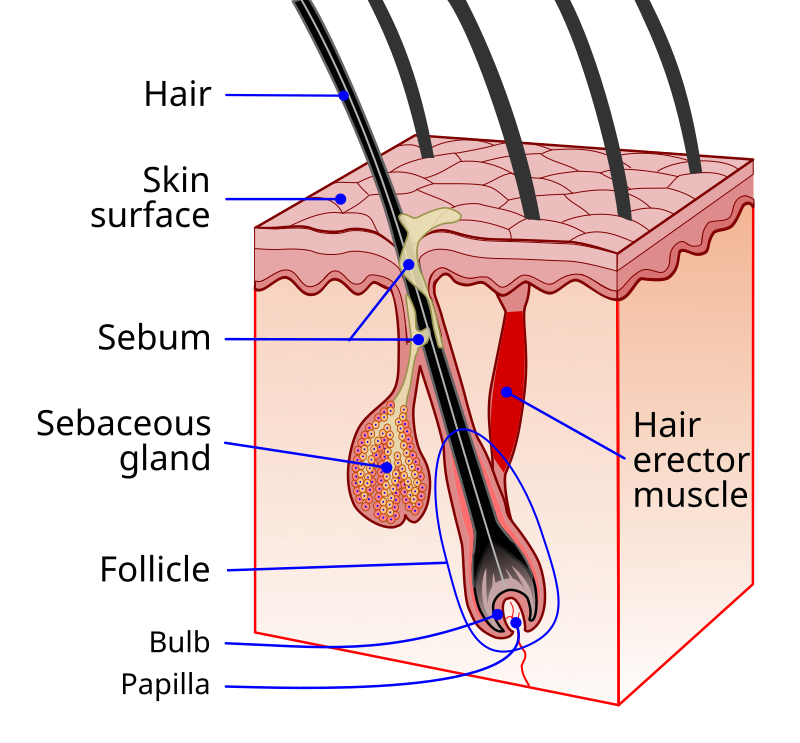
File:Hair_follicle-en.svg · Wikimedia Commons · See Wikimedia Commons
sebaceous gland
Sign in to saveAlso known as oil gland, sebaceous glands
microscopic exocrine gland in the skin that secretes an oily or waxy matter, called sebum, to lubricate and waterproof the skin and hair of mammals
A sebaceous gland is a tiny gland in your skin that produces an oily substance called sebum, which keeps your skin and hair lubricated and water-resistant. These glands matter because they help protect your skin and hair from drying out, though they can sometimes become clogged and cause acne.
AI-generated from the Wikipedia summary — may contain errors.
Key facts
- Mesh
- D012627
- Ta98
- A16.0.00.030 , A15.2.07.044
via Wikipedia infobox
Research
11,734 papers- The Sebaceous Gland: A Key Player in the Balance Between Homeostasis and Inflammatory Skin Diseases.Cells · 2025
- Treatment of sebaceous gland hyperplasia: a review of the literature.The Journal of dermatological treatment · 2021
- [The sebaceous gland].Der Hautarzt; Zeitschrift fur Dermatologie, Venerologie, und verwandte Gebiete · 2010
- Areolar sebaceous gland hyperplasia.BMJ case reports · 2023
- Sebaceous gland carcinoma: Can we do better?Indian journal of ophthalmology · 2018
via PubMed
Wikidata facts
- Named after
- skin oil
- Image
- Hair follicle-en.svg
Show 4 more facts
- described by source
- Encyclopædia Britannica 11th edition
- Commons category
- Sebaceous gland
- NCI Thesaurus ID
- C33519
- different from
- sebaceous adenitis
Sources (9)
via Wikidata · CC0
~13 min read
Encyclopedic overview
A sebaceous gland or oil gland is a microscopic exocrine gland in the skin that opens into a hair follicle to secrete an oily or waxy matter, called sebum, which lubricates the hair and skin of mammals. In humans, sebaceous glands occur in the greatest number on the face and scalp, but also on all parts of the skin except the palms of the hands and soles of the feet. In the eyelids, meibomian glands, also called tarsal glands, are a type of sebaceous gland that secrete a special type of sebum into tears. Surrounding the female nipples, areolar glands are specialized sebaceous glands for lubricating the nipples. Fordyce spots are benign, visible, sebaceous glands found usually on the lips, gums and inner cheeks, and genitals.
Structure
Excerpted from Wikipedia’s “sebaceous gland” article, available under the CC BY-SA 4.0 licence.