Category
page 1Sequences and series

sequence
thumb|A part of an infinite sequence of real numbers (in blue), indexed by a natural number . This sequence is neither increasing, decreasing, convergent, nor Cauchy. It is, however, bounded (by red dashed lines).
In mathematics, a sequence is a collection of objects possibly with repetition, that come in a specified order. Like a set, it contains members (also called elements, or terms). Unlike a set, the same elements can appear multiple times at different positions in a sequence, and unlike a set, the order does matter. The notion of a sequence can be generalized to an indexed family, defin

arithmetic progression
sequence of numbers with constant differences between consecutive numbers
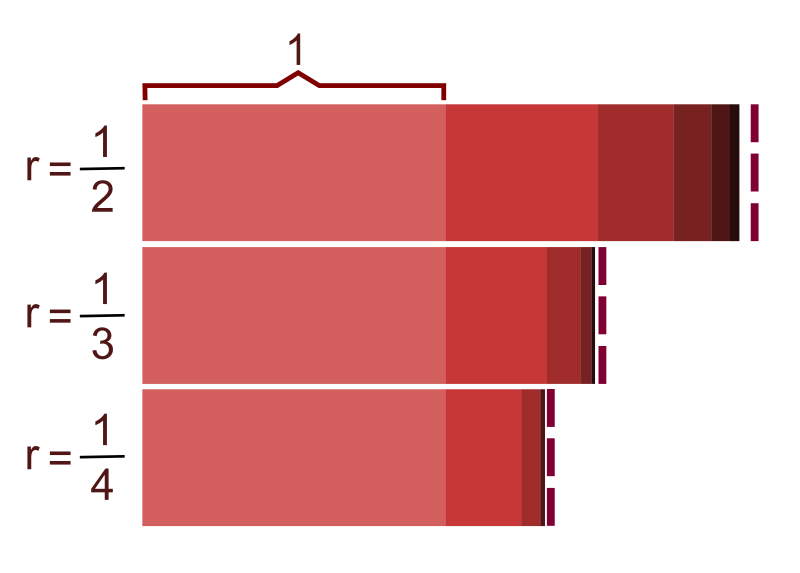
geometric progression
sequence of numbers where each term is found by multiplying the previous one by a fixed, non-zero number

limit of a sequence
null sequence; value that the terms of a sequence "tend to"

cauchy sequence
sequence whose elements become arbitrarily close to each other
𝑛-tuple
In mathematics, a tuple is a finite sequence (or ordered list) of numbers. More generally, it is a sequence of mathematical objects, called the elements of the tuple. An -tuple is a tuple of elements, where is a non-negative integer. There is only one 0-tuple, called the empty tuple. A 1-tuple and a 2-tuple are commonly called a singleton and an ordered pair, respectively. The term "infinite tuple" is occasionally used for "infinite sequences".
subsequence
In mathematics, a subsequence of a given sequence is a sequence that can be derived from the given sequence by deleting some or no elements without changing the order of the remaining elements. For example, the sequence \langle A,B,D \rangle is a subsequence of \langle A,B,C,D,E,F \rangle obtained after removal of elements C, E, and F. The relation of one sequence being the subsequence of another is a partial order.
infinite product
expression representing the product of an infinite sequence
harmonic progression
progression formed by taking the reciprocals of an arithmetic progression
Cauchy product
concept in mathematics
Padé approximant
'best' approximation of a function by a rational function of given order
Farey sequence
increasing sequence of reduced fractions between 0 and 1 whose denominators do not exceed a given positive integer
Champernowne constant
decimal number formed by concatenating successive representations of integers
Chebyshev's sum inequality
inequality relating two increasing sequences of numbers, or one decreasing and another increasing sequence
function iteration
mathematical operation of composing a function with itself repeatedly
monotone convergence theorem
theorem of calculus
random sequence
sequence of random variables
subadditivity
In mathematics, subadditivity is a property of a function that states, roughly, that evaluating the function for the sum of two elements of the domain always returns something less than or equal to the sum of the function's values at each element. There are numerous examples of subadditive functions in various areas of mathematics, particularly norms and square roots. Additive maps are special cases of subadditive functions.
Recamán's sequence
endless sequence
sequence space
a vector space whose elements are infinite sequences of real or complex numbers
polynomial sequence
sequence valued in polynomials
periodic sequence
sequence for which the same terms are repeated over and over
Van der Corput sequence
example of the simplest one-dimensional low-discrepancy sequence over the unit interval; it is constructed by reversing the base-n representation of the sequence of natural numbers (1, 2, 3, …)
superadditivity
In mathematics, a function f is superadditive if
f(x+y) \geq f(x) + f(y)
for all x and y in the domain of f.
low-discrepancy sequence
type of mathematical sequence
oscillation
amount of variation between extrema of a function or sequence