File:Geometric_sequences.svg · Wikimedia Commons · See Wikimedia Commons
geometric progression
Sign in to saveAlso known as geometric sequence
sequence of numbers where each term is found by multiplying the previous one by a fixed, non-zero number
A geometric progression is a sequence of numbers where each number is created by multiplying the previous number by the same fixed amount. This type of sequence appears frequently in real-world situations like population growth, radioactive decay, and financial calculations, making it useful for understanding how things change when they grow or shrink by a constant percentage.
AI-generated from the Wikipedia summary — may contain errors.
Wikidata facts
- Subclass of
- constant-recursive sequence
- Image
- Geometric sequences.svg
Show 2 more facts
- different from
- geometric series
- maintained by WikiProject
- WikiProject Mathematics
Sources (3)
via Wikidata · CC0
~10 min read
Encyclopedic overview
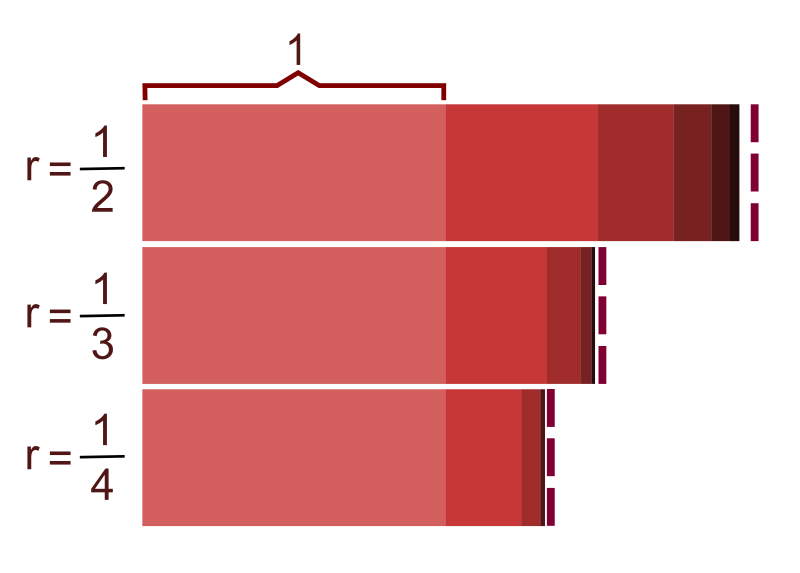
Diagram illustrating three basic geometric sequences of the pattern 1(r) up to 6 iterations deep. The first block is a unit block and the dashed line represents the infinite sum of the sequence, a number that it will forever approach but never touch: 2, 3/2, and 4/3 respectively.
A geometric progression, also known as a geometric sequence, is a mathematical sequence of non-zero numbers where each term after the first is found by multiplying the previous one by a fixed number called the common ratio. For example, the sequence 2, 6, 18, 54, ... is a geometric progression with a common ratio of 3. Similarly 10, 5, 2.5, 1.25, ... is a geometric sequence with a common ratio of 1/2.
Excerpted from Wikipedia’s “geometric progression” article, available under the CC BY-SA 4.0 licence.
Gallery (2)
Available in 65 languages
- Español
- Français
- Deutsch
- 中文
- 日本語
- Русский
- Português
- Italiano
- العربية
- हिन्दी
- Afrikaans
- Amharic
- Armenian
- Azerbaijani
- Bahasa Indonesia
- Basque
- Belarusian
- Bosnian
Show 46 more
- Bulgarian
- Catalan
- Central Kurdish
- Chuvash
- Croatian
- Czech
- Danish
- Esperanto
- Estonian
- Finnish
- Galician
- Georgian
- Greek
- Hebrew
- Hungarian
- Ido
- Irish
- Kazakh
- Latvian
- Lithuanian
- Macedonian
- Malay
- Minangkabau
- Nederlands
- Piedmontese
- Polski
- Punjabi
- Romanian
- rsk
- Serbian
- Serbian (Latin)
- Sinhala
- Slovak
- Slovenian
- Svenska
- Tamil
- Tatar
- Tiếng Việt
- Ukrainian
- Uzbek
- Wu Chinese
- Yakut
- zh_yue
- فارسی
- ไทย
- 한국어
via Wikidata sitelinks · CC0