Category
page 1Skull bones

zygomatic bone
facial bone
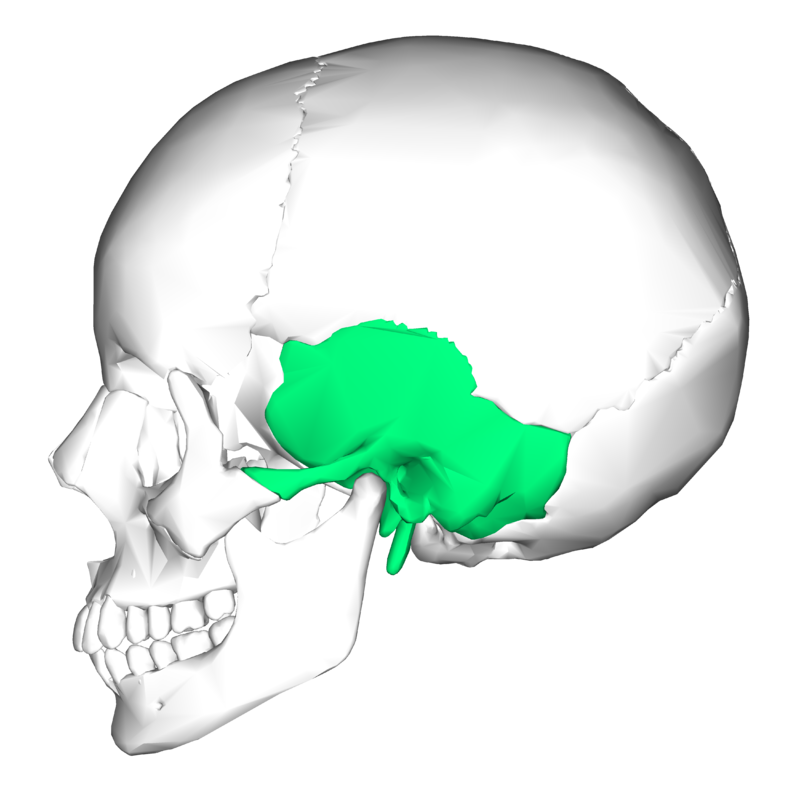
temporal bone
bones situated at the sides and base of the skull, and lateral to the temporal lobes of the cerebrum

parietal bone
bone in the human skull which, when joined together, forms the sides and roof of the cranium

occipital bone
saucer-shaped membrane bone situated at the back and lower part of the cranium
premaxilla
The premaxilla (or praemaxilla) is one of a pair of small cranial bones at the very tip of the upper jaw of many animals, usually, but not always, bearing teeth. In humans, they are fused with the maxilla. The "premaxilla" of therian mammals has been usually termed as the incisive bone. Other terms used for this structure include premaxillary bone or os premaxillare, intermaxillary bone or os intermaxillare, and '''Goethe's bone'''.
Squamosal bone
skull bone
sclerotic ring
ring of bone supporting the eye
Quadrate bone
skull bone
jugal bone
skull bone
articular bone
Part of the lower jaw of most vertebrates
angular bone
bone in the lower jaw of birds, amphibians and reptiles
quadratojugal bone
skull bone
postorbital bone
skull bone
prefrontal bone
skull bone in some tetrapods
Suprangular
thumb|Skull diagram of the dinosaur Proceratosaurus, showing location of surangular
thumb|Skull and jaws diagram of the primitive Synapsida|synapsid [[Dimetrodon, showing location of surangular]]
The surangular or suprangular is a jaw bone found in most land vertebrates, except mammals. Usually in the back of the jaw, on the upper edge, it is connected to all other jaw bones: dentary, angular, splenial and articular. It is often a muscle attachment site. It has been noted in dinosaurs.

splenial bone
thumb|Hemimandible of Trimerorhachis; the splenial (labeled "sp") is visible on the interior surface
thumb|Skull and jaws diagram of the primitive Synapsida|synapsid [[Dimetrodon, showing location of the splenial]]
The splenial is a small bone in the lower jaw of reptiles, amphibians and birds, usually located on the lingual side (closest to the tongue) between the angular and surangular. The splenial and coronoid are together known as the paradental elements. In non-tetrapod vertebrates, the splenial is known as the first infradentary and forms part of the infradentary series along with the p
palpebral bone
small dermal bone of eye socket found in few animals