Category
page 1Sleep

sleep
Sleep is a state of reduced mental and physical activity in which consciousness is altered and certain sensory activity is inhibited. During sleep, there is a marked decrease in muscle activity and interactions with the surrounding environment. While sleep differs from wakefulness in terms of the ability to react to stimuli, it still involves active brain patterns, making it more reactive than a coma or disorders of consciousness.
.jpg)
dream
thumb|upright=1.5|In this illustration, politician Daniel O'Connell dreams of a confrontation between his outfit and that of [[George IV (r. 1820–1830; shown via a thought bubble)]]

bed
thumb|325px|Bedroom on the Detmold Open-air Museum premises
yawn
A yawn is a reflex in vertebrate animals characterized by a long inspiratory phase with gradual mouth gaping, followed by a brief climax (or acme) with muscle stretching, and a rapid expiratory phase with muscle relaxation, which typically lasts a few seconds. For fish and birds, this is described as gradual mouth gaping, staying open for at least three seconds and subsequently a rapid closure of the mouth. Almost all vertebrate animals, including mammals, birds, reptiles, amphibians, and even fish, experience yawning. The study of yawning is called chasmology.

bedroom
thumb|A bedroom in Germany
thumb|Bedroom in the Indian Mound Cottage at Jekyll Island
A bedroom or bedchamber is a room situated within a residential or accommodation unit, primarily used for sleeping. A typical Western bedroom contains as bedroom furniture one or two beds, a clothes closet, and bedside table and dressing table, both of which usually contain drawers. In dwellings with multiple stories, bedrooms are often on the upper floors. Beds range from a crib for an infant; a single or twin bed for a toddler, child, teenager or single adult; to bigger sizes like a full, double, queen, kin

hibernation
thumb| Northern bat hibernating in [[Norway]]
thumb|Bats hibernating in a silver mine
nocturnal emission
spontaneous sleep orgasm

alarm clock
type of clock used to wake up a sleeping person at a certain time

siesta
thumb|right|upright=1.25|A painting of a young woman taking a siesta. (The Hammock, [[Gustave Courbet (1844))]]
thumb|upright=1.1|People taking a siesta in a haystack, Lendava, Yugoslavia, 1957
A siesta (from Spanish, pronounced and meaning "nap") is a short nap taken in the early afternoon, often after the midday meal. Such a period of sleep is a common tradition in some countries, particularly those in warm-weather zones. The "siesta" can refer to the nap itself, or more generally to a period of the day, generally between 2 and 5p.m. This period is used for sleep, as well as leisure, midday
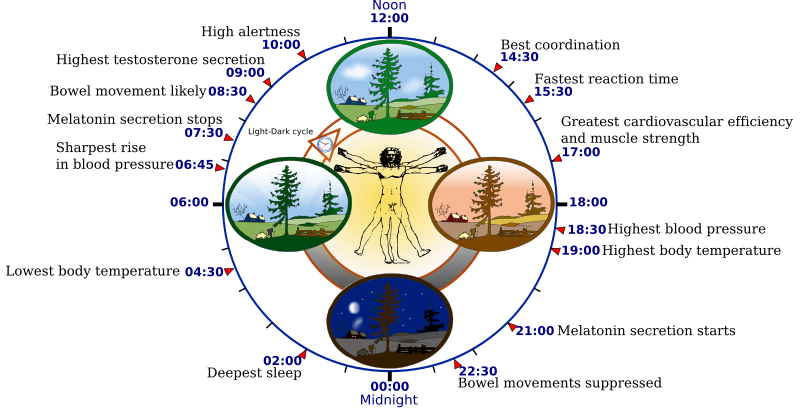
circadian rhythm
natural internal process that regulates the sleep-wake cycle

nocturnality
thumb|right|Owl|Owls are well known for being nocturnal, but some owls are active during the day.

somnolence
Somnolence (alternatively sleepiness or drowsiness) is a state of strong desire for sleep, or sleeping for unusually long periods (compare hypersomnia). It has distinct meanings and causes. It can refer to the usual state preceding falling asleep, the condition of being in a drowsy state due to circadian rhythm disorders, or a symptom of other health problems. It can be accompanied by lethargy, weakness and lack of mental agility.
biorhythm
pseudoscience - the attempt to predict various aspects of a person's life through simple mathematical cycles; not to be confused with scientific term "biological rhythm"
World Sleep Day
world day
nocturnal penile tumescence
spontaneous erection during or after sleep
polyphasic sleep
any sleep pattern with multiple periods of sleep in a 24-hour period

sleepover
thumb|Teenage girls at a sleepover, Gainesville, Georgia, 1952
A sleepover, also known as a slumber party or pajama party, is a social occasion in which a young person stays at the home of a friend. Multiple people and/or friends may sleepover at the friend's home. Typically a younger person will partake in a sleepover; however, an adult or older person may sleep at a friend's home.
night owl
a person who tends to stay up until late at night
yoga nidra
state of consciousness between waking and sleeping induced by a guided meditation

microsleep
thumb|Example of an EEG alpha wave
thumb|Example of an EEG theta wave

nap
thumb|A man napping in a hammock, on a [[patio in Costa Rica]]
bedtime story
telling of a story to somebody about to sleep
sleep hygiene
set of practices around healthy sleeping
sopor
condition of abnormally deep sleep or a stupor from which it is difficult to rouse
sleep
sleep in non-human beings
Sleep-learning
Sleep-learning or sleep-teaching (also known as hypnopædia or hypnopedia) is an attempt to convey information to a sleeping person, typically by playing a sound recording to them while they sleep. Although sleep is considered an important period for memory consolidation, scientific research has concluded that sleep-learning is not possible. Once a concept explored in the early history of psychology, sleep-learning appears frequently in fiction and parapsychology, and is widely considered to be pseudoscience.

blindfold
225px|thumb|right|Astronauts Richard H. Truly and [[Guion Bluford sleeping on board the Challenger. Bluford, in the foreground (upside-down) wears a sleep mask. Astronauts may find it difficult to sleep in space, especially if they are light sensitive.]]
225px|thumb|right|Sleep mask
sleep spindle
EEG waveform that occurs during sleep
power nap
short sleep

f.lux
f.lux (pronounced "flux") is a cross-platform computer program that adjusts a display's color temperature according to location and time of day, offering functional respite for the eyes. The program is designed to reduce eye strain during night-time use, helping to reduce disruption of sleep patterns.
Pokémon Sleep
2023 video game developed by Select Button and Niantic
chronotype
A chronotype is the behavioral manifestation of an underlying circadian rhythm's myriad physical processes. A person's chronotype is the propensity for the individual to sleep at a particular time during a 24-hour period. Eveningness (delayed sleep period; most active and alert in the evening) and morningness (advanced sleep period; most active and alert in the morning) are the two extremes with most individuals having some flexibility in the timing of their sleep period. However, across development there are changes in the propensity of the sleep period with pre-pubescent children preferring
Yobai
__NOTOC__
nocturnal clitoral tumescence
spontaneous swelling of the clitoris during sleep or when waking up
early bird
person who usually gets up early in the morning and goes to bed early in the evening
co-sleeping
Co-sleeping or bed sharing is a practice in which babies and young children sleep close to one or both parents, as opposed to in a separate room. Co-sleeping individuals sleep in sensory proximity to one another, where the individual senses the presence of others. This sensory proximity can either be triggered by touch, smell, taste, or noise. Therefore, the individuals can be a few centimeters away or on the other side of the room and still have an effect on the other. It is standard practice in many parts of the world, and is practiced by a significant minority in countries where cribs are a
counting sheep
mental exercise to fall asleep
sleeping while on duty
falling asleep while working
Multiple Sleep Latency Test
Diagnostic tool used to diagnose sleep disorders
J. Pauly & Sohn
Bedding company
witching hour
time of day when the devil, demons or ghosts are supposed to come out
actigraphy
Actigraphy is a non-invasive method of monitoring human rest/activity cycles. A small actigraph unit, also called an actimetry sensor, is worn for a week or more to measure gross motor activity. The unit is usually in a wristwatch-like package worn on the wrist. The movements the actigraph unit undergoes are continually recorded and some units also measure light exposure. The data can be later read to a computer and analysed offline; in some brands of sensors the data are transmitted and analysed in real time.
bedtime
thumb|Child Asleep (The Rosebud) by Thomas Sully (1841)
sleep inertia
drowsiness just after waking up

Long Ambients Two
2019 studio album by Moby
Neuroscience of sleep
study of the neuroscientific and physiological basis of the nature of sleep
bed rotting
self-care trend of spending large amounts of time in bed
Pregnancy and sleep
waking up early
behaviour or productivity method consisting in waking up early in the morning
sleep diary
data sheet
Redshift
application that adjusts the computer display's color temperature

Why We Sleep
book by Matthew Walker
sleep pod
special types of structures or chairs that allow people to nap, often shielded
infant crying
medical condition
Beddit
Beddit Oy (formerly Finsor Oy) is a Finnish technology company that sells sleep tracking devices and a sleep tracking application to help monitor sleep. The company was founded in October 2006 and released their first sleep tracker in November 2013. In May 2017, Beddit was acquired by Apple Inc.
sleep tracking
process of quantitatively measuring a person's sleep
Sleep onset latency
quantitative measure of the tendency to fall asleep
bundling
traditional social custom and courting behavior
white noise machine
device that produces white noise or other similar random sounds
sleep study
test that records body activity during sleep