Category
page 1Solar phenomena

sunrise
thumb|Sunrise seen over the Atlantic Ocean through [[cirrus clouds on the Jersey Shore at Spring Lake, New Jersey, U.S.]]
Sunrise (or sunup) is the moment when the upper rim of the Sun appears on the horizon in the morning, at the start of the Sun path. The term can also refer to the entire process of the solar disk crossing the horizon.

sunset
thumb|upright=1.35|Actual sunset: Two minutes before the Sun disappears below the horizon.

cosmic radiation
high-speed, i.e. high-energy particle, mainly originating in outer space, outside the Solar system

solar wind
stream of charged particles released from the Sun
%202007-04-30%20T001456.gif)
sunspot
Sunspots are temporary spots on the Sun's surface that are darker than the surrounding area. They are regions of reduced surface temperature caused by concentrations of magnetic flux that inhibit convection. Sunspots appear within active regions, usually in pairs of opposite magnetic polarity. Their number varies according to the approximately 11-year solar cycle.

solar flare
sudden flash of increased brightness on the Sun, usually observed near its surface and in close proximity to a sunspot group
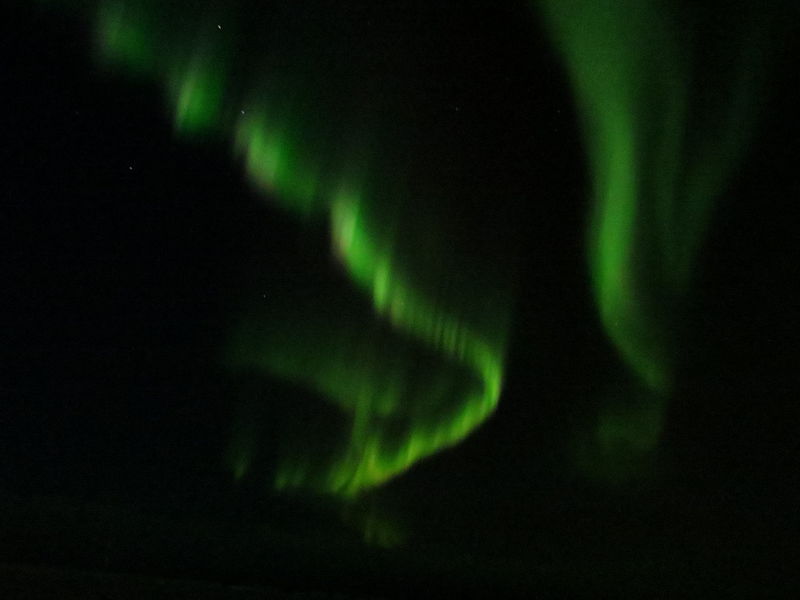
geomagnetic storm
temporary disturbance of the Earth's magnetosphere caused by a disturbance in the interplanetary medium

solar prominence
gaseous outburst from the sun

terminator
moving line that separates the illuminated day side and the dark night side of a planetary body

green flash
meteorological optical phenomena

coronal mass ejection
significant release of plasma and magnetic field from the solar corona
analemma
thumb|Afternoon analemma photo taken in 1998–99 in Murray Hill, New Jersey|Murray Hill, [[New Jersey, U.S., by Jack Fishburn. The Bell Laboratories building is in the foreground.]]
facula
bright spot
granule
convection cell in the photosphere of a star
Manhattanhenge
Manhattanhenge, also called the Manhattan Solstice, is an event during which the setting sun or the rising sun is aligned with the east–west streets of the main street grid of Manhattan, New York City. The astrophysicist Neil deGrasse Tyson claims to have coined the term, by analogy with Stonehenge. The sunsets and sunrises each align twice a year, on dates evenly spaced around the summer solstice and winter solstice. The sunset alignments occur around May 28 and July 13. The sunrise alignments occur around December 5 and January 8.
coronal hole
area where the Sun's corona is colder and darker
Maunder Minimum
The period starting about 1645 and continuing to about 1715 when sunspots were exceedingly rare
spicule
dynamic jet in the chromosphere of the Sun
solar irradiance
power per unit area received from the Sun in the form of electromagnetic radiation
limb darkening
phenomenon of stars
Wolf number
measure of sunspots

supergranulation
thumb|Supegranulation in the chromosphere of Sun.
In solar physics and observation, supergranulation is a pattern of convection cells in the Sun's photosphere. The individual convection cells are typically referred to as supergranules. The pattern was discovered in the 1950s by A.B. Hart using Doppler velocity measurements showing horizontal flows on the photosphere (flow speed about 300 to 500 m/s, a tenth of that in the smaller granules). Later work (1960s) by Leighton, Noyes and Simon established a typical size of about 30000 km for supergranules with a lifetime of about 24 hours.
magnetic reconnection
physical process in highly conducting plasmas in which the magnetic topology is rearranged and magnetic energy is converted to kinetic energy, thermal energy, and particle acceleration
Moreton wave
chromospheric signature of a large-scale solar coronal shock wave. generated by solar flares, discovered by Gail Moreton and Harry E. Ramsey in 1959
solar maximum
period of greatest solar activity in the 11-year solar cycle of the Sun
Dalton Minimum
Period of low solar activity from 1790 to 1830
Miracle of the Sun
series of events reported to have occurred miraculously on 13 October 1917 in Portugal
solar storm
Wikimedia disambiguation page
plage
bright region in the chromosphere of the Sun
solar minimum
period of least solar activity in the 11-year solar cycle of the Sun
heliospheric current sheet
surface which separates the heliosphere into positively and negatively charged components
Spörer's law
Prediction of sunspot latitudes
Spörer Minimum
Hypothesized period of low solar activity from 1460 to 1550
solar phenomena
sunspots, flares, eruptions, etc. on the surface of the Sun
Lahaina Noon
tropical solar phenomenon
Wilson effect
Perceived depression in sunspot umbrae
Solar Wind Composition Experiment
star ejecta measuring device deployed during the Apollo moon landings
Modern Maximum
period of relatively high solar activity which began with Solar Cycle 15 in 1914
Space Weather Prediction Center
NOAA laboratory and service center
Babcock model
mechanism explaining sunspot patterns
Sun outage
interruption in or distortion of geostationary satellite signals caused by interference from solar radiation
astrophysical plasma
ionized plasma found in astrophysical environments
Helmet streamer
sunward-traveling plasma voids observed in the Sun’s outer atmosphere
solar observation
study of the Sun's behavior
active region
temporary region on the Sun
solar energetic particles
High-energy particles from the Sun
first sunrise
space hurricane
A spiral, geomagnetic storm
Fermi glow
space phenomenon
Forbush decrease
rapid decrease in galactic cosmic ray intensity following a coronal mass ejection
Evershed effect
type of solar phenomenon
Alfvén surface
boundary between solar corona and wind
Coronal Rain
Solar phenomena
Solar proton event
solar phenomenon
list of solar storms
Wikimedia list article
Nanoflares
thumb|A close-up of one of the loop brightenings. The frame on the far right is the most zoomed in, showing the putative nanoflare.
thumb|"This false-color temperature map shows solar active region AR10923, observed close to center of the sun's disk. Blue regions indicate plasma near 10 million degrees K." Credit: Reale, et al. (2009), NASA.
Ellerman bombs
Brightenings in the Sun's chromosphere
Coronal seismology
Technique of studying the Sun's corona
convective overshoot
phenomenon of convection
Joy's Law
in astronomy