Category
page 1Solutions

hydrochloric acid
highly corrosive, strong mineral acid in aqueous solution

solution
homogeneous mixture composed of only one phase

solvent
thumb|A solvent dissolves a solute, resulting in a solution
thumb|Ethyl acetate, a nail polish solvent.

solubility
thumb|Example of a dissolved solid (left)
thumb|upright|Formation of crystals in a 4.2 Molar concentration|M [[ammonium sulfate solution. The solution was initially prepared at 20 °C and then stored for 2 days at 4 °C.]]
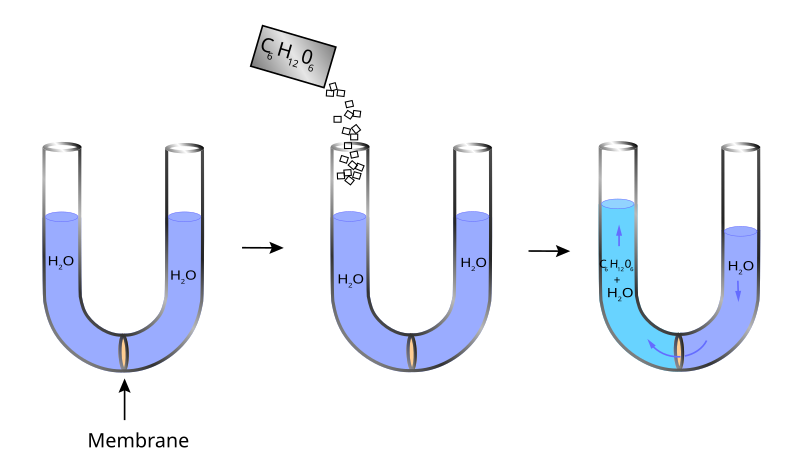
osmotic pressure
measure of the tendency of a solution to take in pure solvent by osmosis

saline water
water that contains a significant concentration of dissolved salts

aqueous solution
solution in which the solvent is water

Raoult's law
law of thermodynamics

solvation
thumb|260px|A sodium ion solvated by water molecules
dispersion
mixture in which components are dispersed in a continuous phase of different composition, where at least one of the phases consists of finely divided phase domains
colligative property
property of solutions that depend upon the ratio of the number of solute particles to the number of solvent molecules in a solution
solubility equilibrium
thermodynamic equilibrium between a solid and a saturated solution of the same compound
ideal solution
solution which obey Raoult's law under all conditions of temperature and concentration
osmolarity
molarity of osmotically active particles
diesel exhaust fluid
standardized aqueous urea solution for exhaust aftertreatment
enthalpy change of solution
enthalpy of Solution

concentrate
thumb|A container of vanilla concentrate
A concentrate is a form of substance that has had the majority of its diluting agent or diluent (in the case of a liquid: the solvent) removed, such that the substance becomes the majority of the composition. Typically, this will be the removal of water from a solution or suspension, such as the removal of water from fruit juice.
Solvated electron
Free electron in a solution, often liquid ammonia
common-ion effect
phenomenon in reactions with electrolytes
Osmolyte
Osmolytes are low-molecular-weight organic compounds that influence the properties of biological fluids. Osmolytes are a class of organic molecules that play a significant role in regulating osmotic pressure and maintaining cellular homeostasis in various organisms, particularly in response to environmental stressors. Their primary role is to maintain the integrity of cells by affecting the viscosity, melting point, and ionic strength of the aqueous solution. When a cell swells due to external osmotic pressure, membrane channels open and allow efflux of osmolytes carrying water, restoring norm

Nital
thumb|SEM micrograph of lamellar pearlite in a eutectoid (0.8% carbon) steel after annealing. Nital etch.
Nital is a solution of nitric acid and alcohol commonly used for etching of metals. It is especially suitable for revealing the microstructure of carbon steels. The alcohol can be methanol or ethanol.
solvation shell
solvent interface of solute
Solubility table
Wikimedia list article
solubility chart
Wikimedia list article
Clerici solution
aqueous solution noted for its high density
Flory–Huggins solution theory
Lattice model of polymer solutions
Hofmeister series
classification of ions in order of their ability to salt out or salt in proteins
free-energy relationship
relationship in physical organic chemistry
Solubilization
process of incorporating the solubilizate into or onto micelles
Dühring's rule
linear relationship between the temperatures at which two solutions exert the same vapour pressure
Polymer solution
homogeneous mixture containing dissolved polymers
Crenation
200px|thumbnail|right|Diagram of a crenated leaf
Crenation (from modern Latin crenatus meaning "scalloped or notched", from popular Latin crena meaning "notch") in botany and zoology, describes an object's shape, especially a leaf or shell, as being round-toothed or having a scalloped edge.