Category
page 1Soyuz programme

Soyuz
series of spacecraft designed for the Soviet space programme

Soyuz programme
crewed spaceflight programme of the Soviet Union
Soyuz
Russian and Soviet rocket family

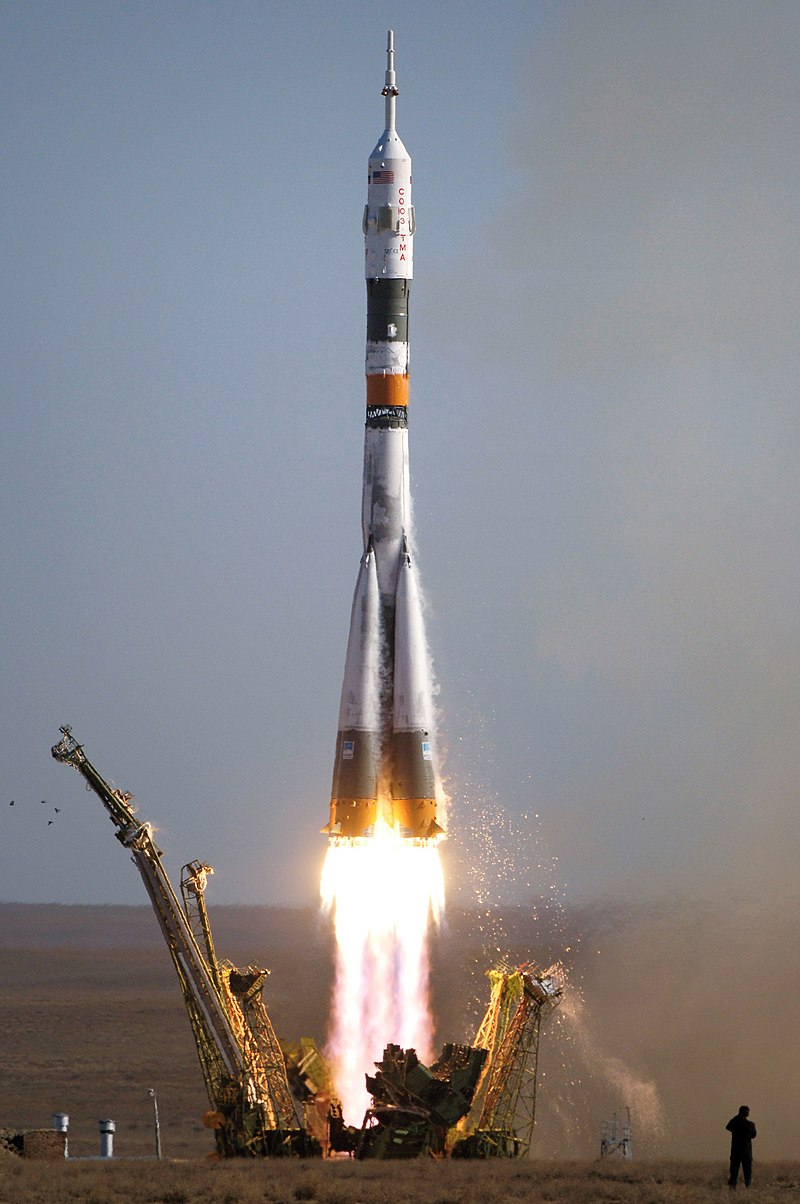
Soyuz-FG
The Soyuz-FG was an improved variant of the Soyuz-U launch vehicle from the R-7 rocket family, developed by the Progress Rocket Space Centre in Samara, Russia. It featured upgraded first and second stage engines, RD-107A and RD-108A, respectively, with enhanced injector heads that improved combustion efficiency and specific impulse. The designation "FG" refers to forsunochnaya golovka (injector head) in Russian.
Soyuz 7K-L1
Soviet spacecraft for crewed lunar flyby
Soyuz-U
Soyuz-U (GRAU index: 11A511U) was a Soviet and later Russian expendable medium-lift launch vehicle designed by the TsSKB design bureau and constructed at the Progress factory in Samara, Russia. The U designation stands for unified, as the launch vehicle was the replacement for the Voskhod rocket and several earlier Soyuz rocket variants. The Soyuz-U is part of the larger R-7 rocket family, which evolved from the R-7 Semyorka, the first intercontinental ballistic missile.
Sokol
space suit used in Soyuz spacecraft
Soyuz
first version of the Soyuz launch vehicle
Foton
satellite
Soyuz 7K-LOK
Soviet crewed lunar orbiting spacecraft
Soyuz 7K-OK
first generation of the Soyuz spacecraft of the Soyuz programme
Soyuz-TMA
revision of the Soyuz spacecraft
Soyuz MS
latest revision of the Soyuz spacecraft
.jpg)
Soyuz-TM
The Soyuz TM () were fourth generation (1986–2002) Soyuz spacecraft used for ferry flights to the Mir and ISS space stations. The Soyuz spacecraft consisted of three parts, the Orbital Module, the Descent Module and the Service Module.
Soyuz 7K-OKS
version of the Soyuz spacecraft
Soyuz-T
The Soyuz-T () was the third generation of the Soyuz spacecraft and operated from 1979 to 1986. The T designation stood for "transport" (), reflecting its primary role ferrying crews to and from space stations. The design was based on the second-generation Soyuz 7K-T and incorporated experience gained from the Military Soyuz program and the Soyuz 7K-TM used for the Apollo–Soyuz Test Project.
Soyuz 7K-T
second generation of the Soyuz spacecraft

Yastreb
thumb|right|250px|Yastreb Suit
Yastreb (, hawk) is a Russian space suit that was specially developed for early Soyuz space vehicle missions and for extra-vehicular activity. This model of space suit allowed the cosmonaut to spacewalk from the orbital module of Soyuz.
list of Soyuz missions
Wikimedia list article
Soyuz 7K-TM
variant of the 2nd-generation Soyuz spacecraft (1974–1976)
ZIL-29061
The ZIL-2906 (Russian: ЗИЛ-2906) is a screw-driven amphibious craft manufactured in Soviet Union from 1975 to 1979 by ZiL. The ZIL-2906 was produced from July 1975 to 1979, five manufactured in total. In 1980, it was succeeded by the ZIL-29061, produced until 1991.
Igla
orbital spacecraft docking
Soyuz 2A
Korean Astronaut Program
program that sent first South Korean to space in 2008

Soyuz-U2
The Soyuz-U2 (GRAU index 11A511U2) was a Soviet, later Russian, carrier rocket. It was derived from the Soyuz-U, and a member of the R-7 family of rockets. It featured increased performance compared with the baseline Soyuz-U, due to the use of syntin propellant, as opposed to RP-1 paraffin, used on the Soyuz-U.

Soyuz abort modes
launch abort modes used by the Soyuz spacecraft
Soyuz-V
Soyuz-V ( meaning Union-V) or Soyuz 11K (), sometimes known in the west as Soyuz-C, was a proposed Soviet spacecraft, which was designed for use as a fuel tanker. It would have been used to refuel other spacecraft, particularly the Soyuz 9K orbital tug. It was part of the Soyuz A-B-V complex for human circumlunar spaceflight.
Soyuz-B
Soyuz-B ( meaning Union-B) or Soyuz 9K () was a proposed Soviet spacecraft, which was designed for use as an orbital tug. A number of applications were proposed for it, including use as part of the Soyuz A-B-V complex for crewed circumlunar spaceflight.
Soyuz-A
Sergei Korolev initially promoted the Soyuz A-B-V circumlunar complex (7K-9K-11K) concept (also known as L1) in which a two-man craft Soyuz 7K would rendezvous with other components (9K and 11K) in Earth orbit to assemble a lunar excursion vehicle, the components being delivered by the proven R-7 rocket.
Soyuz-P
proposed Soviet combat spacecraft
list of Soviet human spaceflight missions
Wikimedia list article