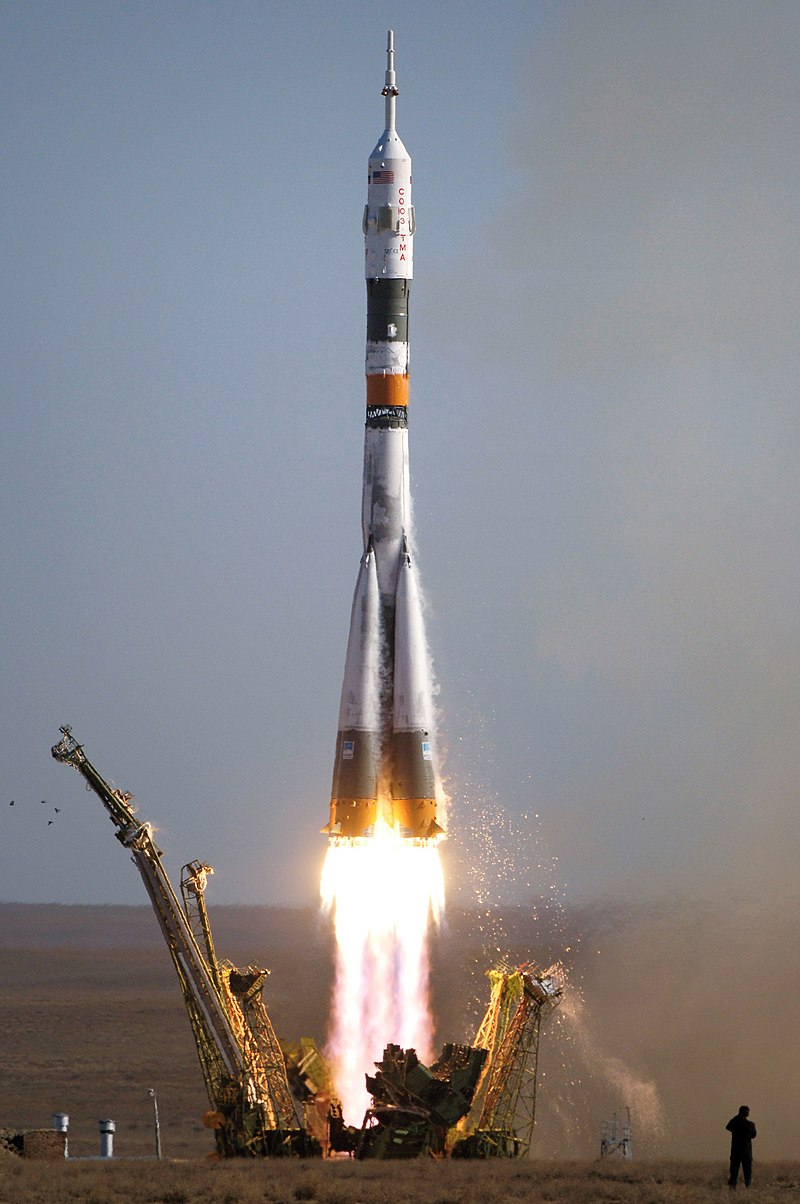
File:Soyuz_TMA-9_launch.jpg · Wikimedia Commons · See Wikimedia Commons
In the Vinony graph
Within Vinony's link graph, Soyuz is referenced by 764 other articles, and connects out to Scout, Mu and Kuaizhou.
Vinony files it under 1960s in the Soviet Union, 1967 in spaceflight and 1968 in spaceflight.
Its subject is documented across 35 Wikipedia language editions.
Key facts
- Function
- Medium-lift launch vehicle
- Manufacturer
- RKT Progress
- Country of origin
- Soviet Union · Russia
- Stages
- 2-4
- Family
- R-7
- Status
- Active
- Launch sites
- Baikonur , Sites 1/5 , 31/6 , and 45/1 Guiana , ELS Plesetsk , Sites 16 , 41 and 43 Vostochny , Site 1S
- First flight
- 28 November 1966
- Carries passengers or cargo
- Soyuz , Progress
via Wikipedia infobox
Wikidata facts
- Subclass of
- R-7
- Part of
- Soyuz programme
- Has part
- RD-0110
- Country
- Soviet Union
- Country of origin
- Soviet Union
- Followed by
- Soyuz-2
- Follows
- Vostok
- Image
- Soyuz TMA-5 launch.jpg
Show 3 more facts
- Commons category
- Soyuz (rocket)
- Commons gallery
- Soyuz (rocket)
- service entry
- 1966-11-28
via Wikidata · CC0
~18 min read
Encyclopedic overview
Soyuz (Russian: Союз, lit. 'union', as in Soviet Union, GRAU index: 11A511) is a family of Soviet and later Russian expendable, medium-lift launch vehicles initially developed by the OKB-1 design bureau and has been manufactured by the Progress Rocket Space Centre in Samara, Russia. The Soyuz family holds the record for the most launches in the history of spaceflight. Most Soyuz rockets are part of the R-7 rocket family, which evolved from the R-7 Semyorka, the world's first intercontinental ballistic missile.
As with several Soviet launch vehicles, the names of recurring payloads became closely associated with the rocket itself. The Soyuz rocket became widely recognized as the launcher of crewed Soyuz spacecraft under the Soyuz programme, and of the derivative uncrewed Progress cargo spacecraft. Despite this recognition, the majority of Soyuz launches have been dedicated to deploying satellites for both governmental and commercial purposes.
Excerpted from Wikipedia’s “Soyuz” article, available under the CC BY-SA 4.0 licence.