Category
page 1Spacecraft launched in 2002
%20Radiator.jpg)
STS-112
STS-112 (ISS assembly flight 9A) was an 11-day Space Shuttle mission to the International Space Station (ISS) flown by . Space Shuttle Atlantis was launched on 7 October 2002 at 19:45 UTC from the Kennedy Space Center's launch pad 39B to deliver the 28,000 pound Starboard 1 (S1) truss segment to the Space Station. Ending a 4.5-million-mile journey, Atlantis landed at 15:44 UTC on 18 October 2002 on runway 33 at the Kennedy Space Center's Shuttle Landing Facility.

STS-113
STS-113 was a Space Shuttle mission to the International Space Station (ISS) flown by Space Shuttle Endeavour. During the 14-day mission in late 2002, Endeavour and its crew extended the ISS backbone with the P1 truss and exchanged the Expedition 5 and Expedition 6 crews aboard the station. With commander Jim Wetherbee and pilot Paul Lockhart at the controls, Endeavour docked with the station on 25 November 2002 to begin seven days of station assembly, spacewalks, and crew and equipment transfers. This was the last flight of Endeavour before entering its Orbiter Major Modification period until

STS-111
STS-111 was a space shuttle mission to the International Space Station (ISS) flown by Space Shuttle Endeavour. STS-111 resupplied the station and replaced the Expedition 4 crew with the Expedition 5 crew. It was launched on 5 June 2002, from Kennedy Space Center, Florida.

STS-110
STS-110 was a Space Shuttle mission to the International Space Station (ISS) on 8–19 April 2002 flown by Space Shuttle Atlantis. The main purpose was to install the S0 Truss segment, which forms the backbone of the truss structure on the station.
STS-109
STS-109 (Hubble Servicing Mission 3B 'SM3B') was a Space Shuttle mission that launched from the Kennedy Space Center on 1 March 2002. It was the 108th mission of the Space Shuttle program, the 27th flight of the orbiter Columbia and the fourth servicing of the Hubble Space Telescope. It was also the penultimate mission of the orbiter Columbia before the STS-107 mission, which was destroyed during re-entry in the Columbia disaster.

INTEGRAL
thumb|right|Animation of INTEGRAL spacecraft orbit trajectory
The INTErnational Gamma-Ray Astrophysics Laboratory (INTEGRAL) is a retired space telescope for observing gamma rays of energies up to 8 MeV. It was launched by the European Space Agency (ESA) into Earth orbit in 2002, and is designed to provide imaging and spectroscopy of cosmic sources. In the MeV energy range, it is the most sensitive gamma ray observatory in space. It is sensitive to higher energy photons than X-ray instruments such as NuSTAR, the Neil Gehrels Swift Observatory, XMM-Newton, and lower than other gamma-ray instrum

Envisat
Envisat ("Environmental Satellite") is a large Earth-observing satellite which has been inactive since 2012. It was launched on 1 March 2002 aboard an Ariane 5 from the Guyana Space Centre in Kourou, French Guiana, into a Sun synchronous polar orbit at an altitude of 790 ± 10 km.
Soyuz TMA-1
crewed spaceflight to the International Space Station
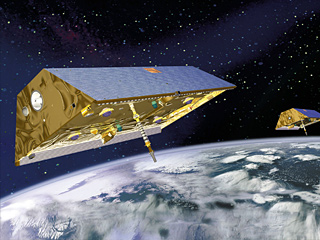
Gravity Recovery and Climate Experiment
joint mission of NASA and the German Aerospace Center
Soyuz TM-34
flight of a Russian Sojus-Spaceship to the ISS
Reuven Ramaty High Energy Solar Spectroscopic Imager
space observatory which reentered in 2023

CONTOUR
The Comet Nucleus Tour (CONTOUR) was a NASA Discovery-class space probe that failed shortly after its July 2002 launch. It was the only Discovery mission to fail.
Aqua
NASA Earth observation satellite
Shenzhou 3
2002 Chinese uncrewed spaceflight
Shenzhou 4
2002 Chinese uncrewed spaceflight
Kalpana-1
Kalpana-1 was the first dedicated meteorological satellite launched by the Indian Space Research Organisation using Polar Satellite Launch Vehicle on 12 September 2002. The satellite is three-axis stabilized and is powered by solar panels, getting up to of power. The METSAT bus was used as the basis for the Chandrayaan lunar orbiter mission of 2008.
ADEOS II
former Earth observation satellite
Eutelsat 70D
decommissioned geostationary communications satellite
AlSat-1
ALSAT-1 is the first Algerian satellite and it is part of a group of satellites collectively known as the Disaster Monitoring Constellation (DMC). The satellite was built by a group of engineers from Surrey Satellite Technology (SSTL) and Algerian Centre National des Techniques Spatiales (CNTS). It was the first DMC satellite to be launched of the five to seven that are planned. The DMC was the first satellite constellation designed for that objective. The launch took place on 28 November 2002 from the Plesetsk Cosmodrome in northern Russia on a Kosmos-3M launcher in -20 degree Celsius weather
Astra 3A
communications satellite
NSS-7
NSS-7 is a communications satellite owned by SES. It launched on 16 April 2002 on an AR-44L model of the Ariane 4 launch vehicle.
JCSAT-2A
JCSAT-2A, known as JCSAT-8 before launch, is a geostationary communications satellite operated by SKY Perfect JSAT Group (JSAT) which was designed and manufactured by Boeing Satellite Systems on the BSS-601 platform. It has Ku-band and C-band payload and was used to replace JCSAT-2 at the 154° East longitude. It covers Japan, East Asia, Australia and Hawaii.
Progress M1-9
Russian cargo spacecraft
Intelsat 904
communications satellite operated by Intelsat
Kosmos 2393
Russian military early warning satellite
Progress M1-8
Russian cargo spacecraft
Kosmos 2394
Russian GLONASS navigation satellite
Kosmos 2388
Russian military early warning satellite
Astra 1K
SES communications satellite incorrectly orbited due to a launch failure
Eutelsat 33B
failed Eutelsat geostationary communications satellite
Kosmos 2396
Russian GLONASS navigation satellite
Progress M-46
Russian cargo spacecraft
Kosmos 2395
Russian GLONASS navigation satellite