Category
page 1Spanish words and phrases

tornado
A tornado, also known as a twister, is a rapidly rotating column of air that extends vertically from the surface of the Earth to the base of a cumulonimbus or cumulus cloud. Tornadoes are often (but not always) visible in the form of a condensation funnel originating from the cloud base, with a cloud of rotating debris and dust close to the ground. Most tornadoes have wind speeds less than , are about across, and travel several kilometers (a few miles) before dissipating. The most extreme tornadoes can attain wind speeds of more than , can be more than in diameter, and can stay on the ground f
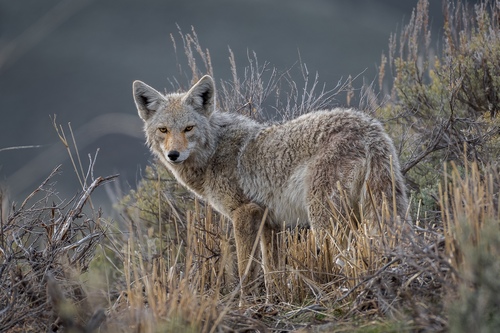
coyote
The coyote (Canis latrans) is a species of canine also known as the American jackal, prairie wolf, and brush wolf. It is native to North America, and it is smaller than its close relative, the gray wolf, and slightly smaller than the closely related eastern wolf and red wolf. It fills much of the same ecological niche as the golden jackal does in Eurasia but the coyote is generally larger.
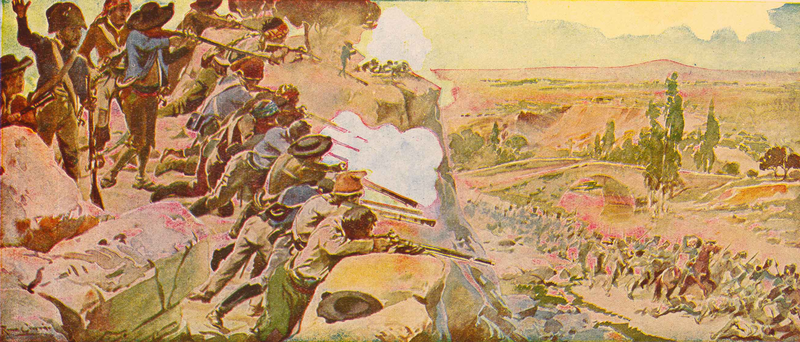
guerrilla warfare
form of irregular warfare

mestizo
'''''' is a term primarily used to denote people of mixed Spanish and Indigenous ancestry in the former Spanish Empire. In certain regions such as Latin America, it may also refer to people who are culturally European, even though their ancestors were Indigenous Americans. The term was used as an ethno-racial exonym for mixed-race that evolved during the Spanish Empire. It was a formal label for individuals in official documents, such as censuses, parish registers, Inquisition trials, and others. Priests and royal officials might have classified persons as mestizos, but individuals also used t

El Clásico
rivalry between Real Madrid and FC Barcelona

sangria
alt=|thumb|Sangria served in traditional clay pitchers

tortilla
A tortilla (, ) is a thin, circular unleavened flatbread from Mesoamerica originally made from masa, and now also from wheat flour.
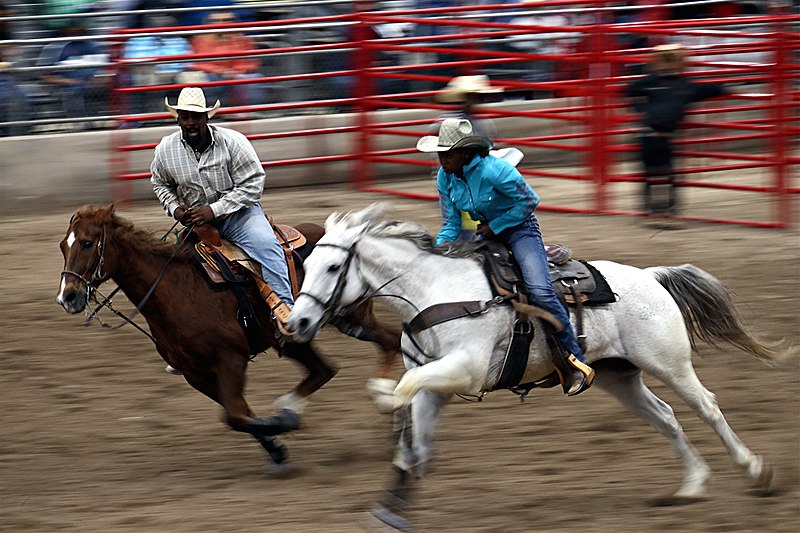
rodeo
Rodeo () is a competitive equestrian sport that arose out of the working practices of cattle herding in Spain and Mexico, expanding throughout the Americas and to other nations. It was originally based on the skills required of the working vaqueros and, later, cowboys in what today is the western United States, western Canada, and northern Mexico. Today, it is a sporting event that involves horses and other livestock, designed to test the skill and speed of the cowboys and cowgirls.
Professional rodeos generally comprise the following events: tie-down roping, team roping, steer wrestling, sadd

Negro
In the English language, the term negro is a term historically used to refer to people of Black African heritage. The term negro means the color black in Spanish and Portuguese (from Latin niger), where English took it from. The term can be viewed as offensive, inoffensive, or completely neutral, largely depending on the region or country where it is used, as well as the time period and context in which it is applied. It has various equivalents in other languages of Europe.

pasodoble
thumb|Festeros parading pasodoble as a military march
thumb|right|Pasodoble on ice: Luca Lanotte & [[Anna Cappellini]]
thumb|260px|Poster for a bullfight in Barcelona

jalapeño
The jalapeño ( , ) is a medium-sized chili pepper pod type cultivar of the species Capsicum annuum. A mature jalapeño chili is long and wide, and hangs down from the plant. The pungency of jalapeño peppers varies, but is usually between 4,000 and 8,500 units on the Scoville scale. Commonly picked and consumed while still green, it is occasionally allowed to fully ripen and turn red, orange, or yellow. It is wider and generally milder than the similar Serrano pepper.

sombrero
The , also known as ('charro hat', referring to the traditional Mexican horsemen) and simply as in English, is a type of hat worn in Mexico. It features an extra-wide brim used to shield the face and eyes from the sun, that is slightly upturned at the edge; a usually high, conical, pointed crown; and a chin strap to hold it in place. Traditionally made of wool felt, hare fur, or wheat straw, it can be adorned with embroidery, decorative trim, or ribbons, with varying regional styles. The crown often has a reinforced band ("pedradas") for added strength in case of impact.

mariachi
Mariachi (, , ) is a genre of regional Mexican music dating back to at least the 18th century, evolving over time in the countryside of various regions of western Mexico. The usual mariachi group today consists of as many as eight violins, two trumpets and at least one guitar, including a high-pitched Mexican Vihuela and an acoustic bass guitar called a guitarrón, and all players take turns singing lead and doing backup vocals.
El Niño southern oscillation
irregularly periodic variation in winds and sea surface temperatures over the tropical eastern Pacific Ocean

flotilla
right|thumb|300px|A Spanish flotilla being engaged by the Royal Navy in the [[action of 5 October 1804]]

Marrano
thumb|300px|Marranos: A secret Passover Seder in Spain during the times of Inquisition. An 1893 painting by [[Moshe Maimon.]]
Marranos were Spanish and Portuguese Jews, as well as Navarrese Jews, who converted to Christianity, either voluntarily or by Spanish or Portuguese royal coercion, during the fifteenth and sixteenth centuries, but who continued to practice Judaism in secret or were suspected of it. They are also called crypto-Jews, a term increasingly preferred in scholarly works over Marranos.

cacique
thumb|right|Túpac Amaru II, an Andean cacique who led a 1781 rebellion against Spanish rule in Peru
thumb|Cangapol, chief of the Tehuelches, 18th century.
junta
Term for administrative council in Spain and Latin America
hidalgo
members of the Spanish and Portuguese nobility; a nobleman without a hereditary title
Don
honorific title used in Iberia, the Hispanic world, Lusophone countries and Italy
Pampero
wind
¿Por qué no te callas?
rebuke by Juan Carlos I to Hugo Chavez

vihuela
The vihuela () is a 15th-century fretted plucked Spanish string instrument, shaped like a guitar (figure-of-eight form offering strength and portability) but tuned like a lute. It was used in 15th- and 16th-century Spain as the equivalent of the lute in Italy and has a large resultant repertory. There were usually five or six doubled strings.
pico de gallo
Mexican condiment

gringo
Gringo (, , ) (masculine) or gringa (feminine) is a term in Spanish and Portuguese for a foreigner. In Spanish, the term usually refers to English-speaking Anglo-Americans. There are differences in meaning depending on region and country. The term can be considered derogatory,English dictionaries:
Spanish dictionaries:
El pueblo unido jamás será vencido
original song written and composed by Sergio Ortega and Eduardo Carrasco

Superclásico
The Superclásico (Superderby) is the football match in Argentina between Buenos Aires rivals River Plate and Boca Juniors. It derives from the Spanish usage of "clásico" to mean derby, with the prefix "super" used as the two clubs are the most popular and successful clubs in Argentine football. In fact, the term 'Clásico' originated in Argentina, particularly with this match up and it was later exported to other countries such as Spain and Mexico. According to some statistics, they command more than 70% of all Argentine football fans between them.

cacerolazo
thumb|right|Casserole protest in Montreal, Quebec, Canada, on May 24, 2012
In Spanish, a cacerolazo ( or ) or cacerolada (); also in Catalan a cassolada ( or ) is a form of popular protest which consists of a group of people making noise by banging pots, pans, and other utensils in order to call for attention.

Maquiladora
thumb|300 px|A maquila in Mexico
A '''''' (), or () is a factory that is largely duty-free and tariff-free. These factories take raw materials and assemble, manufacture, or process them and export the finished product. These factories and systems are present throughout Latin America, including Mexico, Paraguay, Nicaragua, and El Salvador. date back to 1964, when the Mexican government introduced the ('Border Industrialization Program'). Specific programs and laws have made Mexico's maquila industry grow rapidly.
%20(5618095756).jpg)
ejido
upright=1.2|thumbnail|Ejido Cuauhtémoc in Jiquipilas|Jiquipilas, Chiapas
An ejido (, from Latin exitum) is an area of communal land used for agriculture in which community members have usufruct rights rather than ownership rights to land, which in Mexico is held by the Mexican state. People awarded ejidos in the modern era farm them individually in parcels and collectively maintain communal holdings with government oversight. Although the system of ejidos was based on an understanding of the preconquest Aztec calpulli and the medieval Spanish ejido, since the 20th century ejidos have been mana

Costumbrismo
thumb|right|José Jiménez Aranda (1837–1903): The Bullring (1870)

Mesta
thumb|200px|right|The principal drove roads of Spain
The Mesta () was a powerful association protecting livestock owners and their animals in the Crown of Castile that was incorporated in the 13th century and was dissolved in 1836. Although best known for its organisation of the annual migration of transhumant sheep, particularly those of the Merino breed, the flocks and herds of all species of livestock in Castile and their owners were under the oversight of the Mesta, including both the transhumant and the sedentary ones. The transhumant sheep were generally owned in Old Castile and León, wh
tostada
flat or bowl-shaped tortilla that is deep fried or toasted
vigilantism
Vigilantism () is an act commonly summarized as "taking the law into one's own hands" which, according to Merriam Webster, means "to try to punish someone for breaking a law even though one does not have the right to do that." A vigilante is a person who practices or partakes in vigilantism.
Dictablanda
is a dictatorship in which civil liberties are allegedly preserved rather than destroyed, and authoritarian and democratic features are combined. is a pun on ("dictatorship") replacing , which by itself is a Spanish word meaning "hard", with , meaning "soft".

Galácticos
thumb|160px|Zinedine Zidane and [[David Beckham with Real Madrid in 2003. Both are examples of the Galácticos policy.]]
''''' (Spanish for galactics''', referring to superstars) are expensive, world-famous football players recruited during the "galácticos" policy pursued by Florentino Pérez during his presidency at Real Madrid, where in his first tenure between 2000 and 2006, he purchased at least one galáctico'' in the summer of every year. The club's second galáctico era began in 2009 with Pérez's return to presidency, and is considered to be more successful both economically and in terms of
.jpg)
tertulia
thumb|TertuliaA tertulia (, ; ; ) is a social gathering with literary or artistic overtones, especially in Iberia or in Spanish America. The word can also mean an informal meeting of people to talk about current affairs, arts, etc. The word is originally Spanish, and was later borrowed into Catalan and Portuguese. It is typically not used in English outside of an Iberian or Latin American cultural context.
.jpg)
Pronunciamiento
thumb|Execution of the leaders of the failed Spanish 1831 pronunciamento under José María de Torrijos y Uriarte|General Torrijos
A '''''' is a form of military rebellion or coup d'état particularly associated with Spain, Portugal and Ibero-America, especially in the 19th century.
Chaparral
Wikimedia disambiguation page
corregimiento
Corregimiento (; , ) is a Spanish term used for country subdivisions for royal administrative purposes, ensuring districts were under crown control as opposed to local elites. A corregimiento was usually headed by a corregidor. The name comes from the word corregir, meaning "to correct".
%20cropped.jpg)
Modernismo
Modernismo is a literary movement that took place primarily during the end of the nineteenth and early 20th century in the Spanish-speaking world, best exemplified by Rubén Darío, who is known as the father of modernismo. The term modernismo specifically refers to the literary movement that took place primarily in poetry. This literary movement began in 1888 after the publication of Rubén Darío's Azul.... It gave modernismo a new meaning. The movement died out around 1920, four years after the death of Rubén Darío. In Aspects of Spanish-American Literature, Arturo Torres-Ríoseco writes (1963),
Distrito Federal
Wikimedia disambiguation page
Amigo
Amigo(s) (Portuguese and Spanish for male friend) may refer to:
derecho
thumb|right|Timelapse video of a derecho approaching and eventually passing over an airport in South Dakota, United States
A derecho (, from , 'straight') is a widespread, long-lived, straight-line wind storm that is associated with a fast-moving complex of severe thunderstorms referred to as a mesoscale convective system.
Quinta del Buitre
moniker given to a group of five Real Madrid players
corn tortilla
unleavened flatbread made from ground corn (maize)
Señorita
Señorita or Senorita may refer to:

alcalde
thumb|Mayan from Guatemala, 1891|alt=Two sitting men and one standing man. All wear a haedscarf and a hat and a stick in their hands.
Alcalde (; ) is the traditional Spanish municipal magistrate, who had both judicial and administrative functions. An alcalde was, in the absence of a corregidor, the presiding officer of the Castilian cabildo (the municipal council) and judge of first instance of a town. Alcaldes were elected annually, without the right to reelection for two or three years, by the regidores (council members) of the municipal council. The office of the alcalde was signified by a
merindad
'''' () is a mediaeval Spanish administrative term for a country subdivision smaller than a province but larger than a municipality. The officer in charge of a merindad was called a merino'', roughly equivalent to the English count or bailiff.
Venceremos
political song composed by Sergio Ortega, lyrics by Claudio Iturra

cantina
thumb|Musketeers sitting outside a cantina, painted by [[Joaquín Agrasot, 1885–1890|300x300px]]
A cantina is a type of bar common in Latin America and Spain. The word is similar in etymology to "canteen", and is derived from the Italian word for a cellar, winery, or vault.
In Italy, the word cantina refers to a room below the ground level where wine and other products such as salami are stored.
Porteño
' (feminine: Porteña''''', in Spanish) is mainly used to refer to the residents of Buenos Aires, Argentina. It is also used for other port cities, such as El Puerto de Santa María, Spain; Valparaíso, Chile; Mazatlán, Veracruz, Acapulco and Tampico, Mexico; Puerto Cabello, Venezuela; Puerto Colombia, Colombia; Puerto Suárez in Bolivia; Puerto Cortés, Honduras; Puntarenas, Costa Rica, and Montevideo, Uruguay.

Calavera
thumb|A sugar skull, a common gift for children and decoration for the Day of the Dead.
Arroz a la cubana
rice dish
Campeonato Regional Centro
football league
Reconquista
Wikimedia disambiguation page

Pimiento
thumb|Pickled cherry peppers
Yé-yé
generation of Real Madrid players in the 1960s

Corralito
thumb|Fernando De la Rúa|277px

torta
Torta is a culinary term that can, depending on the cuisine, refer to cakes, pies, flatbreads, sandwiches, or omelettes.