Category
page 1Sponge orders

Agelasida
Agelasida is an order of sea sponges in the class Demospongiae.
Dendroceratida
Dendroceratida is an order of sponges of the class Demospongiae. They are typically found in shallow coastal and tidal areas of most coasts around the world. They are generally characterized by concentric layers of fibers containing spongin (a collagen-like material), and by large flagellated chambers that open directly into the exhalant canals. Along with the Dictyoceratida, it is one of the two orders of demosponges that make up the keratose or "horny" sponges, in which a mineral skeleton is minimal or absent and a skeleton of organic spongin-containing fibers is present instead.
Dictyoceratida
Dictyoceratida is an order of sponges in the subclass Ceractinomorpha containing five families. Along with the Dendroceratida, it is one of the two orders of demosponges that make up the keratose or "horny" sponges, in which a mineral skeleton is minimal or absent and a skeleton of organic fibers containing spongin, a collagen-like material, is present instead.
Clathrinida
== Overview ==
The Clathrinida are an order of calcareous sponges found in marine environments. Clathrinida is a well-known non-monophyletic order under the class of calcarea, and was first named in 1958 by Willard D Hartman based on corticalization (body cortex)[5]. The fossil record of calcarea is relatively poor due to the nature of sponge – the fossil remains often don’t have the diagnostic spicules – but it’s certain that they are common in the Paleozoic and Mesozoic but rare in the Cenozoic [7].

Lyssacinosida
Lyssacinosida (also spelled Lyssacinosa) is an order of glass sponges (Hexactinellida) belonging to the subclass Hexasterophora. These sponges can be recognized by their parenchymal spicules usually being unconnected, unlike in other sponges in the subclass where the spicules form a more or less tightly connected skeleton. Lyssacine sponges have existed since the Upper Ordovician, and three families (four including Aulocalycidae) are still alive today. The Venus' flower basket (Euplectella aspergillum) is one of the most well-known and culturally significant of the glass sponges.
Homosclerophorida
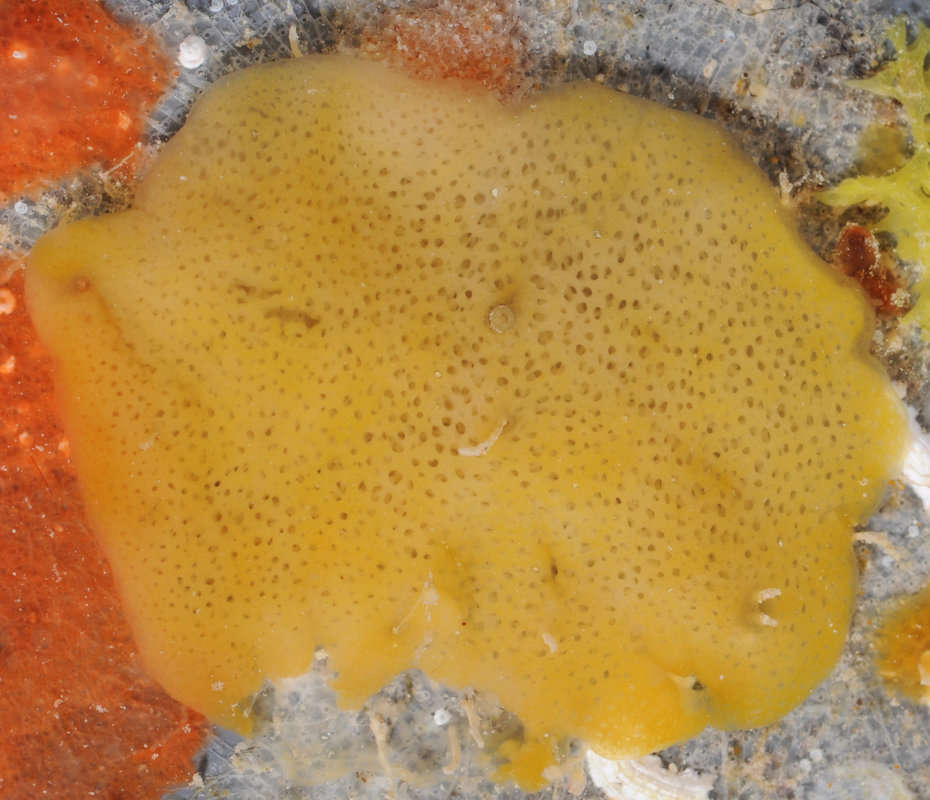
Homosclerophorida is an order of marine sponges. It is the only order in the monotypic class Homoscleromorpha. The order is composed of two families: Plakinidae and Oscarellidae.
Verongiida
Verongiida (also known as Verongida) is an order of sea sponges within the phylum Porifera. The "skeleton" in these sponges is made up of spongin, rather than of spicules. They live in marine environments. The name was proposed by Patricia Bergquist in 1978.
Desmacellidae
Desmacellidae is a family of marine demosponges. It is the only family in the monotypic order Desmacellida.
Lithonida
REDIRECT Minchinellidae
Baerida
Baerida is an order of sea sponges in the subclass of Calcaronea, first described in 2000 by Radovan Borojevic, Nicole Boury-Esnault and Jean Vacelet. Baerida contains four families; two of these families (Lepidoleuconidae and Petrobionidae) were formerly placed within the order Lithonida.

Amphidiscosida
left|thumb|Hyalonema (family Hyalonematidae, B) and an amphidisc microsclere (A, right) in a collage of hexactinellids.
Amphidiscosida (sometimes spelled Amphidiscosa) is an order of hexactinellids (glass sponges). The Amphidiscosida are commonly regarded as the only living sponges in the subclass Amphidiscophora.

Axinellida
Axinellida is an order of demosponges in the subclass Heteroscleromorpha. The order contains the families Axinellidae, Heteroxyidae, Raspailiidae, and Stelligeridae.

Tetractinellida
Tetractinellida is an order of sea sponges belonging to the class Demospongiae. First described in 1876, this order received a new description in 2012 and replaced the two orders Astrophorida and Spirophorida, which then became sub-orders as Astrophorina and Spirophorina.
Biemnida
Biemnida is an order of demosponges in the subclass Heteroscleromorpha.
Lychniscosida
Lychniscosida (sometimes spelled Lychniscosa) is an order of sponges belonging to the class Hexactinellida and subclass Hexasterophora. They are dictyonal sponges (with parenchymal spicules fully fused into a 3D framework) characterized by the presence of additional struts at the nodes of the skeleton. These struts create octahedral frames, known as lychniscs ("lanterns").
Chondrillida
Chondrillida is an order of sea sponges within the subclass Verongimorpha.
Suberitida
Suberitida is an order of sponges belonging to the class Demospongiae.
Clionaida
Clionaida is an order of demosponges in the subclass Heteroscleromorpha.

Vetulina
Vetulina is a genus of sea sponges in the subclass Heteroscleromorpha. It is the only genus in the monotypic family Vetulinidae and the monotypic order Sphaerocladina.
Spongillida
Spongillida is an order of sponges in the subclass Heteroscleromorpha, originally described as the suborder Spongillina. Members of this order are exclusively freshwater animals, and all freshwater sponges are currently considered part of this order, though the monophyly of this group has not yet been confirmed; it is currently unknown whether all freshwater sponges belong within a single natural group.
Bubarida
Bubarida is an order of demosponges in the subclass Heteroscleromorpha.
Merliida
Merliida is an order of demosponges in the subclass Heteroscleromorpha, first described as such by Jean Vacelet in 1979.
Tethyida
Tethyida is an order of sea sponges in the subclass Heteroscleromorpha.

Sceptrulophora
Sceptrulophora (from Ancient Greek, σκῆπτρον, skêptron - "sceptre" and -φόρος, -phóros - "bearing") is an order of hexactinellid sponges (glass sponges). They are characterized by sceptrules, a type of microsclere (microscopic spicule) with a single straight rod terminating at a bundle of spines or knobs. An anchor- or nail-shaped sceptrule is called a clavule. A fork-shaped sceptrule, ending at a few large tines, is called a scopule. A broom-shaped sceptrule, ending at many small bristles, is called a sarule.
Scopalinidae
Scopalinidae is a family of demosponges in the subclass Heteroscleromorpha. It is the only family in the monotypic order Scopalinida.
Chondrosiida
Chondrosiida is an order of sea sponges within the subclass Verongimorpha. Chondrosia reniformis is a unique marine sponge known as the kidney sponge due to its shape and texture. It is primarily found in the Mediterranean Sea and the eastern Atlantic Ocean, typically inhabiting shallow coastal waters.
Polymastiida
REDIRECT Polymastiidae