Category
page 1Stalinism

Joseph Stalin
Joseph Vissarionovich Stalin was a Soviet revolutionary and politician who led the Soviet Union from 1924 until his death in 1953. He held office as general secretary of the Communist Party from 1922 to 1952 and as premier from 1941 until his death. Despite initially governing the country as part of a collective leadership, he eventually consolidated power to become a dictator by the 1930s. Stalin codified the Communist Party's official interpretation of Marxism as Marxism–Leninism, and his version of it is referred to as Stalinism.
Frida Kahlo
Mexican painter (1907–1954)

Nicolae Ceaușescu
dictator of Romania from 1965 to 1989

Vyacheslav Molotov
Soviet politician, statesman and diplomat (1890–1986)

Stalinism
thumb|Official portrait of Joseph Stalin from 1945

Mikhail Ivanovich Kalinin
Soviet politician (1875–1946)

Great Purge
Soviet campaign of political repression, imprisonment, and execution (August 1936 - March 1938)

Georgi Dimitrov
Bulgarian politician (1882-1949)
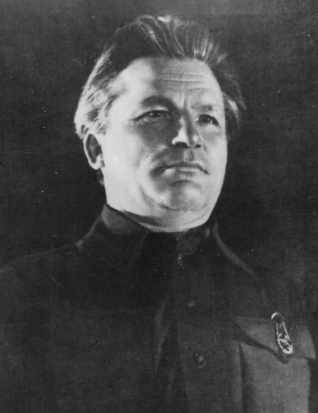
Sergei Kirov
Soviet politician and Bolshevik revolutionary (1886–1934)

Ernst Thälmann
German communist politician, leader of Communist Party of Germany (1886–1944)

Klement Gottwald
5th President of Czechoslovakia

Mátyás Rákosi
former First Secretary of the Hungarian Working People's Party (1892-1971)

Lazar Kaganovich
Soviet politician (1893–1991)

Andrei Zhdanov
Soviet politician (1896-1948)

Lin Biao
Chinese Communist military commander and politician

Bolesław Bierut
Polish politician and leader of Poland (1947–1956)

de-Stalinization
De-Stalinization () comprised a series of political reforms in the Soviet Union after the death of long-time leader Joseph Stalin in 1953, and the thaw brought about by ascension of Nikita Khrushchev to power, and his 1956 secret speech "On the Cult of Personality and Its Consequences", which denounced Stalin's cult of personality and the Stalinist political system.

Khorloogiin Choibalsan
Mongolian general and political leader from the 1930s to 1952

European Day of Remembrance for Victims of Stalinism and Nazism
international day of remembrance

bolshevism
Bolshevism (derived from Bolshevik) is a revolutionary socialist current of Soviet Leninist and later Marxist–Leninist political thought and political regime associated with the formation of a rigidly centralized, cohesive and disciplined party of social revolution, focused on overthrowing the existing capitalist state system, seizing power and establishing the "dictatorship of the proletariat".

Hoxhaism
thumb|Translated works of Enver Hoxha, for whom the ideology is named.
Camilo Torres Restrepo
Colombian theologian (1929-1966)
Vasil Kolarov
Bulgarian politician (1877—1950)
Socialism in One Country
political theory by Joseph Stalin
Moscow Trials
series of three trials held in the Soviet Union at the instigation of Joseph Stalin between 1936 and 1938 against so-called Trotskyists and members of Right Opposition of the Communist Party of the Soviet Union
Nikos Zachariadis
Greek politician (1903-1973)
Kim Tu-bong
Korean linguist and politician (1886–1958?)
people's democracy (theoretical concept within Marxism–Leninism)
multi-party, popular front-influenced rule by the people for the transition to socialism
Sen Katayama
Japanese journalist (1859–1933)
Valko Chervenkov
Bulgarian communist politician, prime minister (1900-1980)
Zhdanov Doctrine
Soviet cultural doctrine developed by Central Committee secretary Andrei Zhdanov in 1946 that proposed the world was divided into two camps: the "imperialistic", headed by the United States; and "democratic", headed by the Soviet Union
Kim family
sovereign ruling family of North Korea
Joseph Stalin's cult of personality
the cult of personality around Joseph Stalin

neo-Stalinism
thumb|upright=1.25|May Day procession with Joseph Stalin's portrait in [[London, 2010]]
Yemelyan Yaroslavsky
Soviet politician (1878-1943)
William Z. Foster
American labor organizer and Communist politician (1881–1961)
Kyuichi Tokuda
Japanese politician, Communist, lawyer
Dimitris Koutsoumpas
Greek communist politician, General Secretary of the Communist Party of Greece
comparison of Nazism and Stalinism
drawing parallels between the ideologies and practices of the USSR under Stalin and Germany under Hitler
Nina Andreyeva
Russian chemist, teacher, author, political activist, and social critic (1938-2020)

Khalq
The Khalq (Dari/, ) was a far-left faction of the People's Democratic Party of Afghanistan (PDPA). Its historical de facto leaders were Nur Muhammad Taraki (1967–1979), Hafizullah Amin (1979) It was also the name of the leftist newspaper produced by the same movement. The Khalq wing was formed in 1967 after the split of the party due to bitter resentment with the rival Parcham faction which had a differing revolutionary strategy.
Harry Pollitt
British communist (1890–1960)
Arso Jovanović
Yugoslav paritsan (1907–1948)
Jackson Hinkle
American political commentator
Andrija Hebrang
Yugoslav politician (1899-1949)
Mahir Çayan
Turkish Marxist–Leninist revolutionary (1945-1972)
Aleksey Badayev
Soviet politician (1883-1951)
Hotel Lux
hotel in Moscow
red-brownism
a pejorative term equating Stalinism and Maoism with fascism
%20utca%20fel%C5%91l%20a%20Honv%C3%A9d%20utca%20fel%C3%A9%20n%C3%A9zve.%20A%20szovjet%20csapatok%20ideiglenes%20kivonul%C3%A1sa%201956.%20okt%C3%B3ber%2031-%C3%A9n.%20Fortepan%2024787.jpg)
tankie
thumb|T-54/T-55|T-54 tanks of the [[Soviet Army deployed in response to the Hungarian Revolution of 1956, from which the term "tankie" originated|265x265px]]
Gonchigiin Bumtsend
Mongolian politician (1881-1953)
authoritarian socialism
type of socialism
vanguardism
Vanguardism, a core concept of Leninism, is the idea that a revolutionary vanguard party, composed of the most conscious and disciplined workers, must lead the proletariat in overthrowing capitalism and establishing socialism, ultimately progressing to communism.
Hysni Milloshi
Albanian politician (1946-2012)
Shibdas Ghosh
Indian politician (1923-1976)
Dialectical and Historical Materialism
book by Joseph Stalin

The Foundations of Leninism
1924 publication written by Joseph Stalin

Elías Lafertte
Chilean worker and politician (1886-1961)
Georgi Atarbekov
Armenian Bolshevik/Soviet security police official (1892–1925)

Neo-Sovietism
thumb|Belarusian Honor Guard carrying the national flags of Belarus and the Soviet Union, as well as the Soviet victory banner, in Minsk, 2019.