Category
page 1Statistical mechanics

Brownian motion
the random motion of particles suspended in a fluid resulting from their collision with the quick atoms or molecules in the gas or liquid

Boltzmann constant
Physical constant relating energy with temperature and other intensive physical quantities
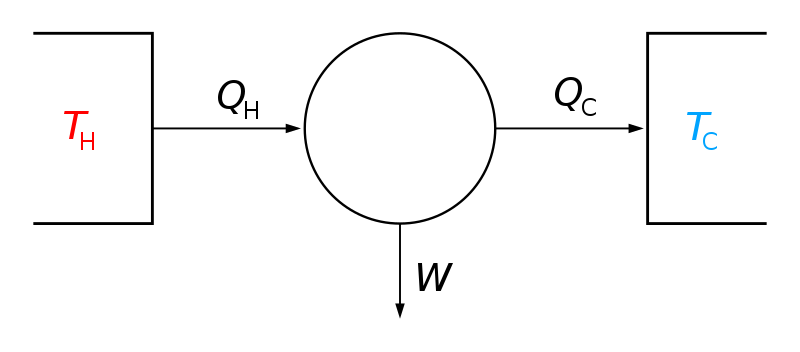
internal energy
energy contained in a system, excluding energy due to its position as a body in external force fields or its overall motion
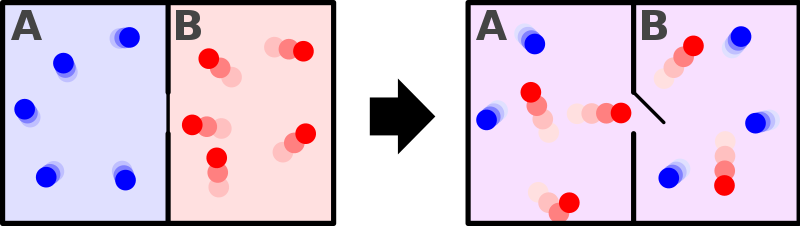
statistical mechanics
physics of large number of particles' statistical behavior
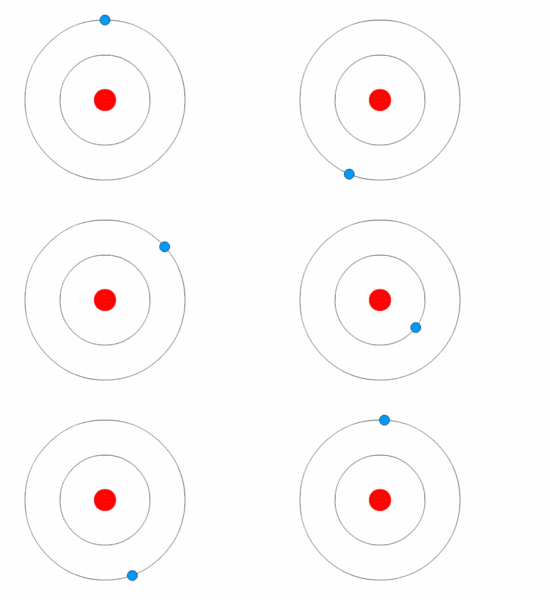
History of atomic theory
history of scientific theory that views matter as made up of atoms of chemical elements

molar gas constant
physical constant; the molar equivalent to the Boltzmann constant

Monte Carlo method
broad class of computational algorithms using random sampling to obtain numerical results
Bose-Einstein statistics
statistical description for the behaviour of bosons

Wien's displacement law
relation between the wavelength of the black-body radiation curve peak and the temperature
Fermi–Dirac statistics
behaviour of many identical fermions, particles with half-integer spin
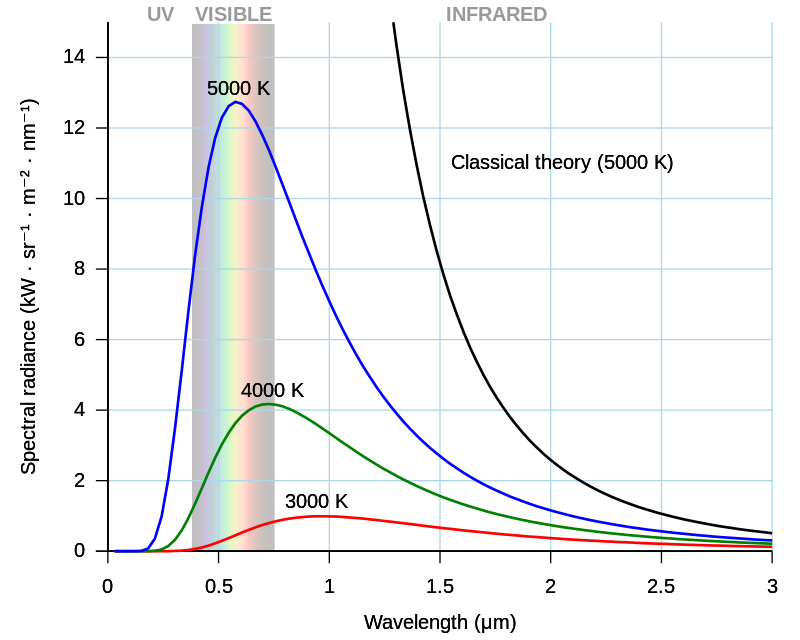
Planck's law
physical law that describes the amount of spectral radiance at a certain wavelength radiated by a black body cavity in thermal equilibrium
statistical physics
branch of physics

Arrhenius equation
formula for the temperature dependence of reaction rates
mean free path
average distance travelled by a moving particle between successive impacts
Boltzmann distribution
probability distribution of energy states of a system
Dulong–Petit law
empirical thermodynamic law that the molar heat capacities of many solids are approximately the same at 3𝑅≈25 J/(K·mol)
Fick's laws of diffusion
mathematical descriptions of molecular diffusion
thermodynamic beta
reciprocal product of temperature with the Boltzmann constant, frequently used in exponentials in physics and chemistry and relating statistical mechanics to information theory
econophysics
Econophysics is a transdisciplinary research field in heterodox economics. It applies theories and methods originally developed by physicists to problems in economics, usually those including uncertainty or stochastic processes and nonlinear dynamics. Some of its application to the study of financial markets has also been termed statistical finance referring to its roots in statistical physics. Econophysics is closely related to social physics.
density matrix
matrix describing a quantum system in a pure or mixed state, a statistical mixture of quantum states
path integral
formal sum or integral over all histories of a quantum system
Boltzmann equation
equation of statistical mechanics

superparamagnetism
Superparamagnetism is a form of magnetism which appears in small ferromagnetic or ferrimagnetic nanoparticles. In sufficiently small nanoparticles, magnetization can randomly flip direction under the influence of temperature. The typical time between two flips is called the Néel relaxation time. In the absence of an external magnetic field, when the time used to measure the magnetization of the nanoparticles is much longer than the Néel relaxation time, their magnetization appears to be on average zero; they are said to be in the superparamagnetic state. In this state, an external magnetic fie
Ising model
mathematical model of ferromagnetism in statistical mechanics
population inversion
state of a physical system in which more members are in higher, excited energy states than in lower, unexcited states
quasistatic process
thermodynamic process in which equilibrium is maintained for the duration of the process

T-symmetry
T-symmetry or time reversal symmetry is the theoretical symmetry of physical laws under the transformation of time reversal,
T: t \mapsto -t.
magnetic refrigeration
cooling technology based on the magnetocaloric effect
time crystal
quantum system whose ground state is one in which the particles are in repetitive motion
coupling constant
parameter describing the strength of a force
microstate
state of a system's detailed microscopic-scale properties, which in aggregate on average give its macrostate
Gibbs paradox
thought experiment in physics
polymer physics
branch of physics
Wien approximation
physical law approximating the spectrum of thermal radiation
Poincaré recurrence theorem
theorem
density of states
system describes the number of states per interval of energy at each energy level available to be occupied
Einstein relation
equation in Brownian motion
renormalization group
method for using scale changes to understand physical theories such as quantum field theories
mean field theory
approximation method where the behavior of a single particle can be treated assuming all other influences are averaged
Boltzmann Medal
award conferred by the Commission on Statistical Physics of the International Union of Pure and Applied Physics
Langevin equation
stochastic differential equation
Fundamental thermodynamic relation
equations on thermodynamic quantities
radial distribution function
description of particle density in statistical mechanics
ergodic hypothesis
hypothesis that typical physical systems studied in statistical mechanics are ergodic, such that time averages equal phase space averages
particle statistics
particular description of multiple particles in statistical mechanics
particle filter
type of Monte Carlo algorithms for signal processing and statistical inference
effective field theory
type of approximation to an underlying physical theory
fluctuation-dissipation theorem
theorem
Wick rotation
formal analytic continuation of the time coordinate that changes a Lorentzian metric signature to a Euclidean one
Luttinger liquid
a theoretical model describing interacting electrons (or other fermions) in a one-dimensional conductor (e.g. quantum wires such as carbon nanotubes)
Granularity
Granularity (also called graininess) is the degree to which a material or system is composed of distinguishable pieces, "granules" or "grains" (metaphorically).
It can either refer to the extent to which a larger entity is subdivided, or the extent to which groups of smaller indistinguishable entities have joined together to become larger distinguishable entities.
photon gas
gas-like collection of photons
master equation
equations governing time evolution of physical systems
Stochastic resonance
signal boosting phenomenon using white noise

BBGKY hierarchy
set of equations describing the dynamics of a system of many interacting particles
thermodynamic limit
mathematical and physics concept
quantum phase transition
transition between different phases of matter at zero temperature
high entropy alloy
alloys with high proportions of several metals
thermal fluctuations
random temperature-influenced deviations of particles from their average state
virial expansion
series expansion of the equation of state for a many-particle system