Category
page 1Staurozoa
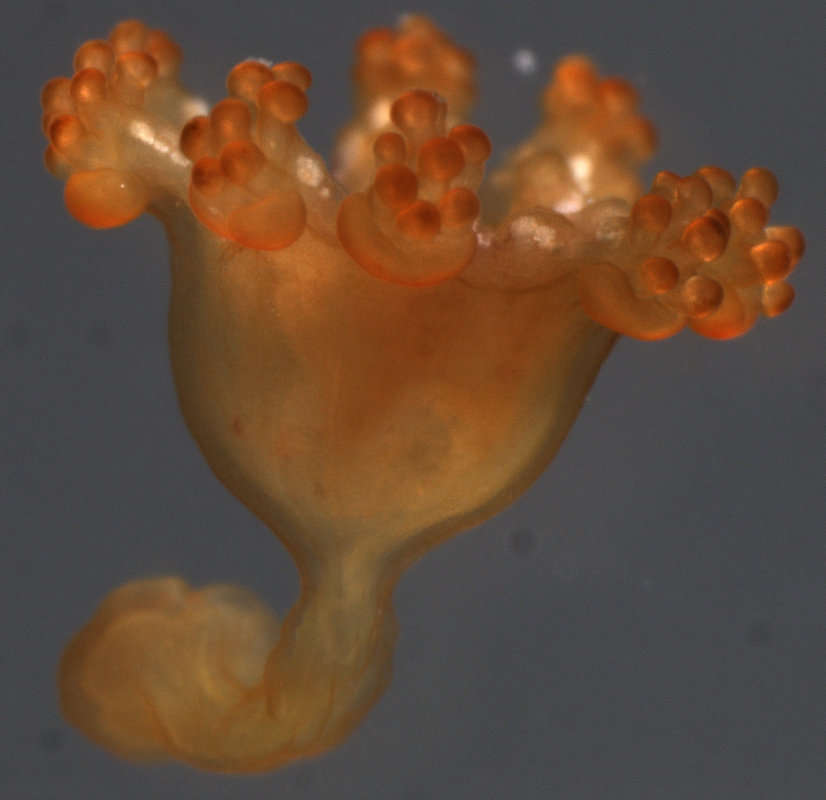
Stauromedusae
Stauromedusae are the stalked jellyfishes. They are the sole living members of the class Staurozoa and belong to the Medusozoa subphylum of Cnidaria. They are unique among medusa jellyfish in that they do not have an alternation of polyp and medusa life cycle phases, but are instead interpreted as an attached medusa stage, with a lifestyle more resembling that of polypoid forms. They have a generally trumpet-shaped body, oriented upside-down in comparison with other jellyfish, with the tentacles projecting upwards, and the stalk located in the centre of the umbrella. Stauromedusae usually has
Staurozoa
Staurozoa is a class of Medusozoa (or jellyfish). It has one extant order: Stauromedusae (stalked jellyfishes) with a total of 50 known species. A fossil group called Conulariida has been proposed as a second order, although this is highly speculative. This extinct order is largely unknown and described as a possibly cnidarian clade of marine life with shell-like structures. Staurozoans are small animals () that live in marine environments, usually attached to seaweeds, rocks, or gravel. They have a large antitropical distribution, a majority found in boreal or polar, near-shore, and shallow w

Conulariidae
Conulariida are an extinct group of medusozoan cnidarians known from fossils spanning from the latest Ediacaran up until the Late Triassic. They are almost exclusively known from their hard external structures (alternatively referred to as a theca, periderm or test), which were pyramidal in shape and made up of numerous lamellae (thin layers). They are thought to have been sessile animals that grew with the narrower tip anchored to the seafloor, with the wider end bearing an array of tentacles used to ensnare prey.