Encyclopedia of Life · EOL (see source)
Stauromedusae
Sign in to saveAlso known as stalked jellyfish
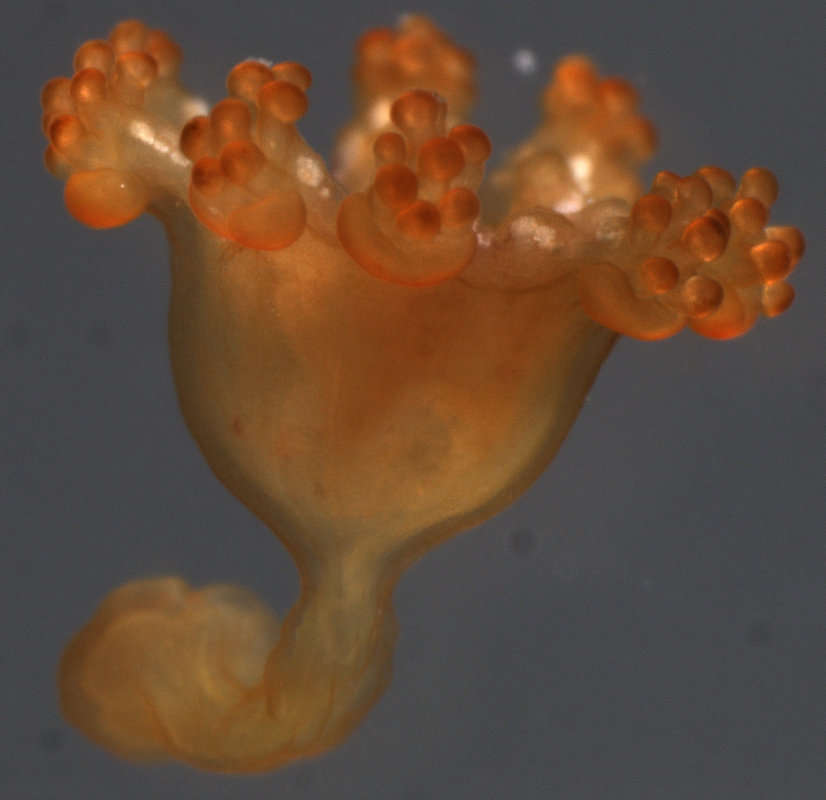
Stauromedusae are the stalked jellyfishes. They are the sole living members of the class Staurozoa and belong to the Medusozoa subphylum of Cnidaria. They are unique among medusa jellyfish in that they do not have an alternation of polyp and medusa life cycle phases, but are instead interpreted as an attached medusa stage, with a lifestyle more resembling that of polypoid forms. They have a generally trumpet-shaped body, oriented upside-down in comparison with other jellyfish, with the tentacles projecting upwards, and the stalk located in the centre of the umbrella. Stauromedusae usually has
Species
stalked jellyfishes
ORDER
- KingdomAnimalia
- PhylumCnidaria
- ClassStaurozoa
- OrderStauromedusae
Ставромеду́зы (лат. Stauromedusae) — отряд стрекающих из подтипа Medusozoa, в настоящее время рассматриваемый в составе монотипического класса Staurozoa. Исключительно донные организмы, в отличие от большинства других Medusozoa лишённые чередования поколений. Взрослые ставромедузы ведут малоподвижный образ жизни, прикрепляясь подошвой к твёрдому субстрату. Питаются мелкими донными и планктонными организмами — ракообразными, моллюсками, личинками других беспозвоночных. Отряд насчитывает около 50 видов, распространённых на мелководье многих морей Мирового океана. Край орального диска Haliclystus stejnegeri. Видны лаппеты с пучками головчатых щупалец и расположенные между ними ропалиоиды
via GBIF
Museum specimens
- Specimen records
- 50
- With media
- 4
- Collections
- CAS, SIO, NMV, YPM, AUM, USNM
- Recorded in
- United States, Antarctica, Australia, South Africa, Mexico, French Polynesia
Wikidata facts
Show 6 more facts
- taxon name
- Stauromedusae
- Commons category
- Stauromedusae
- taxon rank
- order
- topic's main category
- Category:Stauromedusae
- taxon common name
- Bägarmaneter
- start time
- 560000000-
Sources (1)
via Wikidata · CC0
~2 min read
Encyclopedic overview
4 sectionsContents
- Gallery
- References
- Bibliography
- External links
Stauromedusae are the stalked jellyfishes. They are the sole living members of the class Staurozoa and belong to the Medusozoa subphylum of Cnidaria. They are unique among medusa jellyfish in that they do not have an alternation of polyp and medusa life cycle phases, but are instead interpreted as an attached medusa stage, with a lifestyle more resembling that of polypoid forms. They have a generally trumpet-shaped body, oriented upside-down in comparison with other jellyfish, with the tentacles projecting upwards, and the stalk located in the centre of the umbrella. Stauromedusae usually has eight marginal arms at the top of the calyx. They reach their adult sizes within several weeks, typically 1 to 4 centimeters in length.
Members of this class are commonly found in relatively cold waters, close to the shoreline. However, there are a few known species that inhabit tropical and subtropical waters as referenced in the Stauromedusae article by Claudia E. Mills and Yayoi M. Hirano. Sexually mature stauromedusae free-spawn eggs or sperm, which fertilize in the sea and form a creeping, unciliated planula larva. The larvae crawl across the sea floor and find a suitable place, attaching themselves typically to rock or algae, where they eventually develop into a new, attached stauromedusa. Unlike most scyphozoan jellyfish that practice strobilation, or the process of dividing themselves into body segments, which become new individuals, nearly all stauromedusae develop directly into the adult form. Its primary source of food is small organisms, such as copepods, chironomid fly larvae, podocopid ostracods, amphipods, etc. The tendency for the amount of prey consumed increases with the size of the medusae.
Excerpted from Wikipedia’s “Stauromedusae” article, available under the CC BY-SA 4.0 licence.