Category
page 1Strongylida

Strongylida
The Strongylida suborder includes many of the important nematodes found in the gastrointestinal tracts of ruminants, horses, and swine, as well as the lungworms of ruminants and the hookworms of dogs and cats.

Necator americanus
species of worm

Haemonchus contortus
very common parasite of ruminants that attatch to the abomasal mucosa and feed on the blood
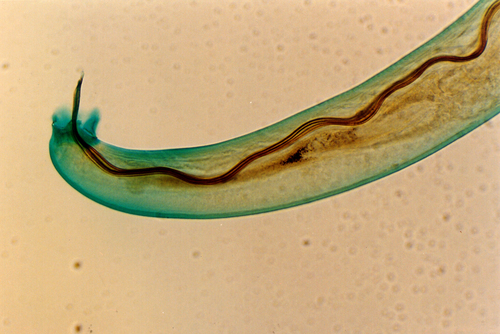
Angiostrongylus cantonensis
species of worm

Syngamus trachea
A gapeworm (Syngamus trachea), also known as a red worm and forked worm, is a parasitic nematode worm that infects the tracheas of certain birds. The resulting disease, known as "gape", occurs when the worms clog and obstruct the airway. The worms are also known as "red worms" or "forked worms" due to their red color and the permanent procreative conjunction of males and females. Gapeworms are common in young, domesticated chickens and turkeys.

Metastrongylus
Metastrongylus is a genus of nematodes of the family Metastrongylidae, usually found as lungworms in pigs and sometimes causing parasitic bronchitis. It causes a disease called metastrongylosis.

Uncinaria stenocephala
species of worm

Dictyocaulus
Dictyocaulus is a genus of nematode parasites of the bronchial tree of horses, sheep, goats, deer, and cattle. Dictyocaulus arnfieldi is the lungworm of horses, and Dictyocaulus viviparus is the lungworm affecting ruminants.

Syngamidae
The Syngamidae are a family of nematodes which commonly parasitize mammals, birds, and rarely humans. They are classified in the Strongyloidae superfamily and Strongylata order.
Metastrongylidae
The Metastrongylidae are a family of nematodes.
Angiostrongylus vasorum
species of worm

Strongylus vulgaris
species of worm

Ostertagia ostertagi
species of worm

Necator
genus of worms

Dictyocaulus viviparus
species of worm
Angiostrongylus
Angiostrongylus is a genus of parasitic nematodes in the family Metastrongylidae.

Nippostrongylus brasiliensis
species of worm

Oesophagostomum
Oesophagostomum is a genus of parasitic nematodes (roundworms) of the family Strongylidae. These worms occur in Africa, Brazil, China, Indonesia and the Philippines. The majority of human infection with Oesophagostomum is localized to northern Togo and Ghana. Because the eggs may be indistinguishable from those of the hookworms (which are widely distributed and can also rarely cause helminthomas), the species causing human helminthomas are rarely identified with accuracy. Oesophagostomum, especially O. bifurcum, are common parasites of livestock and animals like goats, pigs and non-human prima

Uncinaria
Uncinaria is a genus of nematodes. The genus was circumscribed by Josef Aloys Frölich in 1789.
Molineidae
Molineidae is a family of nematodes belonging to the order Rhabditida.
Bunostomum
Bunostomum is a genus of nematodes of the small intestine of ruminants and camelids. Important species include B. phlebotomum in calves and B. trigonocephalum in lambs. The worms are stout and measure in length. Young animals are most commonly affected and only several hundred worms are necessary to cause morbidity. Adults often carry worms without showing clinical signs.

Chabertia ovina
species of nematodes
Muellerius capillaris
species of worm
lungworms
Lungworms are parasitic nematode worms of the order Strongylida that infest the lungs of vertebrates. The name is used for a variety of different groups of nematodes, some of which also have other common names; what they have in common is that they migrate to their hosts' lungs or respiratory tracts, and cause bronchitis or pneumonia. The lungworm will gradually damage the airways or lung tissue by inciting an inflammatory reaction inside the tissue. Ultimately, the parasites survive and reproduce in the respiratory tissues. The category is thus more a descriptive than a precisely taxonomic on