Category
page 1Sui dynasty

Sui dynasty
dynasty that ruled over China from 581 to 618

Sogdia
Sogdia () or Sogdiana was an ancient Iranian civilization between the Amu Darya and the Syr Darya rivers, and in present-day Uzbekistan, Turkmenistan, Tajikistan, Kazakhstan, and Kyrgyzstan. Sogdiana was also a province of the Achaemenid Empire, and listed on the Behistun Inscription of Darius the Great. Sogdiana was first conquered by Cyrus the Great, the founder of the Achaemenid Empire, and then was annexed by the Macedonian ruler Alexander the Great in 328 BC. It would continue to change hands under the Seleucid Empire, the Greco-Bactrian Kingdom, the Kushan Empire, the Sasanian Empire, th
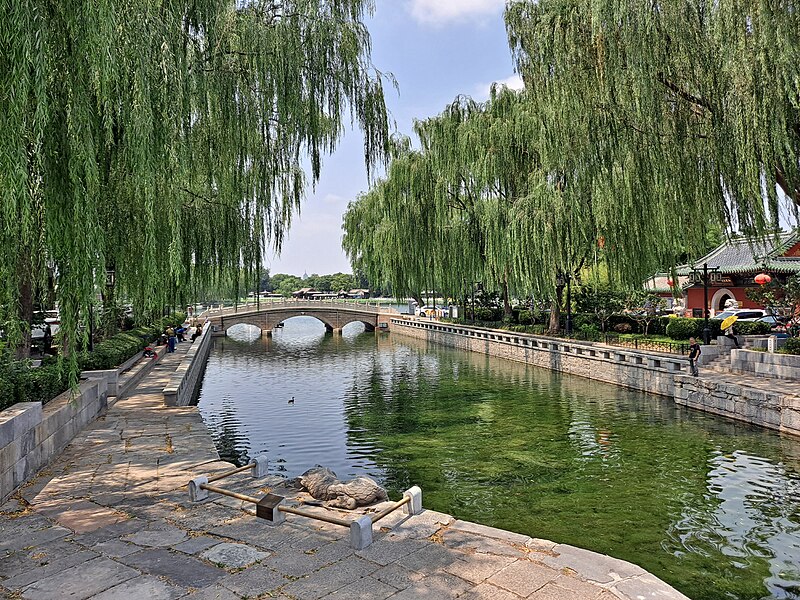
Grand Canal
longest canal or artificial river in the world located in China

Chang'an
thumb|right|300px|que (tower)|Que towers along the walls of Tang-era Chang'an, as depicted in this mural from [[Li Chongrun's tomb at the Qianling Mausoleum in Shaanxi]]
History of Northern Dynasties
7th century Chinese historical text
Mount Tiantai
mountain in Zhejiang, China

Qieyun
The Qieyun () is a Chinese rhyme dictionary that was published in 601 during the Sui dynasty. The book was a guide to proper reading of classical texts, using the fanqie method to indicate the pronunciation of Chinese characters. The Qieyun and later redactions, notably the Guangyun, are important documentary sources used in the reconstruction of historical Chinese phonology.
Ono no Imoko
Japanese politician
equal-field system
ancient Chinese system of land ownership
Fubing system
local militia system in China from 6th to 8th centuries CE
nine grade controller system
classification and categories of government officials in Imperial China
Cheng'en Temple
building in Beijing, China
Four Gates Pagoda
pagoda
Princess Yicheng
Sui princess, daughter of Yang Xie and sister of Yang Shanjing, married Yami Khagan and later his sons
Huteng
thumb|Sogdian Huteng dancer, Xiuding temple pagoda, [[Anyang, Henan, China, Tang dynasty, 7th century.]]
Huteng (, also 胡腾舞, Húténgwǔ, "Dance of the Nomadic leap") was the Chinese term for a type of dance that originated in Central Asia, especially among the Sogdians and the region of Tashkent (石國, Shíguó). The dance was well known during the Tang dynasty, and there are numerous depictions of it in works of art. The dance was characterized by spinning, leaps and backflips. The dancers would particularly make somersaults, first planting their feet firmly on the carpet, tilting their face upward