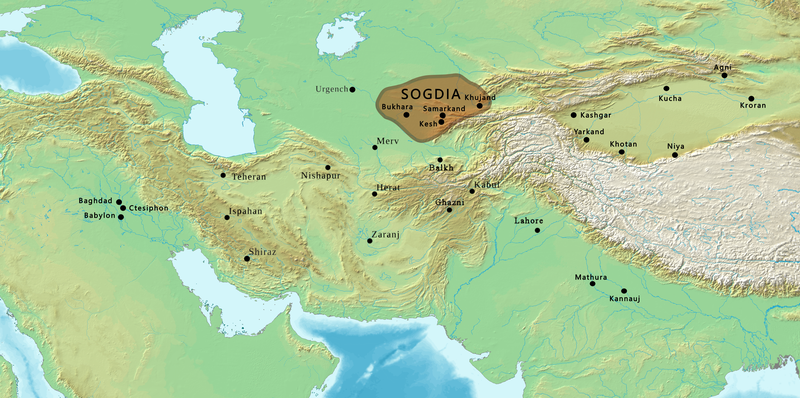
File:Map_of_Sogdia.png · Wikimedia Commons · See Wikimedia Commons
Sogdia
Sign in to saveAlso known as Sogdiana, Sogd
Sogdia () or Sogdiana was an ancient Iranian civilization between the Amu Darya and the Syr Darya rivers, and in present-day Uzbekistan, Turkmenistan, Tajikistan, Kazakhstan, and Kyrgyzstan. Sogdiana was also a province of the Achaemenid Empire, and listed on the Behistun Inscription of Darius the Great. Sogdiana was first conquered by Cyrus the Great, the founder of the Achaemenid Empire, and then was annexed by the Macedonian ruler Alexander the Great in 328 BC. It would continue to change hands under the Seleucid Empire, the Greco-Bactrian Kingdom, the Kushan Empire, the Sasanian Empire, th
Sogdia was an ancient Iranian civilization located in Central Asia between two major rivers, in what is now parts of Uzbekistan, Turkmenistan, Tajikistan, Kazakhstan, and Kyrgyzstan. It matters historically because it was an important region that changed hands between several major empires, including the Achaemenid, Macedonian, Seleucid, and others, making it a significant crossroads in ancient world history.
AI-generated from the Wikipedia summary — may contain errors.
Key facts
- Country.conventional_long_name
- Sogdia, Sogdiana
- Country.image_map
- Map of Sogdia.png
- Country.image_map_caption
- Approximate extent of Sogdia, between the Oxus and the Jaxartes.
- Country.map_width
- 300px
- Country.languages
- Sogdian
- Country.languages_type
- Languages
- Country.religion
- Zoroastrianism, Manichaeism, Hinduism, Buddhism, Islam, Nestorian Christianity
- Country.capital
- Samarkand, Bukhara, Khujand, Kesh
- Country.life_span
- 6th century BC to 11th century AD
- Country.currency
- Imitations of Sasanian coins coins and Chinese cash coins as well as "hybrids" of both.
via Wikipedia infobox
Wikidata facts
- Instance of
- region
- Part of
- Western Regions
- Capital
- Samarkand
- Image
- Sogdian Tribute Bearers on the Apadana Staircase 16 (Best Viewed Size "Large") (4689076272).jpg
- Significant event
- Siege of the Sogdian Rock
Show 5 more facts
- Commons category
- Sogdia
- ethnic group
- Sogdo
- topic's main category
- Category:Sogdia
- described by source
- Encyclopædia Britannica 11th edition
- on focus list of Wikimedia project
- Wikipedia:Vital articles/Level/4
Sources (2)
via Wikidata · CC0
~75 min read
Encyclopedic overview
36 sectionsContents
- Geography
- Name
- History
- Prehistory
- Young Avestan period (c. 900–500 BC)
- Achaemenid period (546–327 BC)
- Hellenistic period (327–145 BC)
- Saka and Kushan periods (146 BC–260 AD)
- Sasanian satrapy (260–479 AD)
- Hephthalite conquest of Sogdiana (479–557 AD)
- Turkic Khaganates (557–742 AD)
- Arab Muslim conquest (8th century AD)
- Umayyads (−750)
- Abbasid Caliphate (750–819)
- Samanids (819–999)
- Turkic conquests: Kara-Khanid Khanate (999–1212)
- Economy and diplomacy
- Central Asia and the Silk Road
- Trade and diplomacy with the Byzantine Empire
- Sogdian traders in the Tarim Basin
- Sogdian merchants, generals, and statesmen in Imperial China
- Language and culture
- Art
- Language
- Clothing
- Religious beliefs
- Slave trade
- Modern historiography
- Notable people
- Diaspora areas
- See also
- References
- Citations
- Sources
- Further reading
- External links
Sogdia () or Sogdiana was an ancient Iranian civilization between the Amu Darya and the Syr Darya rivers, and in present-day Uzbekistan, Turkmenistan, Tajikistan, Kazakhstan, and Kyrgyzstan. Sogdiana was also a province of the Achaemenid Empire, and listed on the Behistun Inscription of Darius the Great. Sogdiana was first conquered by Cyrus the Great, the founder of the Achaemenid Empire, and then was annexed by the Macedonian ruler Alexander the Great in 328 BC. It would continue to change hands under the Seleucid Empire, the Greco-Bactrian Kingdom, the Kushan Empire, the Sasanian Empire, the Hephthalite Empire, the Western Turkic Khaganate, and the Muslim conquest of Transoxiana.
The Sogdian city-states, although never politically united, were centered on the city of Samarkand. Sogdian, an Eastern Iranian language, is no longer spoken. However, a descendant of one of its dialects, Yaghnobi, is still spoken by the Yaghnobis of Tajikistan. It was widely spoken in Central Asia as a lingua franca and served as one of the First Turkic Khaganate's court languages for writing documents.
Excerpted from Wikipedia’s “Sogdia” article, available under the CC BY-SA 4.0 licence.
Gallery (52)
On the map
3 mapped locations
Available in 67 languages
- Español
- Français
- Deutsch
- 中文
- 日本語
- Русский
- Português
- Italiano
- العربية
- हिन्दी
- Afrikaans
- Armenian
- Asturian
- Azerbaijani
- Bahasa Indonesia
- Bashkir
- Basque
- Belarusian
Show 48 more
- Bulgarian
- Catalan
- Chuvash
- Croatian
- Czech
- Esperanto
- Finnish
- Georgian
- Greek
- Hebrew
- Hungarian
- Kazakh
- Latin
- Latvian
- Lithuanian
- Malay
- Malayalam
- Mongolian
- Nederlands
- Nepali
- Norwegian
- Occitan
- Ossetic
- Polski
- Punjabi
- Romanian
- Serbian
- Serbian (Latin)
- simple
- Slovenian
- Svenska
- Swahili
- Tajik
- Tamil
- Tatar
- Tiếng Việt
- Türkçe
- Ukrainian
- Urdu
- Uzbek
- Western Panjabi
- Wu Chinese
- zh_classical
- zh_min_nan
- zh_yue
- فارسی
- ไทย
- 한국어
via Wikidata sitelinks · CC0