Category
page 1Summary statistics
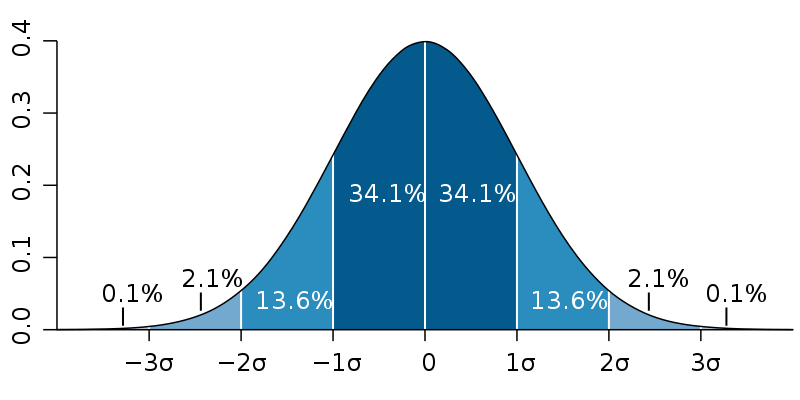
standard deviation
dispersion of the values of a random variable around its expected value

mode
value that appears most often in a set of data

average
In mathematics, an average of a collection or group is a value that is most central, common, or typical in some sense, and represents its overall position. In mathematics, it most commonly refers to the arithmetic mean, but may also refer to other measures such as other types of mean, the median, or the mode.

statistical dispersion
statistical property quantifying how much a collection of data is spread out
weighted mean
type of average
central tendency
statistical value representing the center or average of a distribution

quartile
In statistics, quartiles are a type of quantiles which divide the number of data points into four parts, or quarters, of more-or-less equal size. The data must be ordered from smallest to largest to compute quartiles; as such, quartiles are a form of order statistic. The three quartiles, resulting in four data divisions, are as follows:
thumb|Q1, Median and Q3
The first quartile (Q1) is defined as the 25th percentile, where the lowest 25% data lies below this point. It is also known as the lower quartile.
The second quartile (Q2) is the median of a data set; thus 50% of the data lies below t
range
difference of largest and smallest order statistic

quantile
thumb|Probability density of a normal distribution, with quantiles, , , and , are shown. The area below the red curve is the same in the intervals , , , and .

percentile
In statistics, a percentile or percentile score, also known as centile (often denoted as P_k or Pk, for a given percentage k), is a score (e.g., a data point value) below which a given fraction of all scores in its frequency distribution exists ("exclusive" definition). Alternatively, it is a score or below which a given percentage of the all scores exists ("inclusive" definition). I.e., a score in the k-th percentile would be above approximately k% of all scores in its set. For example, under the exclusive definition, the 97th percentile (P97) is the value such that 97% of the data points are
covariance matrix
measure of covariance of components of a random vector
order statistic
kth smallest value in a statistical sample
location parameter
concept in statistics
decile
In descriptive statistics, a decile is any of the nine values that divide the sorted data into ten equal parts, so that each part represents 1/10 of the sample or population. A decile is one possible form of a quantile; others include the quartile and percentile. A decile rank arranges the data in order from lowest to highest and is done on a scale of one to ten where each successive number corresponds to an increase of 10 percentage points.
summary statistic
Measure in Statistics
mid-range
In statistics, the mid-range or mid-extreme is a measure of central tendency of a sample defined as the arithmetic mean of the maximum and minimum values of the data set:
five-number summary
descriptive statistic
mean absolute difference
measure of statistical dispersion
Sample mean and covariance
statistics computed from a sample of data
trimean
In statistics the trimean (TM), or '''Tukey's trimean''', is a measure of a probability distribution's central tendency defined as a weighted average of the distribution's quartiles:
mean reciprocal rank
search quality measure in information retrieval