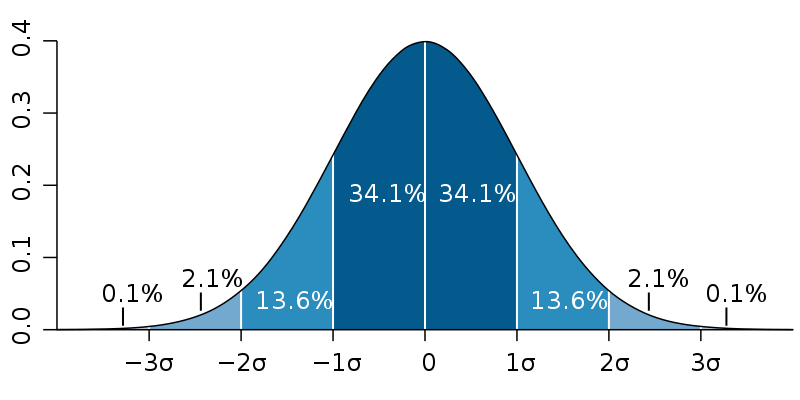
File:Standard_deviation_diagram.svg · Wikimedia Commons · See Wikimedia Commons
standard deviation
Sign in to savedispersion of the values of a random variable around its expected value
Standard deviation measures how spread out the values in a group of data are from the average—essentially telling you whether the numbers cluster tightly together or scatter widely. It matters because it helps you understand whether an average is truly representative of your data or whether there's a lot of variation hiding behind that single number.
AI-generated from the Wikipedia summary — may contain errors.
Wikidata facts
- Instance of
- statistical dispersion
- Part of
- stochastic
- Image
- Standard deviation diagram.svg
Show 6 more facts
- Commons category
- Standard deviation
- Commons gallery
- Standard deviation
- facet of
- statistics
- short name
- SD
- on focus list of Wikimedia project
- Wikipedia:Vital articles/Level/4
- maintained by WikiProject
- WikiProject Mathematics
via Wikidata · CC0
~40 min read
Encyclopedic overview
A plot of normal distribution (or bell-shaped curve) where each band has a width of 1 standard deviation–See also: 68–95–99.7 rule. Cumulative distribution function of a normal distribution with expected value 0 and standard deviation 1
In statistics, the standard deviation is a measure of the amount of variation of the values of a variable about its (arithmetic) average. A low standard deviation indicates that the values of a set tend to be close to their average, while a high standard deviation indicates that the values are spread out over a wider range. Standard deviation may be abbreviated SD or std dev, and is most commonly represented in mathematical texts and equations by the lowercase Greek letter σ (sigma).
Excerpted from Wikipedia’s “standard deviation” article, available under the CC BY-SA 4.0 licence.
Gallery (6)
Available in 80 languages
- Español
- Français
- Deutsch
- 中文
- 日本語
- Русский
- Português
- Italiano
- العربية
- हिन्दी
- Afrikaans
- Albanian
- Assamese
- Asturian
- Azerbaijani
- Bahasa Indonesia
- Bangla
- Basque
Show 61 more
- be_x_old
- Belarusian
- Betawi
- Bosnian
- Bulgarian
- Catalan
- cbk_zam
- Central Kurdish
- Chuvash
- Crimean Tatar
- Croatian
- Czech
- Danish
- Esperanto
- Estonian
- Filipino
- Finnish
- Galician
- Greek
- Hebrew
- Hungarian
- Icelandic
- Kazakh
- Latin
- Latvian
- Lithuanian
- Macedonian
- Malay
- Mongolian
- Nederlands
- Nepali
- Norwegian
- Norwegian Nynorsk
- Occitan
- Polski
- Romanian
- Samoan
- Serbian
- Serbian (Latin)
- Sicilian
- simple
- Sindhi
- Sinhala
- Slovak
- Slovenian
- Sundanese
- Svenska
- Swahili
- Tamil
- Tiếng Việt
- Türkçe
- Ukrainian
- Urdu
- Waray
- Welsh
- Wu Chinese
- zh_min_nan
- zh_yue
- فارسی
- ไทย
- 한국어
via Wikidata sitelinks · CC0