Category
page 1Super-Earths

Kepler-452b
Kepler-452b (sometimes quoted to be an Earth 2.0 or ''Earth's Cousin based on its characteristics; also known by its Kepler object of interest designation KOI-7016.01'') is a super-Earth exoplanet orbiting within the inner edge of the habitable zone of the sun-like star Kepler-452 and is the only planet in the system discovered by the Kepler space telescope. It is located about from Earth in the constellation of Cygnus.
Gliese 581 c
extrasolar planet

super-Earth
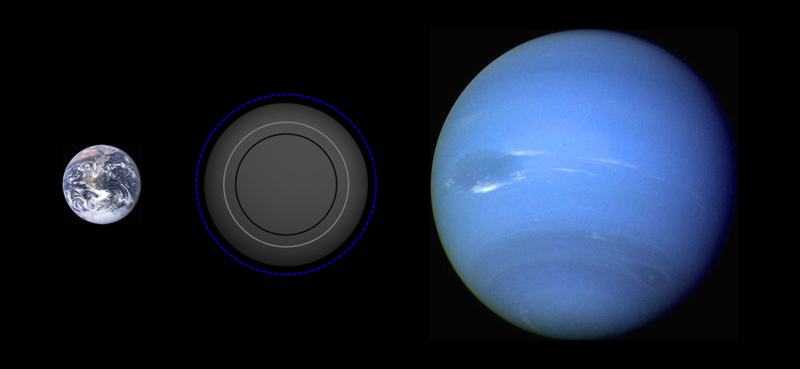
thumb|upright=1.75|right|Illustration of the inferred size of the super-Earth CoRoT-7b (center) in comparison with [[Earth and Neptune]]
A super-Earth is a type of exoplanet with a mass higher than Earth's, but substantially below those of the Solar System's ice giants, Uranus and Neptune, which are 14.5 and 17.1 times Earth's mass respectively. The term "super-Earth" refers only to the mass of the planet, and so does not imply anything about the surface conditions or habitability. The alternative term "gas dwarfs" may be more accurate for those at the higher end of the mass scale, although "m
55 Cancri e
extrasolar planet

COROT-Exo-7b
CoRoT-7b (previously named CoRoT-Exo-7b) is an exoplanet orbiting the star CoRoT-7 in the constellation of Monoceros, from the Earth. It was first detected photometrically by the French-led CoRoT mission and reported in February 2009. Until the announcement of Kepler-10b in January 2011, it was the smallest exoplanet to have its diameter measured, at 1.58 times that of the Earth (which would give it a volume about 3.94 times Earth's) and the first potential extrasolar terrestrial planet to be found. The exoplanet has a very short orbital period, revolving around its host star in about 20 hours
Gliese 1214 b
extrasolar planet
PSR B1257+12 c
2nd exoplanet of PSR 1257+12 system

Kepler-10 b
Kepler-10b is the first confirmed terrestrial planet to have been discovered outside the Solar System by the Kepler Space Telescope. Discovered after several months of data collection during the course of the NASA-directed Kepler Mission, which aims to discover Earth-like planets crossing in front of their host stars, the planet's discovery was announced on January 10, 2011. Kepler-10b has a mass of 3.72±0.42 Earth masses and a radius of 1.47 Earth radii. However, it lies extremely close to its star, Kepler-10, and as a result is too hot to support life as we know it. Its existence was confirm

OGLE-2005-BLG-390Lb
OGLE-2005-BLG-390Lb (known sometimes as Hoth by NASA) is a super-Earth ice exoplanet orbiting OGLE-2005-BLG-390L, a star from Earth near the center of the Milky Way, making it one of the most distant planets known. On January 25, 2006, Probing Lensing Anomalies NETwork/Robotic Telescope Network (PLANET/Robonet), Optical Gravitational Lensing Experiment (OGLE), and Microlensing Observations in Astrophysics (MOA) made a joint announcement of the discovery. The planet does not appear to meet conditions presumed necessary to support life.
Gliese 667 Cc
extrasolar planet
Gliese 876 d
exoplanet
Kepler-10 c
Kepler-10c is an exoplanet orbiting the G-type star Kepler-10, located around 608 light-years away in Draco. Its discovery was announced by the Kepler space telescope team in May 2011, although it had been seen as a planetary candidate since January 2011, when Kepler-10b was discovered. The team confirmed the observation using data from NASA's Spitzer Space Telescope and a technique called BLENDER that ruled out most false positives. Kepler-10c was the third transiting planet to be confirmed statistically (based on probability rather than actual observation), after Kepler-9d and Kepler-11g. Th

Kepler-69 c
Kepler-69c (also known by its Kepler Object of Interest designation KOI-172.02) is a confirmed super-Earth exoplanet, likely rocky, orbiting the Sun-like star Kepler-69, the outermore of two such planets discovered by NASA's Kepler spacecraft. It is located about 2,430 light-years (746 parsecs) from Earth.

Kepler-20 f
Kepler-20f (also known by its Kepler Object of Interest designation KOI-070.05) is an exoplanet orbiting the Sun-like star Kepler-20, the second outermost of five such planets discovered by NASA's Kepler spacecraft. It is located approximately 929 light-years (285 parsecs, or about km) from Earth in the constellation Lyra. The exoplanet was found by using the transit method, in which the dimming effect that a planet causes as it crosses in front of its star is measured. The planet is notable as it has the closest radius to Earth known so far.
PSR B1257+12 d
3rd exoplanet of PSR 1257+12 system
MOA-2007-BLG-192Lb
MOA-2007-BLG-192Lb, occasionally shortened to MOA-192 b, is an extrasolar planet approximately 7,000 light-years away in the constellation of Sagittarius. The planet was discovered orbiting the low-mass star MOA-2007-BLG-192L. It was found when it caused a gravitational microlensing event on May 24, 2007, which was detected as part of the MOA-II microlensing survey at the Mount John University Observatory in New Zealand.
GJ 1132b
extrasolar planet
Kepler-37 d
Kepler-37d is an exoplanet discovered by the Kepler space telescope in February 2013. It is located 209 light years away, in the constellation Lyra. With an orbital period of 39.8 days, it is the largest of the three known planets orbiting its parent star Kepler-37.
Gliese 357 d
extrasolar planet
61 Virginis b
extrasolar planet
HD 156668 b
extrasolar planet
Kepler-9 d
__NOTOC__
Kepler-283 c
extrasolar planet

HD 40307 d
extrasolar planet
HD 40307 b
extrasolar planet
Kepler-20 Ab
Kepler-20b is an exoplanet orbiting Kepler-20 in a system 922 light years from Earth. It is classified as a Super-Earth, as it has a radius and mass greater than that of Earth. Its radius of about 1.87 would typically mean that it is a Mini-Neptune; but its high mass of 9.7 implies that it is an iron-rich rocky world. Along with the other four planets in the system, Kepler-20b was announced on 20 December 2011.
HD 40307 c
extrasolar planet
HIP 116454 b
extrasolar planet
HD 40307 f
extrasolar planet
HD 181433 b
extrasolar planet
HD 7924 b
extrasolar planet
HD 215497 b
extrasolar planet
HD 1461 b
extrasolar planet orbiting HD 1461
K2-141 b
K2-141b (also designated EPIC 246393474.01) is a massive rocky exoplanet orbiting extremely close to a K Type orange main-sequence star K2-141. The planet was first discovered by the Kepler space telescope during its K2 “Second Light” mission and later observed by the HARPS-N spectrograph. It is classified as an ultra-short period planet (USP) and is confirmed to be terrestrial in nature. Its high density implies a massive iron core taking up between 30% and 50% of the planet's total mass.
Gliese 3634 b
extrasolar planet
Wolf 1061d
exoplanet
Kepler-93 b
Kepler-93b (KOI-69b) is a hot, dense transiting Super-Earth exoplanet located approximately away in the constellation of Lyra, orbiting the G-type star Kepler-93. Its discovery was announced in February 2014 by American astronomer Geoffrey Marcy and his team. In July 2014, its radius was determined with a mere 1.3% margin of error, the most precise measurement ever made for an exoplanet's radius at the time.
Kepler-445 b
REDIRECT Kepler-445
Kepler-26e
Kepler-26e is an exoplanet orbiting the star Kepler-26, located in the constellation Lyra. It was discovered by the Kepler telescope in February 2014. It orbits its parent star at only 0.220 astronomical units and completes an orbit once every 46.8 days. It is located within the star's habitable zone. The Habitable Worlds Catalog issued by the Planetary Habitability Laboratory classes the planet as a warm superterran near the inner edge of the optimistic habitable zone, with an equilibrium temperature of . The planet is likely tidally locked due to its proximity to the star.