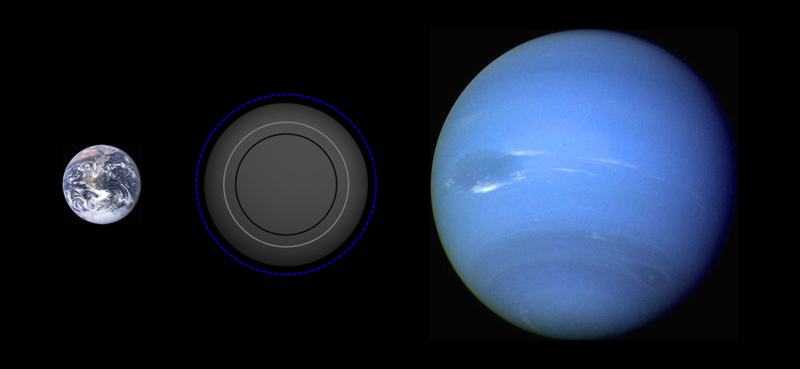
File:Exoplanet_Comparison_Gliese_581_c.png · Wikimedia Commons · See Wikimedia Commons
Gliese 581 c is a planet orbiting a star called Gliese 581, located about 20 light-years from Earth. It attracted significant scientific interest because its size and distance from its star suggested it might be capable of supporting liquid water, making it a candidate in the search for potentially habitable worlds beyond our solar system.
AI-generated from the Wikipedia summary — may contain errors.
Astronomical data · SIMBAD
- Object type
- Pl
- Distance
- 21 light-years
- Coordinates
- RA 229.8618° · Dec -7.7223°
via SIMBAD · CDS Strasbourg
Wikidata facts
- Instance of
- star
- Constellation
- Libra
- Parent body
- Gliese 581
- Mass
- 0.02143
- Orbital period
- 12.919
- Image
- Planetary System in Gliese 581 (artist's impression).jpg
Show 17 more facts
- Commons category
- Gliese 581 c
- catalog code
- TIC 36853511c
- discovery method
- Doppler spectroscopy
- time of discovery or invention
- 2007-07-00
- discoverer or inventor
- High Accuracy Radial Velocity Planet Searcher
- right ascension
- 229.86177972340250
- declination
- -7.72227526632666
- epoch
- J2000.0
- M sin i
- 0.017783
- argument of periapsis
- 148.7
- semi-major axis of an orbit
- 0.074
- orbital eccentricity
- 0
- angular distance
- 0.011755
- right ascension component of proper motion
- -1221.467
- declination component of proper motion
- -97.129
- parallax
- 158.7492
- orbital inclination
- 47
Sources (1)
via Wikidata · CC0
~18 min read
Encyclopedic overview
Gliese 581c /ˈɡliːzə/ (Gl 581c or GJ 581c) is an exoplanet orbiting within the Gliese 581 system. It is the second planet discovered in the system and the third in order from the star. With a mass about 6.8 times that of the Earth, it is classified as a super-Earth (a category of planets with masses greater than Earth's up to ten Earth masses).
At the time of its discovery in 2007, Gliese 581c gained interest from astronomers because it was reported to be the first potentially Earth-like planet in the habitable zone of its star, with a temperature right for liquid water on its surface, and, by extension, potentially capable of supporting extremophile forms of Earth-like life. However, further research cast doubt upon the planet's habitability. Based on newer models of the habitable zone, the planet is likely too hot to be potentially habitable.
Excerpted from Wikipedia’s “Gliese 581 c” article, available under the CC BY-SA 4.0 licence.