Category
page 1Supernatural legends

jinn
Jinn (Arabic: جِنّ), also romanized as djinn or anglicized as genies, are supernatural beings in pre-Islamic Arabian religion and Islam. Like humans, they are accountable for their deeds and can be either believers (''Mu'minun) or unbelievers (kuffar''), depending on whether they accept God's guidance.

werewolf
In folklore, a werewolf (), or occasionally lycanthrope (from Ancient Greek ), is an individual who can shapeshift into a wolf or therianthropic hybrid wolf–humanlike creature, either voluntarily or involuntarily due to a curse or other affliction. In modern fiction, especially film, transformations are often depicted as triggered by the full moon and transmitted by a bite or scratch from another werewolf. Early sources for belief in this ability or affliction, called lycanthropy, are Petronius (27–66) and Gervase of Tilbury (1150–1228).
.jpg)
Lilith
thumb|upright=1|Lilith (painting)|Lilith (1887) by John Collier
Lilith (; ; also spelled Lilit, Lilitu, or Lilis) is a feminine figure in Mesopotamian and Jewish mythology. According to accounts in the Talmud she is a primordial she-demon. Based on Medieval Jewish folklore, Lilith is said to have fled from the Garden of Eden because she did not want to submit to Adam.

curse
thumb|right|220px|A woman performs a cursing ritual (Hokusai)
A curse (also called an imprecation, malediction, execration, malison, anathema, or commination) is any expressed wish that some form of adversity or misfortune will befall or attach to one or more persons, a place, or an object. In particular, "curse" may refer to such a wish or pronouncement made effective by a supernatural or spiritual power, such as a god or gods, a spirit, or a natural force, or else as a kind of spell by magic (usually black magic or dark magic) or witchcraft; in the latter sense, a curse can also be called a
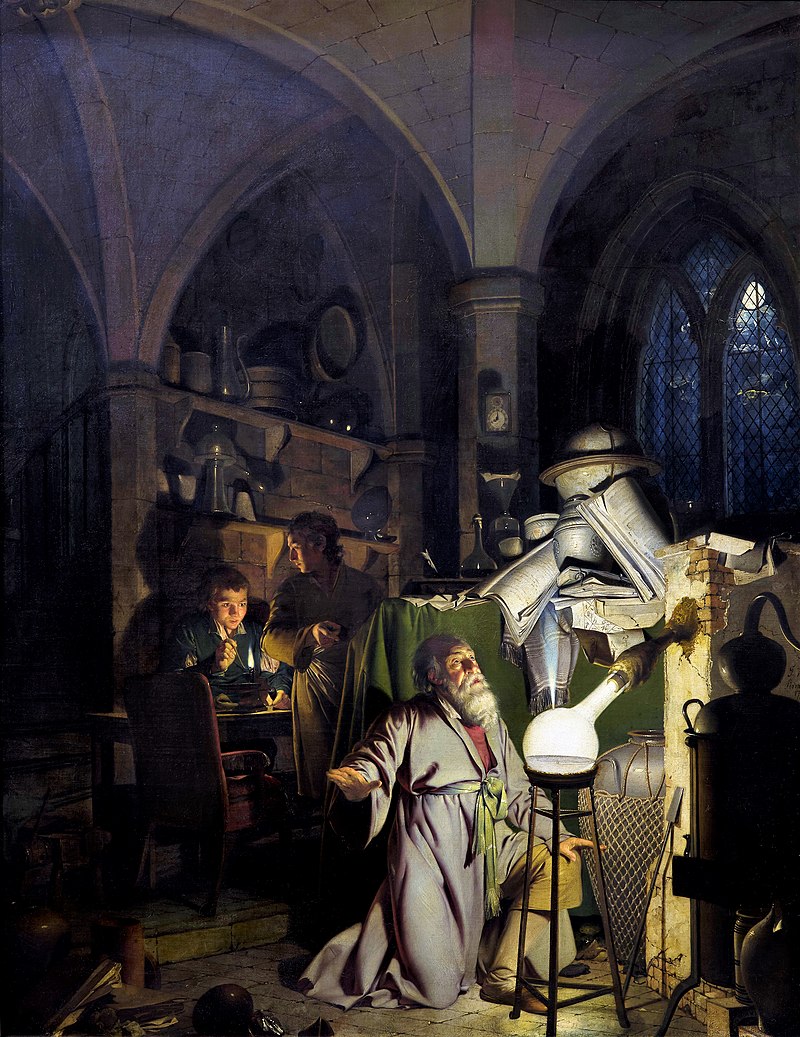
philosopher's stone
legendary alchemical substance

troll
thumb|upright=1.3|''Look at them, troll mother said. Look at my sons! You won't find more beautiful trolls on this side of the moon.'' (1915) by John Bauer (illustrator)|John Bauer
A troll is a being in Nordic folklore, including Norse mythology. In Old Norse sources, beings described as trolls dwell in isolated areas of rocks, mountains, or caves, live together in small family units, and are rarely helpful to human beings.

Antichrist
thumb|The Devil in Christianity|Devil whispers to the Antichrist; detail from Sermons and Deeds of the Antichrist, [[Luca Signorelli, 1501, Orvieto Cathedral.]]
In Christian eschatology, Antichrist, or in broader eschatology, Anti-Messiah, refers to a kind of entity prophesied by the Bible to oppose Jesus Christ and falsely substitute himself as a savior in Christ's place before the Second Coming. The term Antichrist (including one plural form) is found four times in the New Testament, solely in the First and Second Epistle of John. Antichrist is announced as one "who denies the Father and the

siren
creatures half bird and half woman who lured sailors by the sweetness of her song

Midas
thumb|King Midas on a red-figure stamnos from Chiusi around 440 BC, British Museum

Walpurgis Night
Germanic festival celebrating the start of summer

will o' the wisp
thumb|upright=1.35|The Will o' the Wisp and the Snake by Hermann Hendrich (1854–1931)

Merlin
Merlin () is a mythical figure prominently featured in the legend of King Arthur and best known as a prophet and a magician, along with several other main roles. The familiar depiction of Merlin, based on an amalgamation of historical and legendary figures, was introduced by the 12th-century Catholic cleric Geoffrey of Monmouth and then built on by the French poet Robert de Boron and prose successors in the 13th century. Geoffrey's account presented Merlin as a prophet and royal advisor to Arthur's father, Uther Pendragon.

Flying Dutchman
legendary ghost ship

Apsara
thumb|A 12th-century sandstone statue of an apsara from Madhya Pradesh, India

succubus
thumb|upright=1.2|Depiction of a succubus in "My Dream, My Bad Dream" by , 1915
A succubus () is a female demon who is described in various European folklore as appearing in the dreams of male humans in order to seduce them. Repeated interactions between a succubus and a man will lead to sexual activity. The establishment and perpetuation of such a relationship enables the production of a hybrid child known as a cambion, but at the expense of the man, whose mental and physical health will deteriorate rapidly, eventually resulting in his death if the succubus continues courting him for a protra

banshee
thumb|Bunworth Banshee, Fairy Legends and Traditions of the South of Ireland, by [[Thomas Crofton Croker, 1825|300x300px]]

Death
personification of death

gargoyle
thumb|Gargoyles of Notre-Dame de Paris
thumb|Dragon-headed gargoyle of the Tallinn Town Hall, [[Estonia]]
thumb|Gargoyle of the Vasa Chapel at Wawel in [[Kraków, Poland]]

Krampus
thumb|upright|1900s illustration of Saint Nicholas and Krampus visiting a child
The Krampus () is a horned anthropomorphic figure who, in the Central and Eastern Alpine folkloric tradition, is said to accompany Saint Nicholas on visits to children during the night of 5 December (Krampusnacht; "Krampus Night"), immediately before the Feast of St. Nicholas on 6 December. In this tradition, Saint Nicholas rewards well-behaved children with small gifts, while Krampus punishes badly behaved ones with birch rods.
%20-%20Portrait%20of%20an%20Unidentified%20Man%20as%20Mephistopheles%20-%20PPHC000206%20-%20Royal%20College%20of%20Music.jpg)
Mephistopheles
thumb|Mephistopheles by Paul Mathey, 1888
Mephistopheles ( , ), also known as Mephostophilis or Mephisto, is a demon featured in German folklore, originating as the chief devil in the Faust legend. He has since become a stock character appearing in other works of arts and popular culture. Mephistopheles never became an integral part of traditional magic.

incubus
thumb|Depiction of incubi, Vincenz Georg Kininger, 1879
An Incubus () is a male demon who is described in various folklore as appearing in the dreams of female humans in order to seduce them. Repeated interactions between an incubus and a woman will lead to sexual activity, a bond forming between them, and ultimately sexual intercourse, as he requires vaginal ejaculation discharge to survive. The establishment and perpetuation of such a relationship enables the production of a hybrid child known as a cambion, but at the expense of the woman, whose mental and physical health will deteriorate ra

Morgan le Fay
enchantress in Arthurian legend
%2C%20published%201799%2C%20NGA%207459.jpg)
bogeyman
thumb|Goya|Goya's Que viene el Coco (Here Comes the Boogeyman/The Boogeyman Is Coming), c. 1797
The bogeyman (; also spelled or known as bogyman, bogy, or bogey, and boogeyman in the United States and Canada) is a mythical creature typically used to frighten children into good behaviour. Bogeymen have no specific appearances, and conceptions vary drastically by household and culture, but they are most commonly depicted as masculine, androgynous or even feminine monsters that punish children for misbehaviour. The bogeyman, and conceptually similar monsters, can be found in many cultures around

ogre
thumb|upright=1.15|Giovanni Lanfranco: Norandino and Lucina Discovered by the Ogre, [[oil on canvas, c. 1624]]
An ogre (feminine: ogress) is a legendary monster depicted as a large, hideous, humanoid being that eats ordinary human beings, especially infants and children. Ogres frequently feature in mythology, folklore, and fiction throughout the world. They appear in many classic works of literature, and are most often associated in fairy tales and legend.
Wild Hunt
motif in northern European folk myth

elixir of life
magical potion

div (mythology)
A daeva (Avestan: 𐬛𐬀𐬉𐬎𐬎𐬀 daēuua) is a Zoroastrian supernatural entity with disagreeable characteristics. In the Gathas, the oldest texts of the Zoroastrian canon, the daevas are "gods that are (to be) rejected". This meaning is – subject to interpretation – perhaps also evident in the Old Persian "daiva inscription" of the 5th century BC. In the Younger Avesta, the daevas are divinities that promote chaos and disorder. In later tradition and folklore, the dēws (Zoroastrian Middle Persian; New Persian divs) are personifications of every imaginable evil. Over time, the Daeva myth as Div be
.jpg)
Wendigo
Wendigo () is a mythological creature or evil spirit originating from Algonquian folklore. The concept of the wendigo has been widely used in literature and other works of art, such as social commentary and horror fiction.

changeling
thumb|upright=1.2|Der Wechselbalg by Henry Fuseli, 1781
Lady of the Lake
ruler of Avalon in the Arthurian legend
La Llorona
ghost legend in Latin American folklore
Tír na nÓg
Land of Eternal Youth in Irish mythology

shapeshifting
thumb|Zeus turning Lycaon into a wolf, engraving by Hendrik Goltzius|upright=1.2
In mythology, folklore and speculative fiction, shapeshifting is the ability to physically transform oneself through unnatural means. The idea of shapeshifting is found in the oldest forms of totemism and shamanism, as well as the oldest existent literature and epic poems such as the Epic of Gilgamesh and the Iliad. The concept remains a common literary device in modern fantasy, children's literature and popular culture. Examples of shape-shifters include changelings, jinns, kitsune, vampires, and werewolves, alon

Dybbuk
thumb|300px|, by Ephraim Moses Lilien|Ephraim Moshe Lilien (1874–1925).
In Jewish mythology, a '''''' (; , from the Hebrew verb , meaning 'adhere' or 'cling') is a malicious possessing spirit believed to be the dislocated soul of a dead person. It supposedly leaves the host body once it has accomplished its goal, sometimes after being exorcised.
Jersey Devil
also known as the Leeds Devil, legendary creature said to inhabit southern New Jersey, USA

familiar
thumb|A late-16th-century English illustration of a witch feeding her familiars
In European folklore of the medieval and early modern periods, familiars (strictly familiar spirits, as "familiar" also meant just "close friend" or companion, and may be seen in the scientific name for dog, Canis familiaris) were believed to be supernatural entities, interdimensional beings, or spiritual guardians that would protect or assist witches and cunning folk in their practice of magic, divination, and spiritual insight. According to records of the time, those alleging to have had contact with familiar spi
Green Man
sculpture or other representation of a face surrounded by or made from leaves

onryō
thumb|Depiction of an onryō in the , by Katsushika Hokusai.
Annabelle
allegedly haunted Raggedy Ann doll
brownie
mythical creature popular in folklore from Scotland and England
Marie Laveau
American Voodoo practitioner

Perchta
upright=1.2|thumbnail|Peruchty in , Kingdom of Bohemia, 1910
' or ' ('Bertha'; ), also commonly known as '''''' () and other variations, was thought to be a goddess in Alpine paganism in the Upper German and also Austrian and Slovenian regions of the Alps. Her name may mean 'the bright one' or 'the bearer' (, from Proto-Germanic *berhtaz) and is probably related to the name , meaning 'the feast of the Epiphany'. Eugen Mogk provides an alternative etymology, attributing the origin of the name to the Old High German verb , meaning 'hidden' or 'covered'. The exact origin or time of origin is unkn

Oberon
thumb|The Reconciliation of Titania and Oberon by Joseph Noel Paton
Oberon () is a king of the fairies in medieval and Renaissance literature. He is best known as a character in William Shakespeare's play ''A Midsummer Night's Dream'', in which he is King of the Fairies and spouse of Titania, Queen of the Fairies.
Mare
malicious entity in folklore

Mavka
Mavka ( ) or Nyavka ( ) is a type of female spirit in Ukrainian folklore and mythology. The Mavka is a long-haired "Soul of the Forest", typically depicted as a temptress figure who lures men to their deaths.
Hormigueros
municipality in Puerto RIco
divine retribution
supernatural punishment by a deity
Spring-heeled Jack
English folklore legendary character
%20by%20Johannes%20Gehrts.jpg)
Hellhound
thumb|Goddess Hel (being)|Hel and the hellhound [[Garmr by Johannes Gehrts, 1889]]
A hellhound is a mythological hound that embodies a guardian or a servant of hell, the devil, or the underworld. Hellhounds occur in mythologies around the world, with the best-known examples being Cerberus from Greek mythology, Garmr from Norse mythology, the black dogs of English folklore, and the fairy hounds of Celtic mythology. Physical characteristics vary, but they are commonly black, anomalously overgrown, supernaturally strong, and often have red eyes or are accompanied by flames. The behaviors of a He
Yule cat
huge cat in Icelandic folklore
Hoodoo
spiritual practices, traditions and beliefs
werecat
A werecat (also written in a hyphenated form as were-cat) is an analog to "werewolf" for a feline therianthropic creature.
Davy Jones' Locker
legend

Grýla
thumb | Mascot costumes of Grýla (left) and Leppaluði (right)
In Icelandic folklore, Grýla is a monstrous entity who lives in the wilderness of Iceland. The name Grýla is first attested in medieval sources. The earliest unambiguous references to Grýla's gender and her association with Christmas, though, date only from the 17th century. In 17th-century poems about Grýla, she is generally represented as a hideous and greedy troll-like crone, who wanders between human settlements and demands charity from those she encounters, often asking for naughty children. Modern depictions of Grýla tend to f
Robert
haunted doll in Key West, Florida

inugami
thumb|"Inugami" from the Hyakkai Zukan by [[Sawaki Suushi]]
upright|thumb|"Inugami" from the Gazu Hyakki Yagyō by [[Sekien Toriyama. The one on the bottom-left that looks like a child is a "shirachigo" (白児, "white infant") that was either the inugami's pupil or the yōkai child of a disabled person.]]
thumb|Inugami (犬神) from Bakemono no e (化物之繪, c. 1700), Harry F. Bruning Collection of Japanese Books and Manuscripts, L. Tom Perry Special Collections, [[Harold B. Lee Library, Brigham Young University. |alt=]]
vanishing hitchhiker
urban legend in which people traveling by vehicle meet with a hitchhiker who vanishes without explanation, often from a moving vehicle

Kallikantzaros
The kallikantzaros () is a malevolent creature in modern Greek folklore.
Devil's Footprints
Trails of footmarks appeared in Feb 1855
Pan Twardowski
fictional character