Category
page 1Surfaces

sphere
A sphere (from Ancient Greek , ) is a surface analogous to the circle, a curve. In solid geometry, a sphere is the set of points that are all at the same distance from a given point in three-dimensional space. That given point is the center of the sphere, and the distance is the sphere's radius. The earliest known mentions of spheres appear in the work of the ancient Greek mathematicians.

cone
thumb|upright=1.2|A right circular cone and an oblique circular cone
thumb|A double cone, not infinitely extended

cylinder
A cylinder () has traditionally been a three-dimensional solid, one of the most basic of curvilinear geometric shapes. In elementary geometry, it is considered a prism with a circle as its base.

surface
two-dimensional manifold, and, as such, may be an "abstract surface" not embedded in any Euclidean space

Möbius strip
two-dimensional surface with only one side and only one edge

hyperboloid
{| class=wikitable align=right
|- align=center
|150pxHyperboloid of one sheet
|160pxconical surface in between
|150pxHyperboloid of two sheets
|}
In geometry, a hyperboloid of revolution, sometimes called a circular hyperboloid, is the surface generated by rotating a hyperbola around one of its principal axes. A hyperboloid is the surface obtained from a hyperboloid of revolution by deforming it by means of directional scalings, or more generally, of an affine transformation.

paraboloid
thumb|right|Paraboloid of revolution
In geometry, a paraboloid is a quadric surface that has exactly one axis of symmetry and no center of symmetry. The term "paraboloid" is derived from parabola, which refers to a conic section that has a similar property of symmetry.
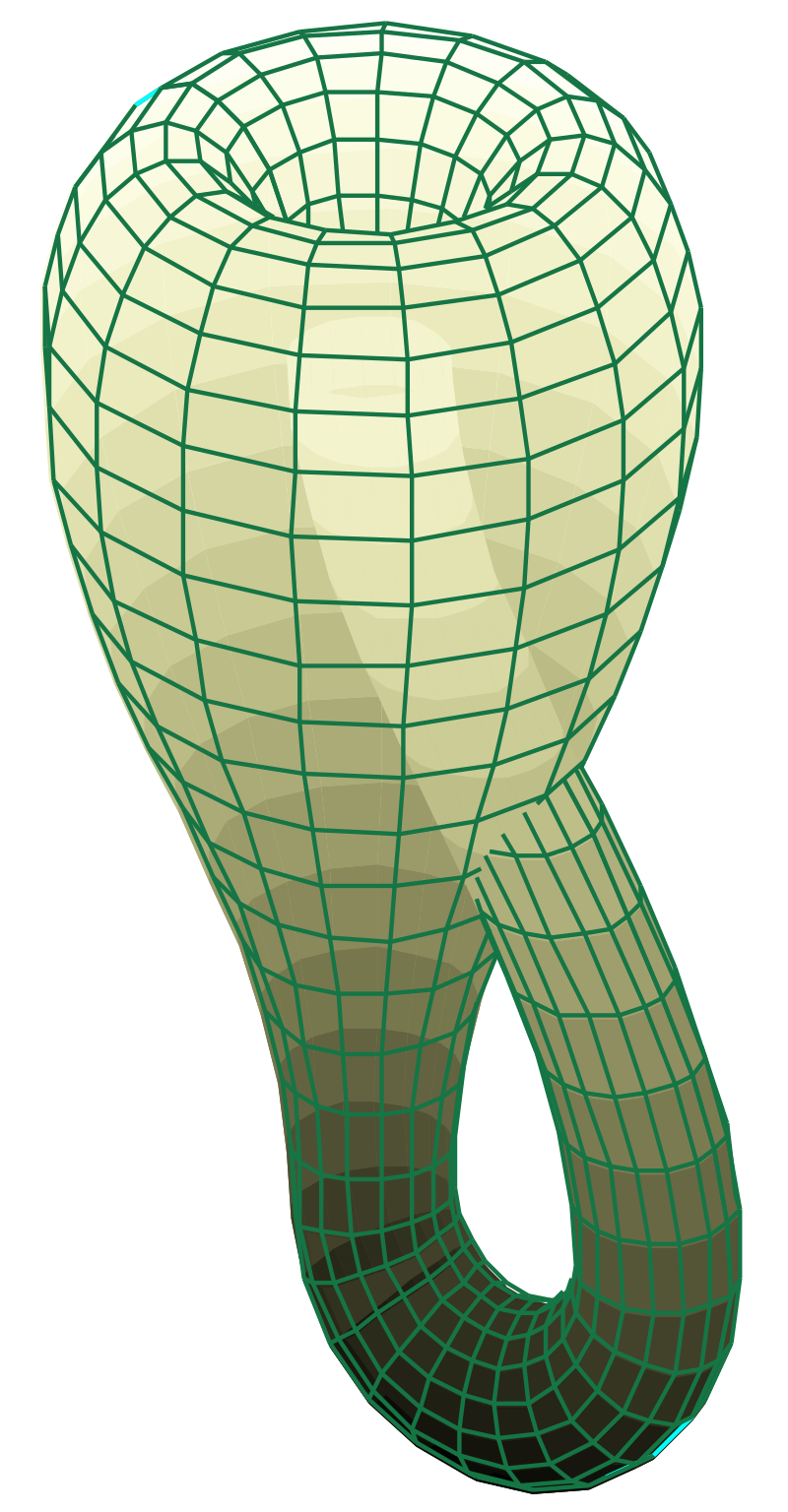
Klein bottle
type of non-orientable surface

normal
in geometry, an object that is perpendicular to a given object, vector perpendicular to a curve or surface
surface integral
generalization of a multiple integral to (possibly)-curved surfaces
Gabriel's Horn
infinite surface of revolution with infinite surface area enclosing a finite volume, which contributed to 17th century debate on the nature of infinity

helicoid
right|thumb|350px|A helicoid with α = 1, −1 ≤ ρ ≤ 1 and − ≤ θ ≤ .
genus
topological property
ruled surface
surface through every point of which runs a straight line which equally is on the surface
equipotential surface
surface of constant scalar potential
hypersurface
In geometry, a hypersurface is a generalization of the concepts of hyperplane, plane curve, and surface. A hypersurface is a manifold or an algebraic variety of dimension , which is embedded in an ambient space of dimension , generally a Euclidean space, an affine space or a projective space.
Hypersurfaces share, with surfaces in a three-dimensional space, the property of being defined by a single implicit equation, at least locally (near every point), and sometimes globally.
Gaussian curvature
product of the principal curvatures of a surface

pseudosphere
In geometry, a pseudosphere is a surface in \mathbb{R}^3. It is the most famous example of a pseudospherical surface. A pseudospherical surface is a surface piecewise smoothly immersed in \mathbb{R}^3 with constant negative Gaussian curvature. A "pseudospherical surface of radius " is a surface in \mathbb{R}^3 having curvature −1/R2 at each point. Its name comes from the analogy with the sphere of radius , which is a surface of curvature 1/R2. Examples include the tractroid, Dini's surfaces, breather surfaces, and the Kuen surface.
Theorema Egregium
"Remarkable theorem" about Gauss' curvature as an invariant

orientability
right|thumb|A torus is an orientable surface
alt=Animation of a flat disk walking on the surface of a Möbius strip, flipping with each revolution.|thumb|The Möbius strip is a non-orientable surface. Note how the disk flips with every loop.
right|thumb|The Roman surface is non-orientable.
Earth's surface
term for the surface of the Earth
space-filling model
molecular model visualizing atoms as intersecting spheres with hidden bonds

conoid
300px|thumb|Right circular conoid:
surface finish
small, local deviations of a surface from a perfectly flat ideal; defined by the three characteristics of lay, surface roughness, and waviness
mean curvature
in differential geometry, an extrinsic measure of curvature of a surface
Bézier surface
species of mathematical spline used in computer graphics, computer-aided design, and finite element modeling, is defined by a set of control points
real projective plane
a compact non-orientable two-dimensional manifold
principal curvature
at a given point of a surface, one of the two eigenvalues of the shape operator at the point

isosurface

physical surface
thumb|right|The surface of an apple has various perceptible characteristics, such as curvature, smoothness, texture, color, and shininess; observing these characteristics by sight or touch allows the object to be identified.
thumb|right|Water droplet lying on a [[damask. Surface tension is high enough to prevent it passing through the textile.]]
thumb|right|The Sun, like all stars, appears from a distance to have a distinct surface, but on closer approach has no set surface.
A surface, as the term is most generally used, is the outermost or uppermost layer of a physical object. It is the porti
first fundamental form
conical surface
union of all the straight lines that pass through a fixed point and intersect a fixed space curve
fractal landscape
stochastically generated naturalistic terrain
Catalan surface
mathematical concept

bicone
thumb|100px|right

Whitney umbrella
three dimensions self-intersecting surface
Gaussian surface
closed surface in three-dimensional space through which the flux of a vector field is calculated; usually the gravitational field, the electric field, or magnetic field
Gauss map
in differential geometry, a function that maps each point in a surface to its normal direction
Boy's surface
three-dimensional self-intersecting surface, an immersion of the real projective plane
lateral surface
area of all the sides of the object, excluding the area of its base and top

superformula
The superformula is a generalization of the superellipse and was proposed by Johan Gielis in 2003. Gielis suggested that the formula can be used to describe many complex shapes and curves that are found in nature. Gielis has filed a patent application related to the synthesis of patterns generated by the superformula, which expired effective 2020-05-10.
surface
mathematical idealization of the surface of a 3D body
Seifert surface
surface whose boundary is a knot or a link
sine–Gordon equation
nonlinear hyperbolic partial differential equation in 1 + 1 dimensions
superegg
right|thumb|Brass superegg by Piet Hein (Denmark)|Piet Hein.
thumb|Piet Hein Superegg
two-dimensional electron gas
scientific model in solid-state physics; electron gas that is free to move in two dimensions, but tightly confined in the third
surface engineering
material and chemical engineering of solid surfaces
Roman surface
a special surface in three dimensions
parametric surface
surface in the Euclidean space
Mach cone
Dupin cyclide
geometric inversion of a standard torus, cylinder or double cone
asymptotic curve
concept in differential geometry
planetary surface
where the solid (or liquid) material of the outer crust on certain types of astronomical objects contacts the atmosphere or outer space
Surface triangulation
division of a surface into triangles

Morin surface
half-way model of an inverted sphere
Dupin indicatrix
conic section which describes the local shape of a surface
Weierstrass–Enneper parameterization
Construction for minimal surfaces
right conoid
ruled surface made of lines orthogonal to an axis

umbilical point
locally spherical point on a mathematical surface
Bézier triangle
Bézier surface created by control point interpolation