Category
page 1Symmetry
.svg)
symmetry
thumb|upright=1.25|Symmetry (left) and asymmetry (right)
thumb|upright=0.8|A spherical symmetry group with [[octahedral symmetry. The yellow region shows the fundamental domain.]]
thumb|upright=0.8|A fractal-like shape that has [[reflectional symmetry, rotational symmetry and self-similarity, three forms of symmetry. This shape is obtained by a finite subdivision rule.]]
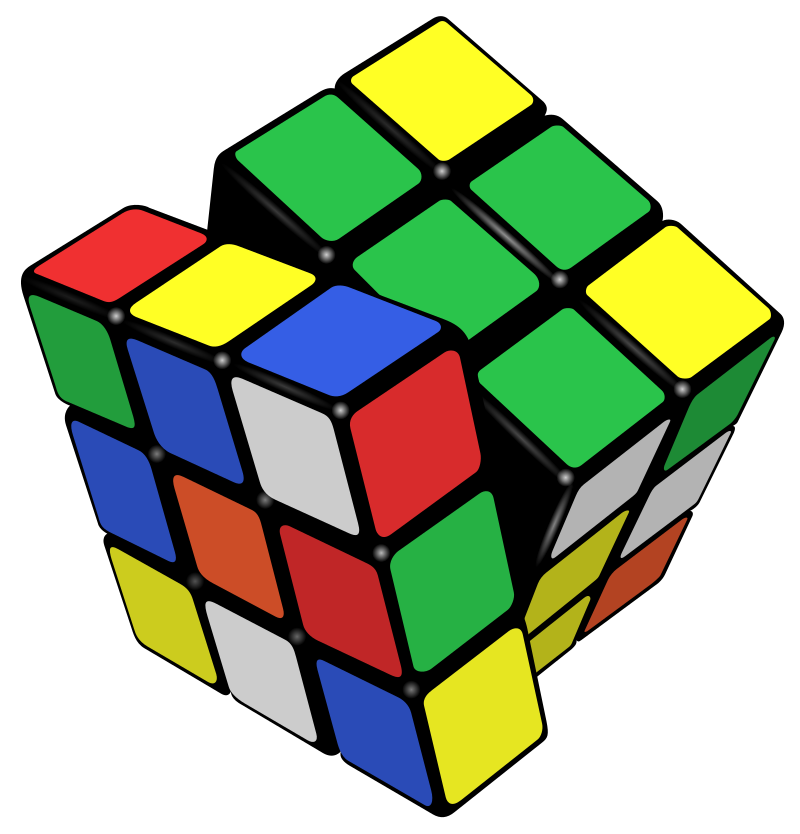
group
algebraic set with an invertible, associative internal operation admitting a neutral element
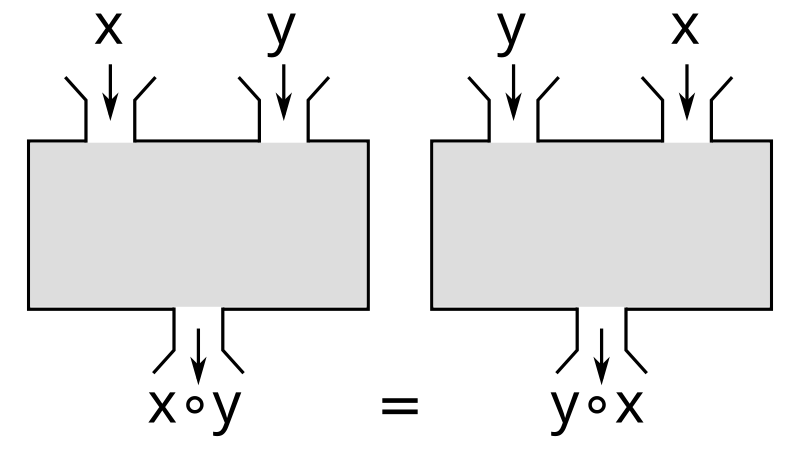
commutative property
property of binary operations, for which changing the order of the operands does not change the result
conservation law
scientific law regarding conservation of a physical property

triskelion
thumb|Neolithic triple-spiral symbol
.jpg)
triptych
thumb|330px|Triptych of the The Elevation of the Cross (Rubens)|Raising of the Cross, Rubens, 1610–11, Antwerp Cathedral
A triptych ( ) is a work of art (usually a panel painting) that is divided into three sections, or three carved panels that are hinged together and can be folded shut or displayed open. It is therefore a type of polyptych, the term for all multi-panel works. The middle panel is typically the largest and flanked by two smaller related works, although there are triptychs of equal-sized panels. The form can also be used for pendant jewelry.

isotropy
thumb|A sphere is isotropic

tessellation
A tessellation or tiling is the covering of a surface, often a plane, using one or more geometric shapes, called tiles, with no overlaps and no gaps. In mathematics, tessellation can be generalized to higher dimensions and a variety of geometries.
crystal system
class of space groups, lattices, point groups, or crystals
Lie group
group that is also a smooth manifold with group operations that are smooth

isometry
thumb|upright=1.4|A Function composition|composition of two opposite isometries is a direct isometry. A reflection in a line is an opposite isometry, like (reflection w.r.t the center diagonal line) or (reflection w.r.t the right diagonal line) on the image. Translation is a direct isometry: a rigid motion.
Noether's theorem
physical law that differentiable symmetries correspond to conservation laws
droste effect
recursive visual effect
spontaneous symmetry breaking
physical phenomenon in which the vacuum expectation value of a field is not invariant under a symmetry of the action, so that a symmetry present at high temperatures is broken at low temperatures
coordinates transformation
function from a set having some geometric structure to itself or another such set

automorphism
thumb|right|400px|An w:Automorphism|automorphism of the Klein four-group shown as a mapping between two Cayley graphs, a permutation in cycle notation, and a mapping between two Cayley tables.
charge-parity-time symmetry
physics theorem
group action
operation of the elements of a group as transformations or automorphisms (mathematics)
Higgs mechanism
mechanism in quantum field theory in which spontaneous symmetry breaking causes gauge bosons to acquire mass
asymmetry
thumb
symmetry in biology
geometric symmetry in living beings
symmetry group
group of transformations under which the object is invariant
symmetric group
group of bijective automorphisms of a set, also called bijective group: the group of bijections on a set (the group of all its permutations), whose group operation is function composition
symmetry
feature of a system that is preserved under some transformation
Poincaré group
group of isometries of Minkowski spacetime
axial symmetry
symmetry with respect to an axis, when a shape which does not change upon undergoing a rotation around its symmetry axis
space group
symmetry group of a configuration in space

T-symmetry
T-symmetry or time reversal symmetry is the theoretical symmetry of physical laws under the transformation of time reversal,
T: t \mapsto -t.
inversion
mathematical operation on Euclidian spaces which reverses distances with respect to a given point
rotational symmetry
symmetry (something looking the same) under rotation
molecular symmetry
symmetry of chemical molecules
Lorentz covariance
equivalence in relativistic physics of observation with respect to change of (inertial) reference frame
Higgs field
scalar field whose vacuum expectation value spontaneously breaks electroweak gauge symmetry
Erlangen program
research program on the symmetries of geometry
C-symmetry
In physics, charge conjugation is a transformation that switches all particles with their corresponding antiparticles, thus changing the sign of all charges: not only electric charge but also the charges relevant to other forces. The term C-symmetry is an abbreviation of the phrase "charge conjugation symmetry", and is used in discussions of the symmetry of physical laws under charge-conjugation. Other important discrete symmetries are P-symmetry (parity) and T-symmetry (time reversal).
Yang–Mills theory
nonabelian generalization of electrodynamics, which can be used to describe electroweak and strong nuclear interactions
chirality
phenomenon applied in physics
conformal field theory
quantum field theory enjoying conformal symmetry
symmetry of second derivatives
theorem

cymatics
thumb|200px|Resonance made visible with black seeds on a harpsichord soundboard
thumb|right|200px|Cornstarch and water solution under the influence of sine wave vibration
200px|thumb|A demonstration of sand forming cymatic patterns on a metal plate.
Cymatics (from ) is a subset of modal vibrational phenomena. The term was coined by Swiss physician Hans Jenny (1904–1972). Typically the surface of a plate, diaphragm, or membrane is vibrated, and regions of maximum and minimum displacement are made visible in a thin coating of particles, paste, or liquid. Different patterns emerge in the excitato
transformation geometry
study of geometry focusing on groups of geometric transformations
symmetry breaking
effect or phenomenon that is not invariant under a presumed or approximate symmetry of a physical system
symmetry
symmetry in mathematics
crystallographic point group
classification system for crystals
translational symmetry
invariance with respect to addition of a constant vector to a coordinate system
scale invariance
features that do not change if length or energy scales are multiplied by a common factor
irreducible representation
type of linear representation

symmetry
geometrical property and transformation
Schoenflies notation
notation to represent symmetry in point groups
continuous symmetry
symmetry-based invariance to continuous group action
conformal symmetry
extension to the Poincaré group
cyclic symmetries
Curie’s principle
Symmetry principle
circular symmetry
type of continuous symmetry for a planar object that can be rotated by any arbitrary angle and map onto itself
dihedral symmetry in three dimensions
regular polygonal symmetries
list of space groups pidr
Wikimedia list article
centrosymmetry
150px|thumb|right|Benzene is a centrosymmetric molecule having a center of symmetry at the center
Explicit symmetry breaking
symmetry breaking in physics
list of spherical symmetry groups
Wikimedia list article
Noether's second theorem
Physics theorem for symmetries of action