File:Rubik's_cube.svg · Wikimedia Commons · See Wikimedia Commons
group
Sign in to saveAlso known as group (algebra), group (math), mathematical group, algebraic group
algebraic set with an invertible, associative internal operation admitting a neutral element
A group is a mathematical structure where you have a collection of elements and a way to combine any two of them that always produces another element in the collection, with the combination process being reversible and orderly. It matters because groups appear throughout mathematics and science as a fundamental way to describe symmetries, transformations, and other patterns that follow consistent rules.
AI-generated from the Wikipedia summary — may contain errors.
Wikidata facts
- Subclass of
- inverse semigroup
- Has part
- inverse
- Image
- Rubiks revenge tilt.jpg
Show 5 more facts
- studied by
- abstract algebra
- maintained by WikiProject
- WikiProject Mathematics
- Commons category
- Group theory
- topic has template
- Template:Group navbox
- on focus list of Wikimedia project
- Wikipedia:Vital articles/Level/4
Sources (1)
via Wikidata · CC0
~40 min read
Encyclopedic overview
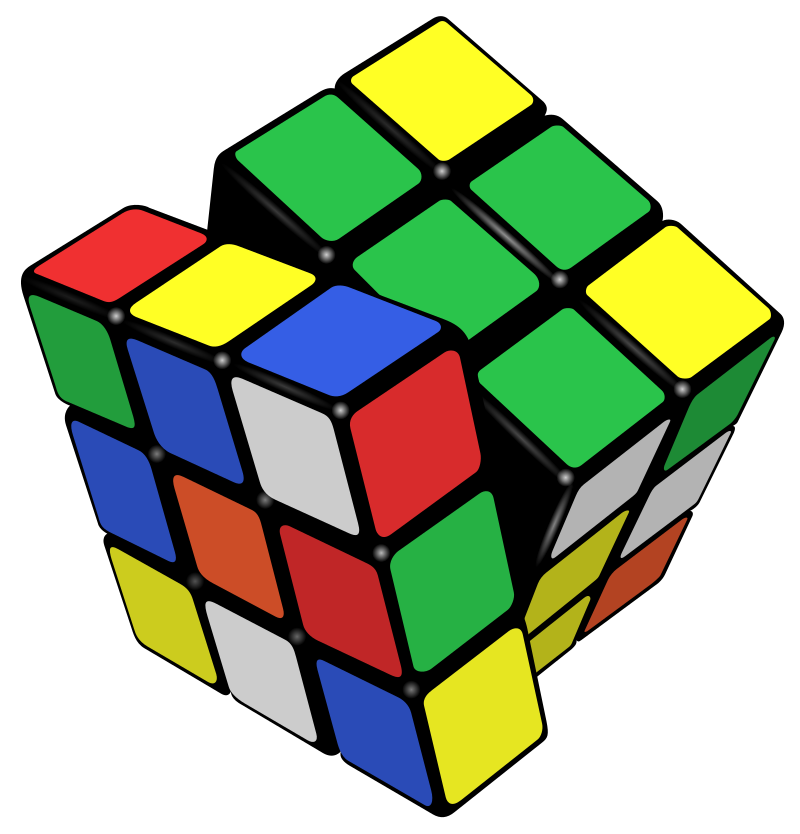
The manipulations of the Rubik's Cube form the Rubik's Cube group. In mathematics, a group is a set with an operation that combines any two elements of the set to produce a third element within the same set and the following conditions must hold: the operation is associative, it has an identity element, and every element of the set has an inverse element. For example, the integers with the addition operation form a group.
The concept of a group was elaborated for handling, in a unified way, many mathematical structures such as numbers, geometric shapes and polynomial roots. Because the concept of groups is ubiquitous in numerous areas both within and outside mathematics, some authors consider it as a central organizing principle of contemporary mathematics.
Excerpted from Wikipedia’s “group” article, available under the CC BY-SA 4.0 licence.
Gallery (12)
Available in 89 languages
- Español
- Français
- Deutsch
- 中文
- 日本語
- Русский
- Português
- Italiano
- العربية
- हिन्दी
- Afrikaans
- Armenian
- Bahasa Indonesia
- Bangla
- Bashkir
- Basque
- Belarusian
- Bulgarian
Show 70 more
- Catalan
- Central Kurdish
- Chuvash
- Croatian
- Czech
- Danish
- Esperanto
- Estonian
- Filipino
- Finnish
- Galician
- Georgian
- Greek
- Hebrew
- Hungarian
- Icelandic
- Ido
- Interlingua
- Irish
- Kabyle
- Kannada
- Kazakh
- Latin
- Latvian
- Lithuanian
- Lombard
- Luxembourgish
- Macedonian
- Malagasy
- Malay
- Malayalam
- Maltese
- Mongolian
- Nederlands
- Newari
- Northern Frisian
- Norwegian
- Norwegian Nynorsk
- Novial
- Occitan
- Piedmontese
- Polski
- Romanian
- Serbian
- Serbian (Latin)
- Sicilian
- Silesian
- simple
- Slovak
- Slovenian
- Svenska
- Tajik
- Tamil
- Tibetan
- Tiếng Việt
- Türkçe
- Ukrainian
- Urdu
- Volapük
- Welsh
- West Flemish
- Western Panjabi
- Wu Chinese
- Yiddish
- zh_classical
- zh_min_nan
- zh_yue
- فارسی
- ไทย
- 한국어
via Wikidata sitelinks · CC0