Category
page 1Talpidae

Talpidae
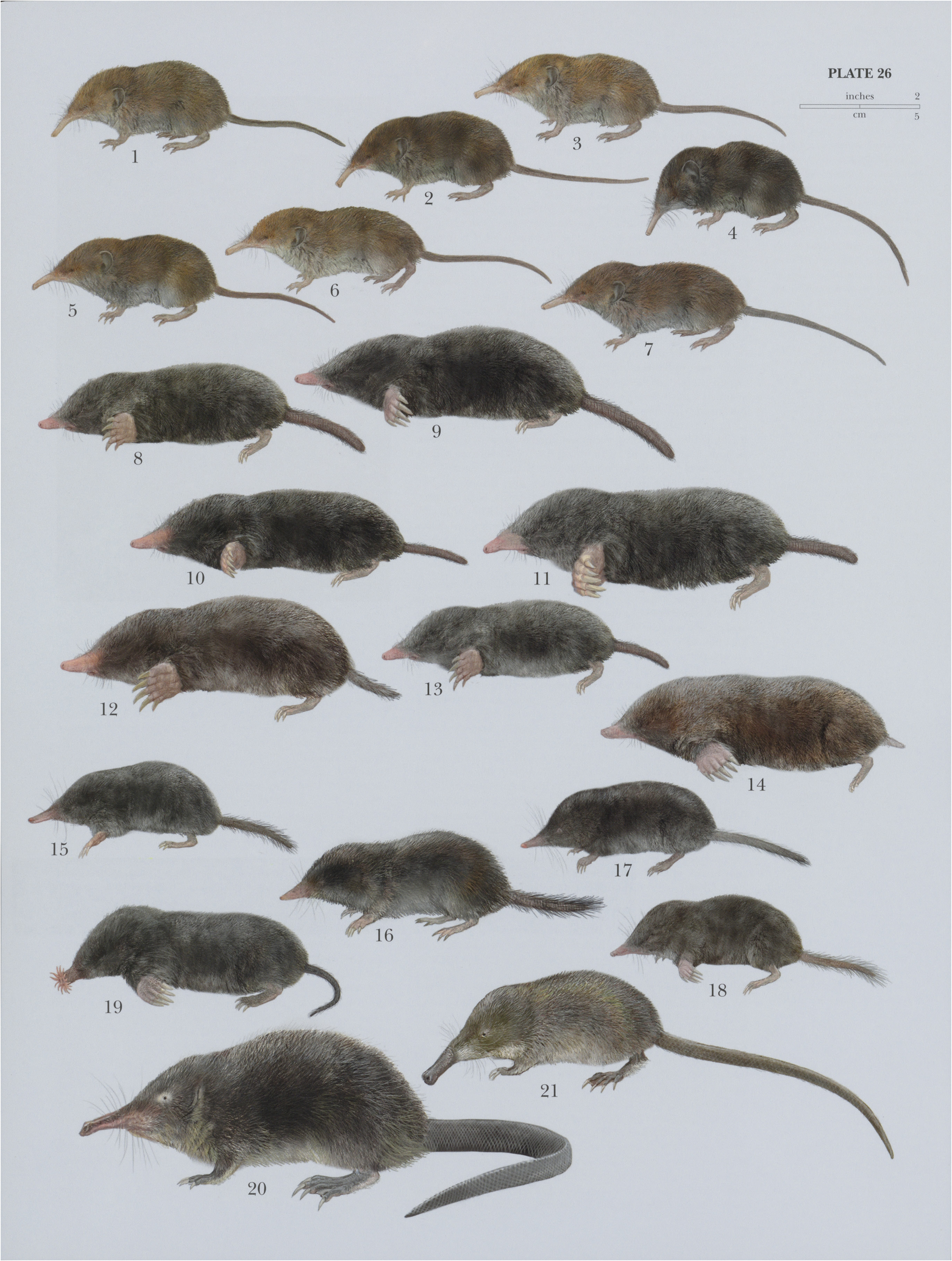
The family Talpidae () includes the true moles (as well as the shrew moles and desmans) who are small insectivorous mammals of the order Eulipotyphla. Talpids are all digging animals to various degrees: moles are completely subterranean animals; shrew moles and shrew-like moles somewhat less so; and desmans, while basically aquatic, excavate dry sleeping chambers; whilst the quite unique star-nosed mole is equally adept in the water and underground. Talpids are found across the Northern Hemisphere of Eurasia and North America (although none are found in Ireland nor in the Americas south of nor

Russian Desman
species of mammal of genus Desmana in the family Talpidae

mole
small underground mammal feeding on larvae and insects

Star-nosed mole
species of mammal

Pyrenean desman
species of mammal

Eastern mole
species of mammal

hairy-tailed mole
species of mammal

American Shrew Mole
species of mammal

white-tailed mole
species of mammal
Desman
Desmans are aquatic insectivores of the tribe Desmanini (also considered a subfamily, Desmaninae) in the mole family, Talpidae.

Long-tailed Mole
species of mammal
Scapanulus oweni
species of mammal

Scaptochirus moschatus
species of mammal

Japanese shrew mole
species of mammal
Euroscaptor mizura
species of mammal

True's Shrew Mole
species of mammal
Talpinae
The subfamily Talpinae, sometimes called "Old World moles" or "Old World moles and relatives", is one of three subfamilies of the mole family Talpidae, the others being the Scalopinae, or New World moles, and the Uropsilinae, or shrew-like moles.
Scalopinae
The Scalopinae, or New World moles, are one of three subfamilies of the family Talpidae, which consists of moles and mole-like animals; the other two subfamilies being the Old World talpids (the Talpinae) and the Chinese shrew-like moles (Uropsilinae). The Scalopinae are the only Talpidae subfamily to consist entirely of undisputed moles and no mole-like close relatives such as shrew-moles or desmans.

molehill
thumb|Several lines of molehills in the pasture.
thumb|Trail of Mole (animal)|mole pass of molehills at [[Kasori Shell Mound, Chiba city]]
A molehill (or mole-hill, mole mound) is a conical mound of loose soil raised by small burrowing mammals, including moles, but also similar animals such as mole-rats, and voles. The word is first recorded in the first half of the 15th century. Formerly, the hill was known as a 'wantitump', a word still in dialect use for centuries afterwards.
Talpini
Talpini is a tribe of mammals known as Old World moles. It is a division of the subfamily Talpinae.
Urotrichini
Urotrichini is a tribe of the mole family, and consists of Japanese and American shrew-moles. They belong to the Old World moles and relatives branch of the mole family (Talpidae). There are only two species, each of which represents its own genus. The name "shrew-moles" refers to their morphological resemblance to shrews, while generally being thought of as "true moles". The species are the Japanese shrew mole and True's shrew mole.
Urotrichus
Urotrichus is a genus of talpid that contains a single living species, the Japanese shrew mole (Urotrichus talpoides). Two fossil species (Urotrichus dolichochir and Urotrichus giganeus) are also known.
Neurotrichus
Neurotrichus is a genus of shrew-like moles. It is classified, together with the fossil genus Quyania, in the tribe Neurotrichini of the subfamily Talpinae. The only living species is the American shrew-mole (N. gibbsii) of the northwestern United States and British Columbia. A fossil species, Neurotrichus columbianus from the Hemphillian of Oregon, was placed in the genus in 1968, but this animal is now thought to be more closely related to the Chinese fossil genus Yanshuella.

Alpiscaptulus medogensis
species of mammals
Scalopini
The Scalopini are a tribe of moles belonging to the family Talpidae. They include all the New World moles apart from the strikingly distinctive star-nosed mole. As the similarity of the names implies, they are the standard form of the Scalopinae, the North American or New World moles, and can be found virtually anywhere north of Northern Mexico and south of Northern Canada where environmental factors (chiefly the presence of soil) permit.
Neurotrichini
Neurotrichini is a tribe within the subfamily Talpinae of the mole family. It includes the living genus Neurotrichus with a single living species, the American shrew-mole (Neurotrichus gibbsii). While today restricted to the New World, fossils are known from Eurasia.
Condylura
Condylura is a genus of moles that contains a single extant species, the star-nosed mole (Condylura cristata) endemic to the northern parts of North America. It is also the only living member of the tribe Condylurini.
Eimer's organ
type of organ
molecatcher
thumb|A captured mole
A molecatcher is a person who traps or kills moles in places where they are considered a nuisance to crops, lawns, sportsfields or gardens.