Category
page 1Tang dynasty
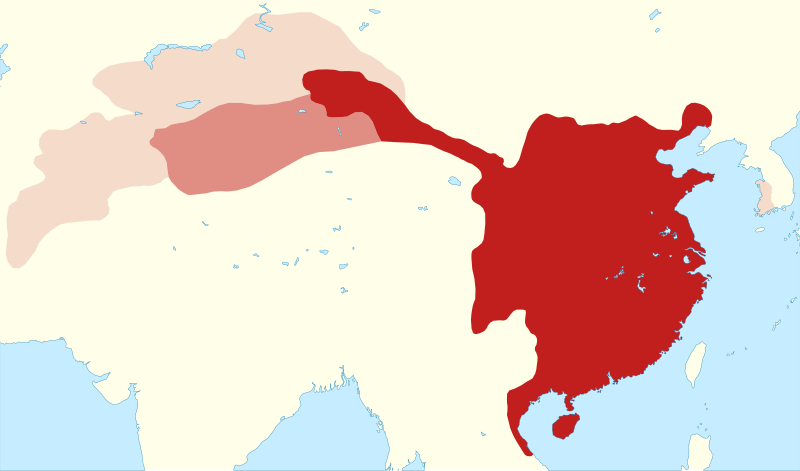
Tang dynasty
empire in the China proper between 618 and 907 AD

firework
thumb|Ritual devils and townspeople participate in a Correfoc (firerun) at the culmination of Festa Major 2012, in Vilanova i la Geltrú
Fireworks are low explosive pyrotechnic devices used for aesthetic and entertainment purposes. They are most commonly used in fireworks displays (also called a fireworks show or pyrotechnics), combining a large number of devices in an outdoor setting. Such displays are the focal point of many cultural and religious celebrations, though mismanagement can lead to fireworks accidents.

playing card
card used as one of a set for playing card games

Sogdia
Sogdia () or Sogdiana was an ancient Iranian civilization between the Amu Darya and the Syr Darya rivers, and in present-day Uzbekistan, Turkmenistan, Tajikistan, Kazakhstan, and Kyrgyzstan. Sogdiana was also a province of the Achaemenid Empire, and listed on the Behistun Inscription of Darius the Great. Sogdiana was first conquered by Cyrus the Great, the founder of the Achaemenid Empire, and then was annexed by the Macedonian ruler Alexander the Great in 328 BC. It would continue to change hands under the Seleucid Empire, the Greco-Bactrian Kingdom, the Kushan Empire, the Sasanian Empire, th

varnish
thumb|right|Varnish on wood stairs
thumb|Varnished oak floor

Chang'an
thumb|right|300px|que (tower)|Que towers along the walls of Tang-era Chang'an, as depicted in this mural from [[Li Chongrun's tomb at the Qianling Mausoleum in Shaanxi]]
Western Regions
referred to the regions west of Yumen Pass, most often Central Asia (e.g. Altishahr or the Tarim Basin in southern Xinjiang), ancient China (during the Han and Tang dynasties)
.png)
Tuyuhun
thumb|Rouran Khaganate, Tuyuhun, [[Yueban and Northern Wei]]
Tuyuhun (; LHC: *tʰɑʔ-jok-guən; Wade-Giles: ''T'u-yühun''), also known as Henan () and Azha (; ), was a dynastic monarchy established by the nomadic peoples related to the Xianbei in the Qilian Mountains and upper Yellow River valley, in modern Qinghai, China.
Jin deui
Chinese fried pastry
Hanlin Academy
Chinese university
Choe Chiwon
Silla Confucian & official, philosopher, and poet (857 ~ 908 ?)

Xueyantuo
The Xueyantuo or Sir Tardush were an ancient Turkic tribe from the Tiele confederation and a khaganate in Northeast Asia who were at one point vassals of the Göktürks, later aligning with the Tang dynasty against the Eastern Turkic Khaganate.
beef noodle soup
noodle soup with beef
Li Gao
Duke of Liang from 400 to 417

Huaqing Chi
hot springs complex near Xi'an, China
Sumpa
The Sumpa () were a tribe living in northeastern Tibet from ancient times. Chinese historical sources refer to them as "Qiang", a term for people living in what is now southwest China, and their actual ethnic identity is not known. Their territory was absorbed by the Tibetan Empire in the late 7th century, after which point they gradually lost their independent identity.
Lhasa Zhol Pillar
stone pillar dating to c 764 CE and inscribed with what may be the oldest known example of Tibetan writing
White Deer Grotto Academy
school building
Belitung shipwreck
Archaeological wreck of an Arabian dhow which sank around 830 AD
Tipao
type of publication in imperial China
Pei Xing
Tang dynasty writer
Niu-Li Factional Struggles
Confrontation in the Tang Dynasty
Fayan school
a Chinese Chan Buddhist sect, one of the Five Houses of Chán
Essentials of Government from Many Books
Chinese encyclopedia completed in 631

Zhang Gongjin
Tang dynasty person CBDB = 13751
Jigu Suanjing
The Ten Computational Canons
Chinese mathematics text collection
Cold-Food Powder
poisonous psychoactive drug

Sogdian Whirl dance
type of dance, the folk dance from the Western Regions of Tang Dynasty; clear and lively rhythm, accompanied by multi-rotating pedals
Huteng
thumb|Sogdian Huteng dancer, Xiuding temple pagoda, [[Anyang, Henan, China, Tang dynasty, 7th century.]]
Huteng (, also 胡腾舞, Húténgwǔ, "Dance of the Nomadic leap") was the Chinese term for a type of dance that originated in Central Asia, especially among the Sogdians and the region of Tashkent (石國, Shíguó). The dance was well known during the Tang dynasty, and there are numerous depictions of it in works of art. The dance was characterized by spinning, leaps and backflips. The dancers would particularly make somersaults, first planting their feet firmly on the carpet, tilting their face upward
Six Kingdoms
Yongtong Bridge
single-hole circular arch bridge in China
Zhang Zhuo
Tang dynasty person CBDB = 30975
Tōgaku
is the Japanese pronunciation of an early style of music and dance from the Tang dynasty in China. was introduced into Japanese culture from China no earlier than the 8th century, and is still performed as one style of the imperial court music called .
During the Nara period (710–794), music and dances continued to flow into the capital from many parts of Asia. Many styles were eventually organized under two basic categories of . The first, , consisted of pieces of Chinese and Indian origin, while included Manchurian, Korean, and many of the Japanese pieces. These two styles can be distinguish