Category
page 1Taxa described in 1804

Pithecia
genus of mammals
Pyrosoma
Pyrosoma is a genus of pyrosomes, marine colonial tunicates in the class Thaliacea. It contains four pelagic species found in temperate waters worldwide. Pyrosomes are filter feeders that uniquely use a type of continuous jet propulsion, generated by individual zooids, to slowly move forward while grazing; the species P. atlanticum has the highest known food clearance rate among zooplankton grazers. Colonies can reach lengths of up to . *Pyrosoma atlanticum* has special light organs that contain glowing bacteria (*Photobacterium* sp.), and these bacteria make the colony glow blue-green in the
Trypethelium
Trypethelium is a genus of lichenized fungi in the family Trypetheliaceae. The widespread genus contains about 50 species predominantly found in tropical areas. Trypethelium was circumscribed by German botanist Kurt Polycarp Joachim Sprengel in 1804.
Coscinodon
Coscinodon is a genus of mosses belonging to the family Grimmiaceae.
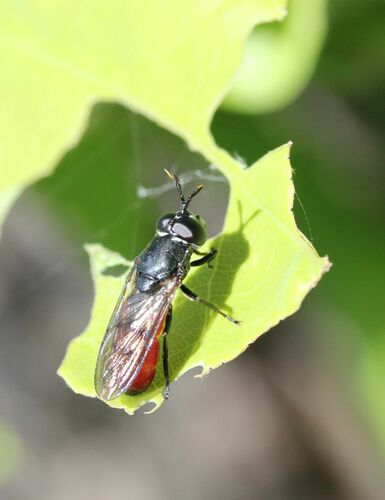
Psarus abdominalis
Psarus is a monotypic genus of hoverfly endemic to Europe. Its only species, Psarus abdominalis is 8.5–10 mm long. The body and head are glossy black. The frons has a distinct tubercle. The elongate antennae are porrect, with the arista on the apical half of the third segment. The abdominal tergites are extensively orange. Psarus abdominalis occurs from France in the west to European Russia in the east, and from the Baltic in the north to Greece in the south. It is now locally extinct and threatened. The habitat of the species is forest landscape and mixed agricultural landscape (bocage).