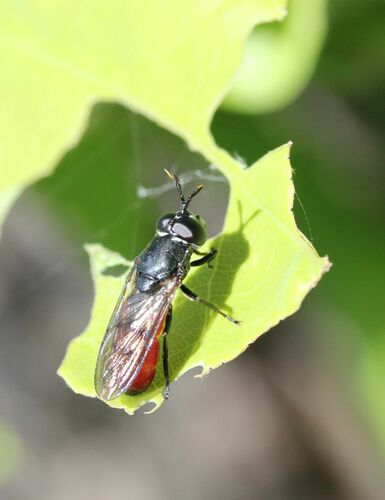
(c) Соколков Юрий Павлович, some rights reserved (CC BY-NC), uploaded by Соколков Юрий Павлович · cc-by-nc
Psarus abdominalis
Sign in to savePsarus is a monotypic genus of hoverfly endemic to Europe. Its only species, Psarus abdominalis is 8.5–10 mm long. The body and head are glossy black. The frons has a distinct tubercle. The elongate antennae are porrect, with the arista on the apical half of the third segment. The abdominal tergites are extensively orange. Psarus abdominalis occurs from France in the west to European Russia in the east, and from the Baltic in the north to Greece in the south. It is now locally extinct and threatened. The habitat of the species is forest landscape and mixed agricultural landscape (bocage).
Species
SPECIES
- KingdomAnimalia
- PhylumArthropoda
- ClassInsecta
- OrderDiptera
- FamilySyrphidae
via GBIF
Museum specimens
- Specimen records
- 10
- With media
- 12
- Family
- Syrphidae
- Collections
- RBINS-SCIENTIFIC HERITAGE, MNHN, MZLU
- Recorded in
- Allemagne, Sweden
Wikidata facts
- Instance of
- taxon
Show 5 more facts
- taxon rank
- species
- taxon name
- Psarus abdominalis
- taxon common name
- Vermiljoenzweefvlieg
- diel cycle
- diurnality
- short name
- P. abdominalis
Sources (3)
via Wikidata · CC0
~1 min read
Encyclopedic overview
2 sectionsContents
- External links
- References
Psarus is a monotypic genus of hoverfly endemic to Europe. Its only species, Psarus abdominalis is 8.5–10 mm long. The body and head are glossy black. The frons has a distinct tubercle. The elongate antennae are porrect, with the arista on the apical half of the third segment. The abdominal tergites are extensively orange. Psarus abdominalis occurs from France in the west to European Russia in the east, and from the Baltic in the north to Greece in the south. It is now locally extinct and threatened. The habitat of the species is forest landscape and mixed agricultural landscape (bocage). Image:EuropäischenZweiflügeligen1790TafLXXI.jpg |another Meigen illustration (figure 1) the remaining illustrations are of Paragus species File:FloraRome (34).JPG |Habitat Parco della Caffarella, Rome File:PsarusMNHN.jpg |syntype
==External links== Ukraine Biodiversity image
Excerpted from Wikipedia’s “Psarus abdominalis” article, available under the CC BY-SA 4.0 licence.
Gallery (2)
Available in 7 languages
via Wikidata sitelinks · CC0