Category
page 1Taxa described in 1926
Cantharellales
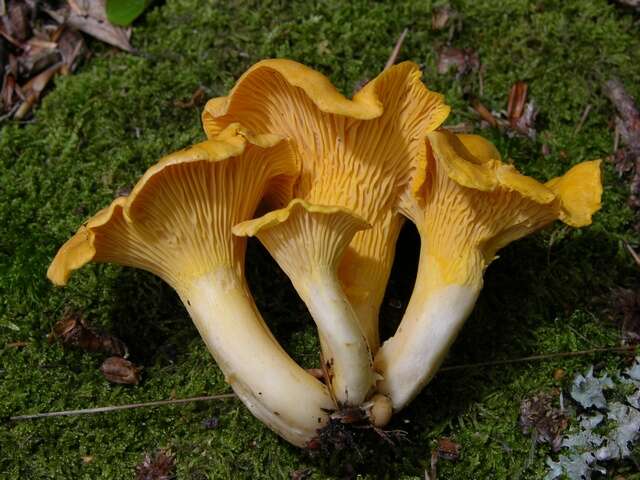
The Cantharellales are an order of fungi in the class Agaricomycetes. The order includes not only the chanterelles (Cantharellaceae), but also some of the tooth fungi (Hydnaceae), clavarioid fungi (Aphelariaceae and Clavulinaceae), and corticioid fungi (Botryobasidiaceae). Species within the order are variously ectomycorrhizal, saprotrophic, associated with orchids, or facultative plant pathogens. Those of economic importance include edible and commercially collected Cantharellus, Craterellus, and Hydnum species as well as crop pathogens in the genera Ceratobasidium and Thanatephorus/Rhizocton
Rhodocybe
Rhodocybe is a genus of fungi in the family Entolomataceae. Basidiocarps (fruit bodies) are agaricoid (gilled mushrooms) producing pink basidiospores that are unevenly roughened or pustular under the microscope. Species are saprotrophic and mostly grow on the ground, occasionally on wood. The genus is distributed worldwide.
Trogoniformes
REDIRECT Trogon
Sthenurinae
Sthenurinae (from Sthenurus, Greek for 'strong-tailed') is a subfamily within the marsupial family Macropodidae, known as short-faced kangaroos or sthenurine kangaroos. No members of this subfamily are extant today, with all becoming extinct by the late Pleistocene. Procoptodon goliah, the largest macropodid known to have existed, was a sthenurine kangaroo, but sthenurines occurred in a range of sizes, with Procoptodon gilli being the smallest at the size of a small wallaby.
Coryneliales
The Coryneliales are an order of ascomycetous fungi within the monotypic subclass Coryneliomycetidae in the class Eurotiomycetes and within the subdivision Pezizomycotina. Species in this order are found almost exclusively in the tropics, primarily as a pathogen on the gymnosperm Podocarpus, although it has been found on other plants like the Southern Hemisphere beech Nothofagus, and Drimys.
Xanthopyreniaceae
The Xanthopyreniaceae are a family of lichen-forming fungi in the order Collemopsidiales. Members of this family are found worldwide on rocks in various climates, from temperate to polar regions, where they form inconspicuous crusty growths or live hidden within the rock surface. Where lichenised, species partner with cyanobacteria, and several lineages are parasitic (lichenicolous) on other lichens. The family is characterized by small, dark fruiting bodies that release spores through a single opening at the top.
Marblepsis
Marblepsis is a genus of moths in the subfamily Lymantriinae. The genus was described by Hering in 1926.
Mayorella
Mayorella is a genus of small amoeboid protists in the phylum Amoebozoa. The genus consists of amoebae that exhibit pseudopodia and feed on a variety of organisms through phagocytosis, making them an important group in microbial ecology across most environments worldwide. Mayorella species have been found in soil, freshwater and marine environments.
Cystobasidiaceae
The Cystobasidiaceae are a family of fungi in the order Cystobasidiales. The family currently comprises two genera, both of which contain fungal parasites with auricularioid (laterally septate) basidia, some of which are known only from their yeast states.
Tomapoderus
Tomapoderus is a genus in the family Attelabidae, the leaf-rolling weevils. Species in this genus are native to China and South Korea. They have also been found in India, Thailand, and Russia.
Afreumenes
thumb|226px|An Afreumenes potter wasp building a nest
Paratomapoderus
Paratomapoderus is a genus in the family Attelabidae, the leaf rolling weevils. Species in this genus are native to Africa.
Aaages
Aaages is a genus of beetle in the family Coccinellidae (ladybird beetles, or ladybugs). There is only one species in this genus, Aaages prior, which has frequently been misspelled in the subsequent literature.
Diploschistella
Diploschistella is a genus of fungi in the family Gomphillaceae.
Acalyphes
Acalyphes is a monotypic moth genus in the family Geometridae. Its single species, Acalyphes philorites, is found in Australia, where it feeds on pencil pine (Athrotaxis cupressoides). Both the genus and species were first described by Alfred Jefferis Turner in 1926
Acanthodillo
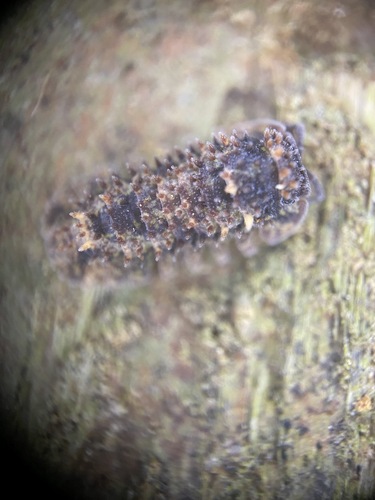
Acanthodillo is a genus of woodlice belonging to the family Armadillidae. This genus was described in 1926 by Karl Wilhelm Verhoeff. The type specimen for this species is Acanthodillo erinaceus from New Caledonia. , the genus contains 10 accepted species.
Toniniopsis
Toniniopsis is a genus of crustose and squamulose lichens in the family Ramalinaceae. The genus was circumscribed by Swiss lichenologist Eduard Frey in 1926, with Toniniopsis obscura designated the type and only species. The genus name of Toniniopsis is in honour of Carlo Tonini (1803–1877), who was an Italian chemist and botanist (Lichenology), who worked in Verona and was a member and President of the Academy of Agriculture.
As a result of molecular phylogenetic studies, several species, formerly classified in genus Bacidia, have been transferred to Toniniopsis.
Stirtonia
genus of fungi
Bollmaniulus
Bollmaniulus is a genus of millipede in the family Parajulidae.
Agiton idioptila
Agiton is a monotypic moth genus in the family Epermeniidae. Its sole species, Agiton idioptila, is found in Australia, where it has been recorded from Queensland. Both the genus and species were first described by Alfred Jefferis Turner in 1926.
Halochroa
Halochroa is a genus of moths of the family Erebidae. The genus was erected by George Hampson in 1926.