Category
page 1Taxa described in 1964
Plicaturopsis
Plicaturopsis is a genus of fungi in the family Amylocorticiaceae. The genus was circumscribed by English mycologist Derek Reid in 1964. In 2023 P. scarlatina was reclassified to Phlebia making P. crispa the only described species in the genus.
Parmastomyces
Parmastomyces is a genus of fungi in the family Fomitopsidaceae. The genus was circumscribed by Czech mycologists František Kotlaba and Zdenek Pouzar in 1964, with Tyromyces kravtzevianus Bondartzev & Parm. as the type species. Parmastomyces species cause a brown rot. The genus has a monomitic hyphal system.
Nanodacna
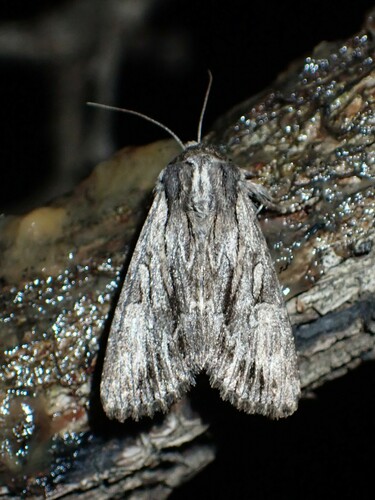
Nanodacna is a genus of moths in the family Elachistidae.
Metatrichia
genus of slime molds
Amazonomyces
Amazonomyces is a lichenized genus of fungi in the family Arthoniaceae.
The genus contains 3 species:
Amazonomyces farkasiae (Lücking) Lücking, Sérus. & G. Thor, 1998
Amazonomyces palmae Bat. & Cavalc., 1963
Amazonomyces sprucei (R. Sant.) Lücking, Sérus. & G. Thor, 1998

Rhinopetitia
Rhinopetitia is a genus of freshwater ray-finned fish, characins, belonging to the family Stevardiidae. The fishes in this genus are endemic to Brazil.
Relicina
Relicina is a genus of foliose lichens belonging to the large family Parmeliaceae. Established as a genus in 1974 after initially being treated as a series within Parmelia, Relicina now encompasses about 40 species worldwide. These lichens typically grow as yellow-green, leaf-like patches with flat fringed by short black hairs, attaching to their substrate by a swollen base. The genus is characterized chemically by the presence of usnic acid and various other lichen products, and is distinguished from related groups by details of ascospore structure and surface features.
Rachelia
genus of insects
Nothomitra
Nothomitra is a genus of fungi in the earth tongue family Geoglossaceae. There is no known common name. Nothomitra is morphologically distinguished from Microglossum in that the fertile hymenium in Nothomitra is not flattened as in Microglossum. Furthermore, the hymenium in Nothomitra is distinctly free at the junction of the stipe, unlike in Microglossum in which the hymenium is flattened and gradually intergrades with the stipe.
Cardiobacterium
Cardiobacterium is a genus of bacteria in the family Cardiobacteriaceae. These Gram-negative bacillus (rod-shaped) bacteria are commonly grouped with other bacteria into the HACEK group.
Pyrofomes
Pyrofomes is a genus of fungi in the family Polyporaceae. The genus was circumscribed by Czech mycologists František Kotlaba and Zdenek Pouzar in 1964. The type species, Pyrofomes demidoffii, was once considered a widespread species with a distribution that included East Africa, Middle Asia, Europe, and North America. DNA evidence demonstrated that North American collections represented a lineage that was different than European collections. The North American sibling was reinstated as P. juniperinus in 2017.
Septobasidiales
REDIRECT Septobasidiaceae
Mycomedusiospora flavida
Mycomedusiospora is a fungal genus in the Sordariomycetes class (subclass Sordariomycetidae) of the Ascomycota. The relationship of this taxon to other taxa within the class is unknown (incertae sedis), and it has not yet been placed with certainty into any order or family. This is a monotypic genus, containing the single species Mycomedusiospora flavida.
Sexanymphon
Sexanymphon is a monotypic genus of sea spider (class Pycnogonida) in the family Nymphonidae. The only species in this genus is Sexanymphon mirabilis. As the name of this genus implies, sea spiders in this genus feature six pairs of legs in adults instead of the usual four leg pairs. The species S. mirabilis is notable as one of only two species of sea spiders with six leg pairs. This species is found in the Southern Ocean.