Category
page 1Taxa described in 1980

fungi
A fungus (: fungi or funguses) is any member of the group of eukaryotic organisms that includes yeast and mold as well as the mushroom. These organisms are classified in the biological kingdom Fungi.

Basidiomycota
The Basidiomycota () are one of two large divisions that, together with the Ascomycota, constitute the subkingdom Dikarya (often referred to as the "higher fungi") within the kingdom Fungi. Members are known as basidiomycetes. This division includes: agarics, puffballs, stinkhorns, bracket fungi, other polypores, jelly fungi, boletes, chanterelles, earth stars, smuts, bunts, rusts, mirror yeasts, and Cryptococcus, the human pathogenic yeast.
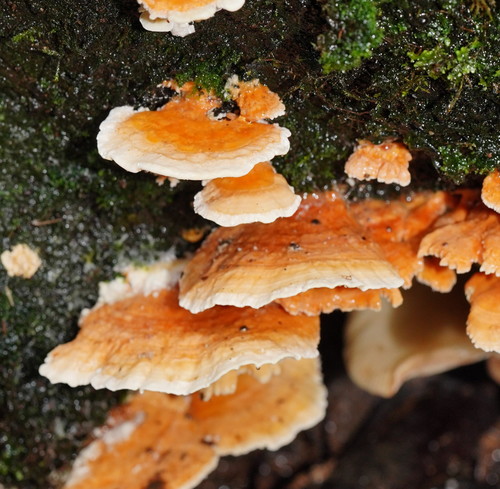
Antrodiella
Antrodiella is a genus of fungi in the family Steccherinaceae of the order Polyporales.
Hygrophoropsidaceae
The Hygrophoropsidaceae are a family of mushrooms that are gilled in appearance but lie within the Boletales. The family contains 18 species within two genera: Leucogyrophana and Hygrophoropsis, with the best-known member being the "false chanterelle", Hygrophoropsis aurantiaca. Hygrophoropsidaceae was circumscribed by French mycologist Robert Kühner in 1980, with Hygrophoropsis as the type genus. Unlike most members of the Boletales, Hygrophoropsidaceae species are saprophytic wood-rotting fungi that cause brown rot in their hosts. The genera Austropaxillus and Tapinella, once placed in this

Petrosiidae
Petrosiidae is a family of sponges, first described in 1980 by Rob van Soest which contains the following four genera:
Acanthostrongylophora Hooper, 1984
Neopetrosia de Laubenfels, 1949
Petrosia Vosmaer, 1885
Xestospongia de Laubenfels, 1932
Paraembolides
Paraembolides is a genus of Australian funnel-web spiders that was first described by Robert John Raven in 1980.

Niphatidae
Niphatidae is a family of demosponges in the order Haplosclerida, first described in 1980 by Rob van Soest. It contains the following genera:
Amphimedon Duchassaing & Michelotti, 1864
Cribrochalina Schmidt, 1870
Dasychalina Ridley & Dendy, 1886
Gelliodes Ridley, 1884
Haliclonissa Burton, 1932
Hemigellius Burton, 1932
Microxina Topsent, 1916
Niphates Duchassaing & Michelotti, 1864
Pachychalina Schmidt, 1868
Trapeliopsis
Trapeliopsis is a genus of lichen-forming fungi in the family Trapeliaceae. These lichens form thin, granular crusts or tiny overlapping scales () that create miniature rosette patterns on their growing surface. The genus was established in 1980 by Hannes Hertel and Gotthard Schneider and includes about 20 species found worldwide.
Xerotrema
Xerotrema is a small genus of fungi in the family Odontotremataceae. It comprises two species. The genus was circumscribed by Martha Allen Sherwood and Brian John Coppins in 1980. The type species, Xerotrema megalospora, is found in the United States and Canada. X. quercicola was added to the genus in 2008. These fungi produce tiny, deeply cup-shaped fruiting bodies on weathered, barkless wood of conifers and hardwoods in temperate regions. While the genus was originally thought to be non-lichenized, at least one species appears to form facultative partnerships with green algae, meaning i
Herteliana
Herteliana is a genus of lichen-forming fungi. It contains four species of crustose lichens.
Pseudoroegneria
Pseudoroegneria is a genus of grasses. It includes 16 species native to temperate and subarctic Eurasia, from Ukraine, Finland, and Greece to Pakistan, Siberia, and northern China, as well as northwestern Africa (Morocco and Algeria) and western North America (Alaska to northeastern Mexico).
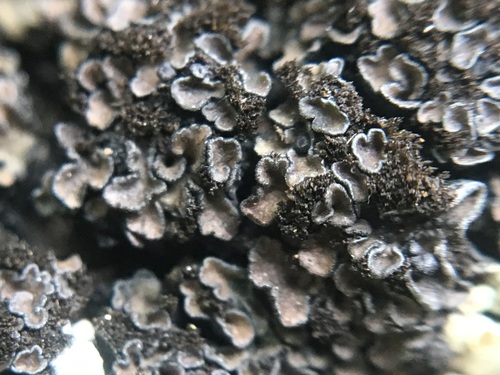
Psorula
Psorula is a fungal genus in the family Psoraceae. It is a monotypic genus, containing the single lichen species Psorula rufonigra. The genus was circumscribed by German lichenologist Gotthard Schneider in 1980.
Varitentacula yantaiensis
Varitentacula yantaiensis is a species of deep sea hydrozoan of the family Halicreatidae. It is the only species in the monotypic genus Varitentacula.
Eremoblastus
Eremoblastus is a genus of flowering plants belonging to the family Brassicaceae. It includes a single species, Eremoblastus caspicus, an annual native to Kazakhstan.
Cladophialophora
Cladophialophora is a genus of fungi in the family Herpotrichiellaceae. It has 35 species. The genus contains black yeast-like fungi, some of which are species of important medical significance. Cladophialophora bantiana causes the rare brain disease cerebral phaeohyphomycosis. Cladophialophora carrionii is a common cause of chromoblastomycosis in semi-arid climates. Some of the species are endophytes–associating with plants. For example, Cladophialophora yegresii is a cactus endophyte, which is sometimes introduced into humans via cactus spines.
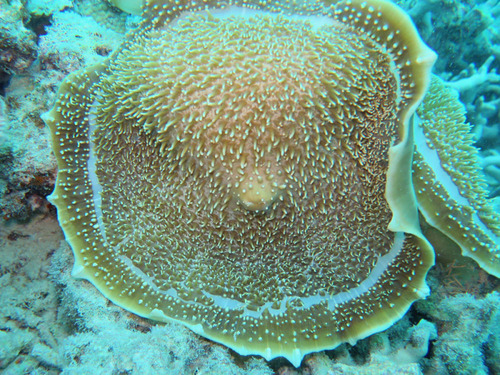
Amplexidiscus
Amplexidiscus fenestrafer, also known as the elephant ear anemone, is a species of coral belonging to the phylum Cnidaria. The name "elephant ear anemone" is a misnomer because it is actually a species of coral. It is the only species in the monotypic genus Amplexidiscus.
Cetrariopsis
Cetrariopsis is a genus of foliose lichens in the large family Parmeliaceae. The genus contains three species, including the type, Cetrariopsis wallichiana.
Kairothamnus
Kairothamnus is a genus of plants under the family Picrodendraceae described as a genus in 1980. The only known species is Kairothamnus phyllanthoides, endemic to Morobe Province in Papua New Guinea.
Esslingeriana
Esslingeriana is a fungal genus in the family Parmeliaceae. The genus is monotypic, containing the single foliose lichen species Esslingeriana idahoensis, commonly known as the tinted rag lichen. It is found in northwestern North America.
Sparsitubus
Sparsitubus is a fungal genus in the family Polyporaceae. It is a monotypic genus, containing the single species Sparsitubus nelumbiformis, found in Hainan and Yunnan, China. Molecular analysis suggests that Sparsitubus is in a clade of white rot polypores and may be closely related to the Ganodermataceae.
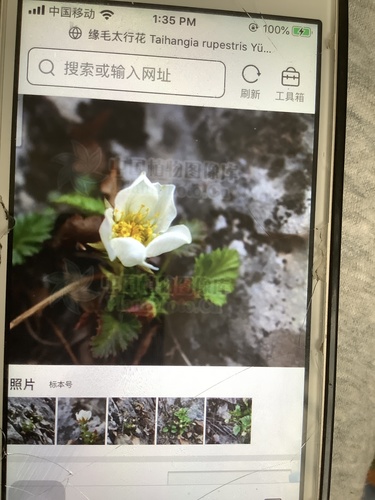
Taihangia
Taihangia is a genus of flowering plants in the family Rosaceae. It includes a single species, Taihangia rupestris, a perennial native to Hebei and northern Henan provinces in central China.
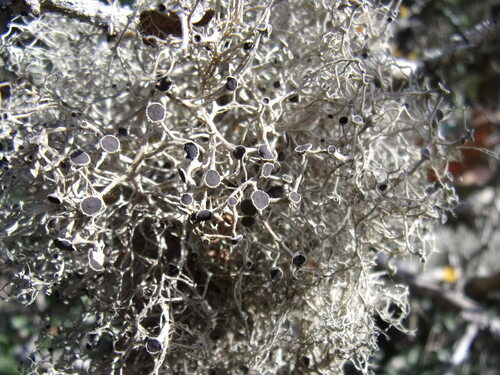
Tornabea
Tornabea is a monotypic genus of lichenized fungi in the family Physciaceae.
It only contains the one accepted species, Tornabea scutellifera
Navisporus
Navisporus is a genus of seven species of tropical poroid fungi in the family Polyporaceae. It was circumscribed by Norwegian mycologist Leif Ryvarden in 1980 with Navisporus floccosus as the type species. This fungus, first described as Trametes floccosa by Giacomo Bresadola in 1896, is thought to have been originally collected in Tanzania.
Karsteniomyces
Karsteniomyces is a genus of lichenicolous fungi of unknown familial, ordinal, and class placement in the Ascomycota. The genus was circumscribed by David Leslie Hawksworth in 1980. The species of this genus are found in Europe.
Thamnogalla
Thamnogalla is a fungal genus in the family Cordieritidaceae. It is a monotypic genus, containing the single lichenicolous species Thamnogalla crombii, found in Europe and North America. The genus was circumscribed in 1980 by David Leslie Hawksworth. The type species was originally described as Endocarpon crombiei by amateur botanist and collector William Mudd.
Psorinia
Psorinia is a genus of fungi in the family Lecanoraceae.