Category
page 1Taxa described in 1986

Archosauriformes
Archosauriformes (Greek for 'ruling lizards', and Latin for 'form') is a clade of diapsid reptiles encompassing archosaurs and some of their close relatives. It was defined by Jacques Gauthier (1994) as the clade stemming from the last common ancestor of Proterosuchidae and Archosauria. Phil Senter (2005) defined it as the most exclusive clade containing Proterosuchus and Archosauria. Gauthier as part of the Phylonyms (2020) defined the clade as the last common ancestor of Gallus, Alligator, and Proterosuchus, and all its descendants. Archosauriforms are a branch of archosauromorphs which orig
Teloschistales
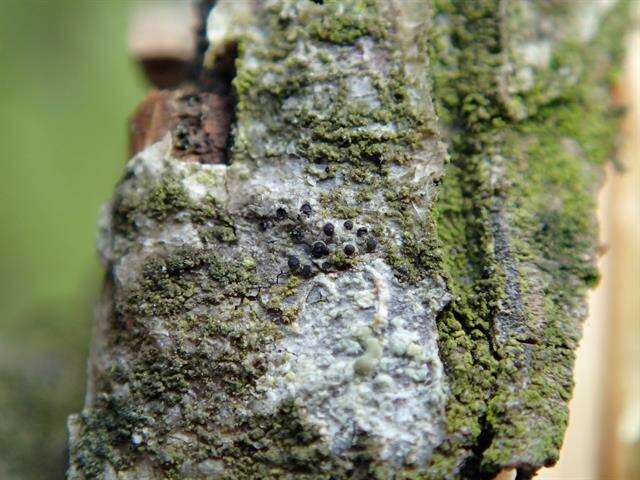
The Teloschistales are an order of mostly lichen-forming fungi belonging to the class Lecanoromycetes in the division Ascomycota. According to one 2008 estimate, the order contains 5 families, 66 genera, and 1954 species. The predominant photobiont partners for the Teloschistales are green algae from the genera Trebouxia and Asterochloris.
.jpg)
Arthoniales
The Arthoniales is the second largest order of mainly crustose lichens, but fruticose lichens are present as well. The order contains around 1500 species, while the largest order with lichenized fungi, the Lecanorales, contains more than 14000 species.

Pertusariales
The Pertusariales are an order of fungi in the class Lecanoromycetes, comprising 8 families, 31 genera, and over 600 species, many of which form lichens. This diverse group is characterized by complex taxonomic history and ongoing phylogenetic revisions. Originally proposed by Maurice Choisy in 1949 and later formally published by the lichenologists David L. Hawksworth and Ove Eriksson in 1986, Pertusariales has undergone significant reclassification due to molecular phylogenetics studies. The order includes well-known genera such as Pertusaria and Ochrolechia, as well as families like Megaspo
Verrucariales
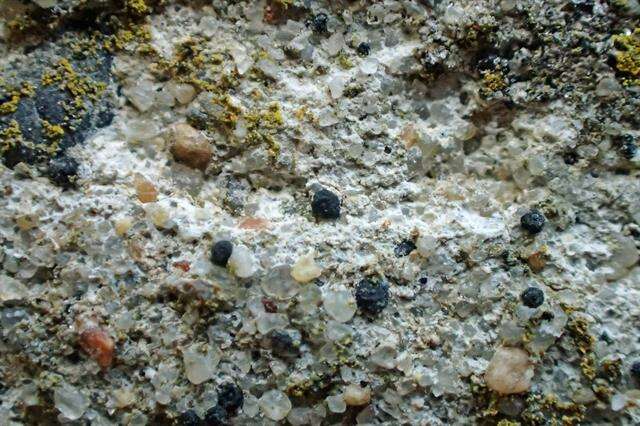
Verrucariales is an order of ascomycetous fungi within the subclass Chaetothyriomycetidae of the class Eurotiomycetes. Although most of the Verrucariales are lichenised, the family Sarcopyreniaceae consists of 11 species of lichenicolous (lichen-dwelling) fungi.
Lichinales
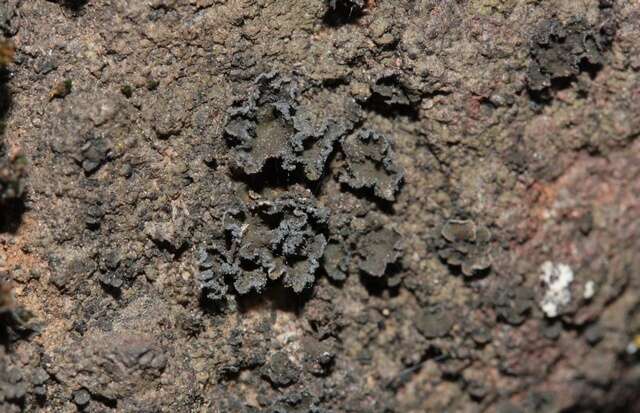
Lichinales is the sole order of ascomycete fungi in the class Lichinomycetes. It contains three families: Gloeoheppiaceae (3 genera), Lichinaceae (43 genera), and Peltulaceae (1 genus). Most species are lichenized. Lichinales was proposed in 1986 by German lichenologists Aino Henssen and Burkhard Büdel. The class Lichinomycetes was created by Valérie Reeb, François Lutzoni and Claude Roux in 2004.

Pyrenulales
The Pyrenulales are an order of ascomycetous fungi within the class Eurotiomycetes and within the subphylum Pezizomycotina.
.jpg)
Flavoparmelia
Flavoparmelia is a genus of foliose lichens in the family Parmeliaceae. Because of their appearance, they are commonly known as greenshield lichens. The widely distributed genus contains about 40 species.
Garcibarrigoa
Garcibarrigoa is a genus of South American flowering plants in the daisy family.
Haloferax
Haloferax (common abbreviation: Hfx.) is a genus of halobacteria in the order Haloferacaceae.
Macrostomorpha
Macrostomorpha is a clade of free living flatworms in the group Rhabditophora.

Fellhanera
Fellhanera is a genus of mostly leaf-dwelling lichens in the family Ectolechiaceae. Established by the lichenologist Antonín Vězda in 1986 and named in honour of the Austrian lichenologist Josef Hafellner, the genus comprises 69 accepted species as of 2026. These small lichens form powdery, crust-like growths that adhere tightly to their substrate without developing a true protective skin (a ), and they produce distinctive chemical compounds including roccellic acid and zeorin that help distinguish them from similar-looking genera.
Arctoparmelia
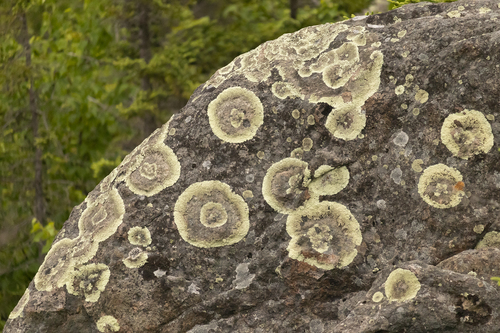
Arctoparmelia is a genus of foliose lichens in the family Parmeliaceae. Established in 1986, the genus comprises five species of rock-dwelling lichens found primarily in arctic and boreal regions of the Northern Hemisphere. These lichens are characterized by their distinctive velvety or ivory-white to pale brown lower surfaces, concentric growth patterns, and unique chemistry, including the presence of alectoronic acid and negative reactions to iodine-based tests. Arctoparmelia species, commonly known as ring lichens, vary in size from small thalli to specimens up to in diameter, and typically
Coccocarpiaceae
The Coccocarpiaceae are a family of lichen-forming in the order Peltigerales. There are three genera and about 60 species in the family. Species in this family have a widespread distribution, including boreal and austral regions.
Lahmiales
REDIRECT Lahmia
Gloeocorticium cinerascens
Gloeocorticium is a genus of fungi in the Cyphellaceae family. The genus is monotypic, containing the single species Gloeocorticium cinerascens, found in Argentina.

Physciella
Physciella is a genus of lichen-forming fungi in the family Physciaceae. Circumscribed by the lichenologist Ted Esslinger in 1986, it is distinguished from the similar genera Physcia and Phaeophyscia by its (comprising long, narrow, wavy, parallel hyphae) lower cortex, the lack of the secondary metabolite (lichen product) atranorin in the upper cortex, and short, ellipsoid-shaped conidia.
Lichenotheliaceae
The Lichenotheliaceae are a family of fungi, and the only family in the order Lichenotheliales, which is in the class Dothideomycetes. The family contains three genera.
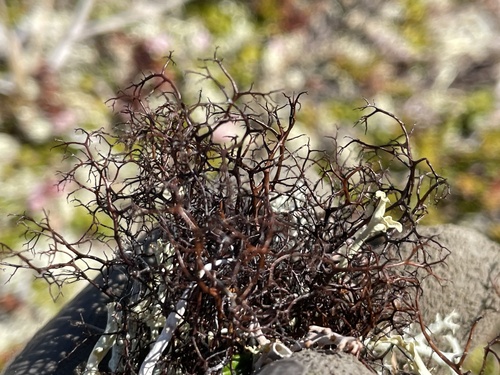
Bryocaulon
Bryocaulon is a small genus of lichen-forming fungi in the family Parmeliaceae. The genus has a widespread distribution in north temperate regions, and contains four species. These lichens form shrub-like tufts with cylindrical branches that are covered in tiny white pores for gas exchange. They are found mainly in cold regions of the Northern Hemisphere, particularly in arctic and mountainous areas where they grow on acidic bark and rocks.
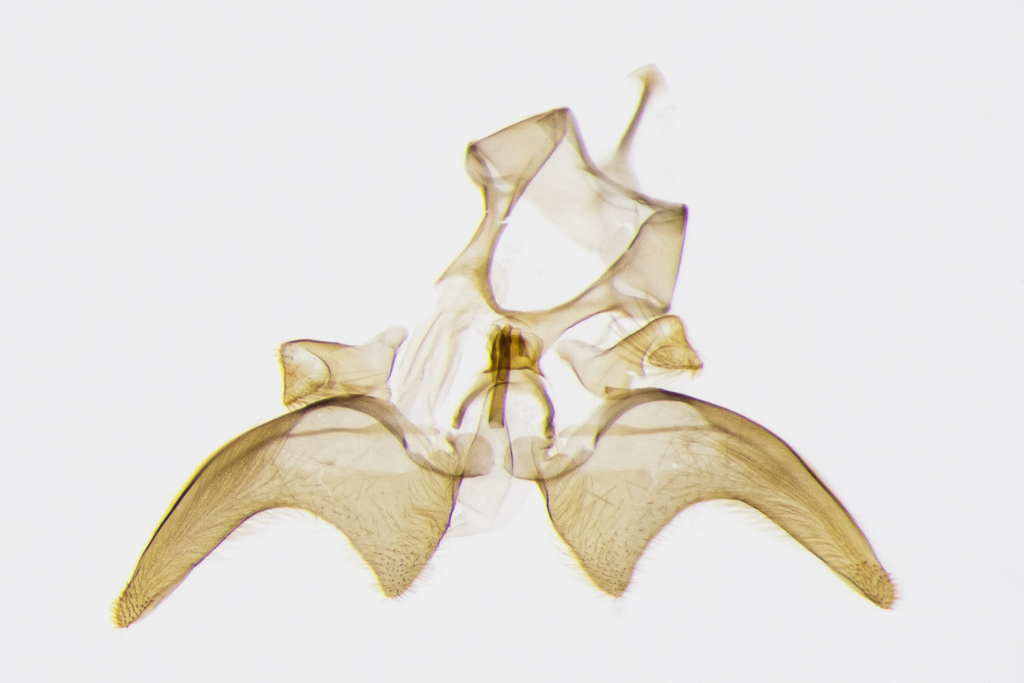
Karsholtia marianii
Karsholtia is a genus of moths of the family Tineidae. The genus contains the single species Karsholtia marianii. It is found in Norway, Sweden, Denmark, Germany, Austria, France and on Sicily.
Levinella
Levinella is a genus of sponges belonging to the family Levinellidae.

Canoparmelia
Canoparmelia is a genus of lichen-forming fungi in the family Parmeliaceae. The widespread genus contains about 35 species. Canoparmelia, a segregate of the parmelioid lichen genus Pseudoparmelia, was circumscribed by John Elix and Mason Hale in 1986.
Peltulaceae
REDIRECT Peltula
Requienellaceae
The Requienellaceae are a family of ascomycete fungi in the order Xylariales. Members of the family occur on bark, wood, and sometimes lichens. The family was originally proposed for fungi thought to be allied with the Pyrenulales, but molecular phylogenetic studies later showed that its type genus, Requienella, belongs in Xylariales.
Cheiromycina
Cheiromycina is a genus of lichen-forming fungi belonging to the family Malmideaceae.
Gyalectales
Gyalectales is an order of lichen-forming fungi in the class Lecanoromycetes. It contains 5 families, 18 genera and about 550 species.

Calopadia
Calopadia is a genus of foliicolous (leaf-dwelling) lichens in the family Ectolechiaceae. The genus was established by the Czech lichenologist Antonín Vězda in 1986 and contains around 24 species found primarily in tropical regions. These lichens form thin, pale brownish to greyish crusts on leaf surfaces and produce small brown disc-shaped fruiting bodies. They are distinguished from similar genera by their non-black fruiting structures and characteristic curved or coiled asexual spores. The genus has its greatest diversity in the Neotropics, though species have also been recorded from tropic
Myelorrhiza
Myelorrhiza is a genus of two Australian species of lichen-forming fungi in the family Ramalinaceae. These lichens form leaf-like growths with narrow, overlapping lobes that attach to their substrate using root-like strands called rhizines. They are found in tropical rainforests of northern Queensland, where they grow on tree bark and rocks. The genus was initially thought to belong to the family Cladoniaceae, but molecular studies placed it outside Cladoniaceae and aligned it with ramalinoid lineages; it is now treated in Ramalinaceae.
Amphisphaeriales
The Amphisphaeriales are an order of fungi within the class Sordariomycetes and subclass Xylariomycetidae.
Megabraula
Megabraula is a fly genus in the family Braulidae. These are very unusual flies, wingless and flattened, and barely recognizable as Diptera. Megabraula is found in Nepal and is 3 mm in length. Both species are found in the nests of Apis laboriosa

Ahtiana
Ahtiana is a fungal genus in the family Parmeliaceae. A monotypic genus, it contains the single species Ahtiana sphaerosporella, the mountain candlewax lichen, found in western North America. The species was originally classified as Parmelia sphaerosporella by Johannes Müller Argoviensis in 1891, before Trevor Goward established the new genus Ahtiana in 1985, naming it after Finnish lichenologist Teuvo Ahti. This foliose lichen is characterised by its pale yellowish-green thallus, spherical spores, laminal apothecia (fruiting bodies), and the presence of usnic and caperatic acids. It primarily

Badimia
Badimia is a genus of foliicolous (leaf-inhabiting) lichens in the family Ramalinaceae.
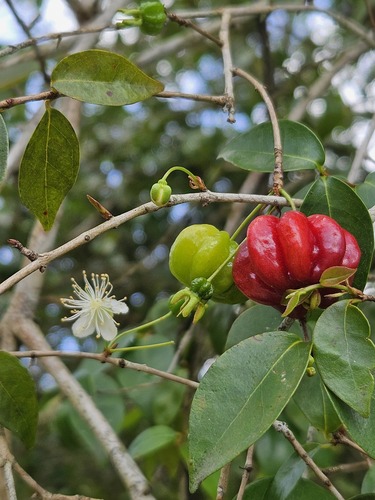
Pinda
genus of plants
Narcosius
Narcosius is a genus of butterflies in the family Hesperiidae (Eudaminae).
Othniocera
Othniocera is a genus of fruit flies in the family Tephritidae.
Loflammia
Loflammia is a small genus of lichen-forming fungi in the family Ectolechiaceae. The genus was established by the Czech lichenologist Antonín Vězda in 1986 to accommodate a group of foliicolous (leaf-dwelling) lichens with distinctive reddish fruiting bodies. These lichens form small greyish-white crusts on the surfaces of living leaves in tropical forests, and are recognised by their bright carmine-red disc-shaped reproductive structures. Species are known from Central and South America, Africa, and Papua New Guinea.
Barubria
Barubria is a fungal genus in the family Ectolechiaceae. It contain a single species Barubria fuscorubra, a leaf-dwelling lichen. The genus was established in 1986 by the Czech lichenologist Antonín Vězda, based on material collected from Guinea (West Africa). It is characterised by dark blue, sharply pointed (asexual spore-producing structures) and by asci (spore sacs) whose tip stains blue in iodine. The species forms a thin, smooth crust on leaf surfaces and produces brown fruiting bodies (apothecia) that narrow where they meet the crust.
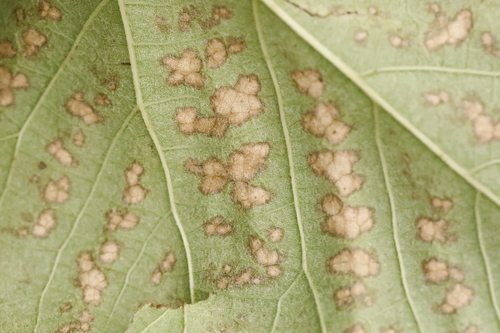
Pseudopezicula
Pseudopezicula is a genus of fungi in the family Helotiaceae. Circumscribed by mycologist Richard P. Korf in 1986, the genus contains two species that cause angular leaf scorch disease on grapes.

Hafellia
Hafellia is a genus of lichen-forming fungi in the family Caliciaceae. The genus has a widespread distribution, especially in tropical regions. The genus is named in honour of the Austrian lichenologist Josef Hafellner. The genus was proposed by the German lichenologist Klaus Kalb in 1986 to contain two bark-dwelling species, formerly in genus Buellia, with callispora-type spores. These ascospores have ridged walls, and are thin walled at their tips at early states of their differentiation.