Category
page 1Taxonomic ranks

species
A species () is the basic unit of classification and a taxonomic rank of an organism, as well as a unit of biodiversity. It can be defined as the largest group of organisms in which any two individuals of the appropriate sexes or mating types can produce fertile offspring, typically by sexual reproduction. Other ways of defining species include their karyotype, DNA sequence, morphology, behaviour, or ecological niche. In addition, palaeontologists use the concept of the chronospecies since fossil reproduction cannot be examined. The most recent rigorous estimate for the total number of species

genus
Genus (; : genera ) is a taxonomic rank above species and below family as used in the biological classification of living and fossil organisms as well as viruses. In binomial nomenclature, the genus name forms the first part of the binomial species name for each species within the genus.

family
taxonomic rank (or a taxon at that rank) between order and genus

kingdom
taxonomic rank
class
taxonomic rank in biology
order
taxonomic rank

phylum
In biology, a phylum (; : phyla) is a level of classification, or taxonomic rank, that is below kingdom and above class. Traditionally, in botany the term division has been used instead of phylum, although the International Code of Nomenclature for algae, fungi, and plants accepts the terms as equivalent. Depending on definitions, the animal kingdom Animalia contains about 32 phyla, the plant kingdom Plantae contains about 14 phyla, and the fungus kingdom Fungi contains about eight phyla. Current research in phylogenetics is uncovering the relationships among phyla within larger clades like Ec

domain
taxonomic rank (for "ordinary" organisms thus not viruses)

subspecies
In biological classification, subspecies (: subspecies) is a rank below species, used for populations that live in different areas and vary in size, shape, or other physical characteristics (morphology), but that can successfully interbreed. Not all species have subspecies, but for those that do there must be at least two. Subspecies is abbreviated as subsp. or ssp. and the singular and plural forms are the same ("the subspecies is" or "the subspecies are").
tribe
taxonomic rank between family and genus
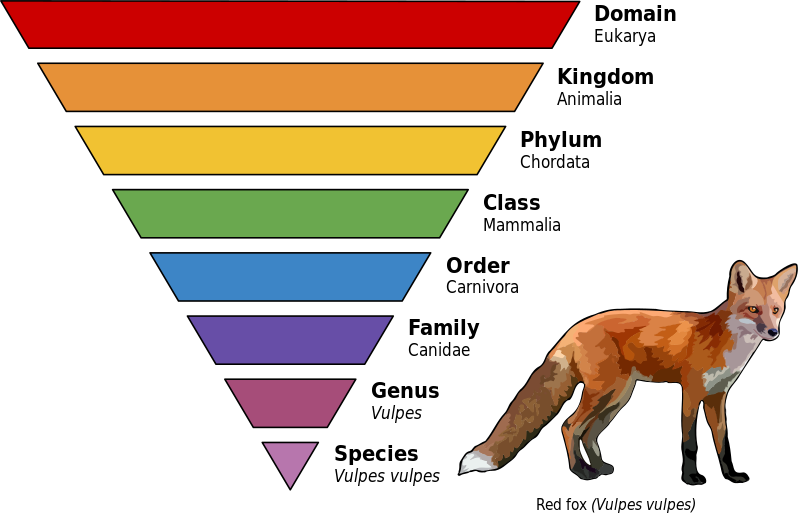
taxonomic rank
in biology, level in a taxonomic hierarchy
variety
taxonomic rank
subfamily
In biological classification, a subfamily (Latin: ', plural ') is an auxiliary (intermediate) taxonomic rank, positioned below family and above genera. It is used to classify groups of related genera within a family, helping organize the diversity of life more precisely.
subphylum
In zoological nomenclature, a subphylum is a taxonomic rank below the rank of phylum.

subgenus
thumb|A hoverfly of the subgenus [[Eristalis (Eoseristalis)]]
In biology, a subgenus ( subgenera) is a taxonomic rank directly below genus.
division
taxonomic rank in botanical classification, equivalent to phylum in zoology
race
informal rank in the taxonomic hierarchy, below the level of subspecies
strain
genetic variant, a subtype or a culture within a biological species
form
one of the secondary taxonomic ranks, below that of variety, in botanical nomenclature
species aggregate
informal grouping of taxa
section
taxonomic rank in botany
section
taxonomic rank
series
taxonomic rank in botany
realm
taxonomic rank for viruses
subtribe
In a social context, a subtribe is a secondary division of a broader ethnic grouping or tribe, functioning as a distinct unit defined by specific kinship ties, geographic territory, or linguistic dialects. For example, the Kipsigis are a major sub-tribe that falls under the broader Kalenjin ethnic group of East Africa.
legion
taxonomic rank

biovar
thumb|Aeromonas veronii biovar sobria|Aeromonas veronii biovar sobria [[Gram stain on microscope slide]]
A biovar is a variant prokaryotic strain that differs physiologically or biochemically from other strains in a particular species. Morphovars (or morphotypes) are those strains that differ morphologically. Serovars (or serotypes) are those strains that have antigenic properties that differ from other strains.
__FORCETOC__
forma specialis
taxonomic rank