Category
page 1Technology neologisms
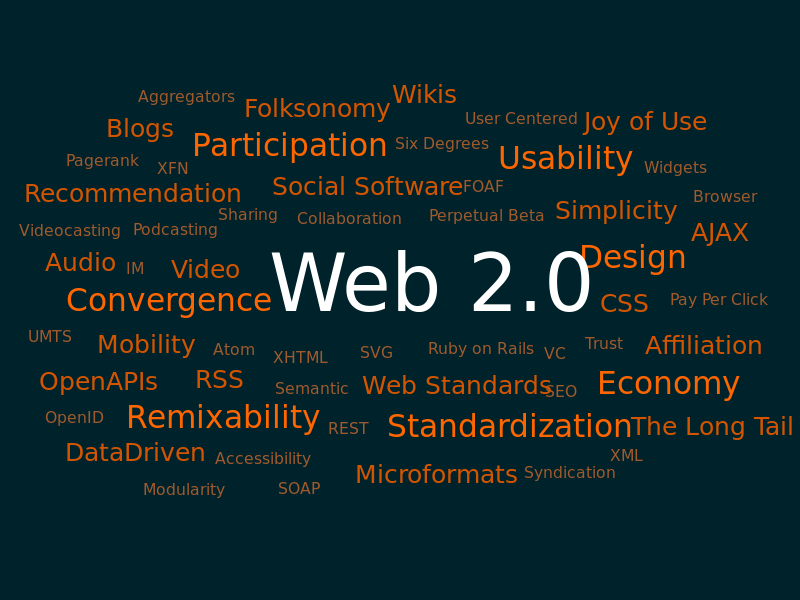
Web 2.0
World Wide Web sites that use technology beyond the static pages of earlier Web sites

clickbait
thumb|right|upright=1.35|Fictional examples of "chumbox" style adverts, employing common clickbait tactics of using an information gap to encourage reader curiosity, and promising easy-to-read numbered lists

plug-in
software component that adds a specific feature to an existing software application
software refactoring
process of restructuring existing computer code without changing its external behavior
1% rule
hypothesis that more people will lurk in a virtual community than will participate
applet
In computing, an applet is any small application that performs one specific task that runs within the scope of a dedicated widget engine or a larger program, often as a plug-in. The term is frequently used to refer to a Java applet, a program written in the Java programming language that is designed to be placed on a web page. Applets are typical examples of transient and auxiliary applications that do not monopolize the user's attention. Applets are not full-featured application programs, and are intended to be easily accessible.
digital native
person who has grown up in the digital age
dark pattern
user interface designed for a user to make choices without being aware of them
rage-baiting
In internet slang, rage-baiting (also ragebaiting, rage-farming, or rage-seeding) is the manipulative tactic of eliciting outrage with the goal of increasing internet traffic, online engagement, and revenue, as well as attracting new subscribers, followers, or supporters. This manipulation occurs through offensive or inflammatory headlines, memes, tropes, or comments that provoke users to respond in kind.

Zen and the Art of Motorcycle Maintenance
1974 philosophical novel in which a father and a son are on a motorcycle trip with friends
time shifting
recording a program to be viewed or listened to after the airing time

giclée
thumb|right|200px|The Hippopotamus and Crocodile Hunt by [[Peter Paul Rubens, printed on paper and canvas stock, with the seven Epson pigmented ink printer cartridges used to produce it (printer and prints commonly called giclée)]]
Tivoization
Tivoization () is the practice of designing hardware that incorporates software under the terms of a copyleft software license like the GNU General Public License (GNU GPL), but uses hardware restrictions or digital rights management (DRM) to prevent users from running modified versions of the software on that hardware. Richard Stallman of the Free Software Foundation (FSF) coined the term in reference to TiVo's use of GNU GPL licensed software on the TiVo brand digital video recorders (DVR), which actively block modified software by design. Stallman believes this practice denies users some of
phantom vibration syndrome
Perception that one's mobile phone is vibrating or ringing when it is not
singularitarianism
Singularitarianism is a movement defined by the belief that a technological singularity—the creation of superintelligence—will likely happen in the medium future, and that deliberate action ought to be taken to ensure that the singularity benefits humans.

throbber
thumb|150px|A throbber animation like that seen on many websites when a Blocking (computing)|blocking action is being performed in the background|alt=A circle of mostly grey and some black segments, animated to appears as though it is moving clockwise
Galápagos syndrome
term in business studies on product development
technorealism
Technorealism is an attempt to expand the middle ground between techno-utopianism and Neo-Luddism by assessing the social and political implications of technologies so that people might all have more control over the shape of their future. An account cited that technorealism emerged in the early 1990s and was introduced by Douglas Rushkoff and Andrew Shapiro. In the Technorealism manifesto, which described the term as a new generation of cultural criticism, it was stated that the goal was not to promote or dismiss technology but to understand it so the application could be aligned with basic h
spinner
graphical control element in interface design
social machine
social system
theranostics
Theranostics, or theragnostics, refers to the combination of diagnosis and therapy (treatment) of disease in a single medical intervention or technique. For example, a combination of radioactive isotopes may be administered to simultaneously identify and attack cancerous lesions. Typically theranostic approaches involve a medical imaging component, such as radiotracers, contrast agents, positron emission tomography, and magnetic resonance imaging.
Unbundling
Unbundling is the process of breaking up packages of products and services that were previously offered as a group, possibly even free. Unbundling has been called "the great disruptor". Unbundling prices and extending choice are generally processes seen as favourable to customers.