File:Web_2.0_Map.svg · Wikimedia Commons · See Wikimedia Commons
Web 2.0
Sign in to saveAlso known as social Web, participative Web, participatory Web
World Wide Web sites that use technology beyond the static pages of earlier Web sites
Web 2.0 refers to websites that go beyond simply displaying static information, instead using advanced technology to create interactive experiences where users can actively participate and share content. This shift matters because it transformed the web from a one-way source of information into a two-way platform where people can contribute, collaborate, and connect with each other.
AI-generated from the Wikipedia summary — may contain errors.
Wikidata facts
- Part of
- World Wide Web
- Followed by
- Web3
- Follows
- Web 1.0
Show 5 more facts
- Commons category
- Web 2.0
- topic's main category
- Category:Web 2.0
- discoverer or inventor
- Tim O'Reilly
- different from
- Internet2
- software version identifier
- 2.0
via Wikidata · CC0
~39 min read
Encyclopedic overview
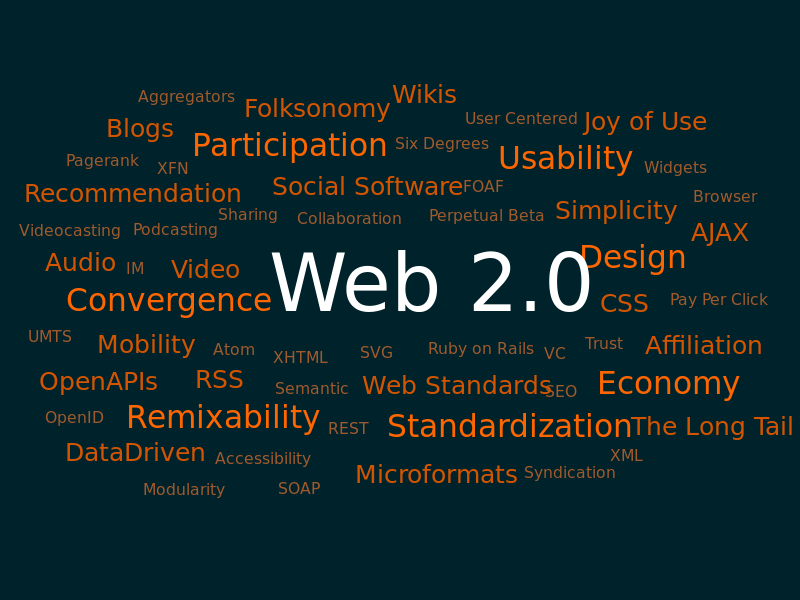
A tag cloud (a typical Web 2.0 phenomenon in itself) presenting Web 2.0 themes
Web 2.0 (also known as participative (or participatory) web and social web) refers to websites that emphasize user-generated content, ease of use, participatory culture, and interoperability (i.e., compatibility with other products, systems, and devices) for end users.
Excerpted from Wikipedia’s “Web 2.0” article, available under the CC BY-SA 4.0 licence.
Gallery (3)
Available in 61 languages
- Español
- Français
- Deutsch
- 中文
- 日本語
- Русский
- Português
- Italiano
- العربية
- हिन्दी
- Armenian
- Azerbaijani
- Bahasa Indonesia
- Bangla
- Basque
- Bavarian
- Bulgarian
- Burmese
Show 42 more
- Catalan
- Croatian
- Czech
- Danish
- Esperanto
- Estonian
- Finnish
- Galician
- Greek
- Hebrew
- Hungarian
- Kazakh
- Kurdish
- Lithuanian
- Macedonian
- Malay
- Malayalam
- Nederlands
- Norwegian
- Polski
- Romanian
- Serbian
- Serbian (Latin)
- Sicilian
- simple
- Slovak
- Slovenian
- Svenska
- Tajik
- Tamil
- Tiếng Việt
- Türkçe
- Ukrainian
- Uzbek
- Venetian
- Wu Chinese
- Yiddish
- zh_min_nan
- zh_yue
- فارسی
- ไทย
- 한국어
via Wikidata sitelinks · CC0