Category
page 1Teeth

tooth
A tooth (: teeth) is a hard, calcified structure found in the jaws (or mouths) of many vertebrates and used to break down food. Some animals, particularly carnivores and omnivores, also use teeth to help with capturing or wounding prey, tearing food, for defensive purposes, to intimidate other animals often including their own, or to carry prey or their young. The roots of teeth are covered by gums. Teeth are not made of bone, but rather of multiple tissues of varying density and hardness that originate from the outermost embryonic germ layer, the ectoderm.

toothpaste
thumb|alt=Photo with toothpaste from a tube of toothpaste being applied to the bristles of a toothbrush in the foreground|Toothpaste from a tube being applied to the bristles of a toothbrush
Toothpaste is a paste or gel dentifrice that is used with a toothbrush to clean and maintain the aesthetics of teeth. Toothpaste is used to promote oral hygiene: it is an abrasive that aids in removing dental plaque and food from the teeth, assists in suppressing halitosis, and delivers active ingredients (most commonly fluoride) to help prevent tooth decay (dental caries) and gum disease (gingivitis). Due
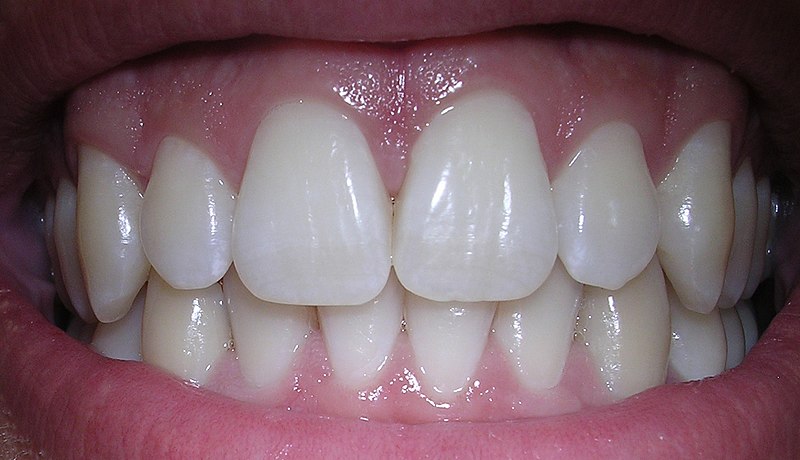
human tooth
calcified whitish structure in humans' mouths used to break down food

canine tooth
tooth located between the lateral incisor and the first premolar

cementum
Cementum is a specialized calcified substance covering the root of a tooth. The cementum is the part of the periodontium that attaches the teeth to the alveolar bone by anchoring the periodontal ligament.

diastema
A diastema (: diastemata, from Greek , 'space') is a space or gap between two teeth. Many species of mammals have diastemata as a normal feature, most commonly between the incisors and molars. More colloquially, the condition may be referred to as gap teeth or tooth gap.

dentition
thumb|335px|Cast of a human upper jaw showing incisors, canines, [[premolars, and two of the three possible pairs of molars.]]

hyperdontia
Hyperdontia is the condition of having supernumerary teeth, or teeth that appear in addition to the regular number of teeth (32 in the average adult). They can appear in any area of the dental arch and can affect any dental organ. The opposite of hyperdontia is hypodontia, where there is a congenital lack of teeth, which is a condition seen more commonly than hyperdontia. The scientific definition of hyperdontia is "any tooth or odontogenic structure that is formed from tooth germ in excess of usual number for any given region of the dental arch." The additional teeth, which may be few or many
occlusion
in dentistry, contact between teeth

malocclusion
In orthodontics, a malocclusion is a misalignment or incorrect relation between the teeth of the upper and lower dental arches when they approach each other as the jaws close. The English-language term dates from 1864; Edward Angle (1855 – 1930), the "father of modern orthodontics," popularised it. The word derives .

fang
thumb|The four canine tooth|canines, or fangs, of a domestic [[cat. (The largest two teeth of the top and bottom rows of teeth.)]]

Yaeba
thumb|Singer and model with .
In Japan, are human teeth, especially upper canines, with an uncommonly fang-like appearance. most often refers to a tooth overlapping another tooth or protruding from higher in the gum. In Japan it is perceived as a sign of youthfulness and natural beauty.

teething
thumb|A 9-month-old infant with a right lower central incisor about to emerge
thumb|A 9-month-old infant with a visible right lower central incisor
Teething is the process by which an infant's first teeth (the deciduous teeth, often called "baby teeth" or "milk teeth") appear by emerging through the gums, typically arriving in pairs. The mandibular central incisors are the first primary teeth to erupt, usually between 6 and 10 months of age, causing discomfort and pain to the infant. It can take several years for all 20 teeth to complete the tooth eruption. Though the process of teething is so
shark tooth
teeth of a shark
relic of the tooth of the Buddha
a cetiya "relic" of Gautama Buddha

toothcomb
thumb|The Lemuriformes|lemuriform toothcomb, viewed from the underside of the lower jaw
pharyngeal tooth
teeth in the pharyngeal arch of the throat of cyprinids, suckers, and a number of other fish species otherwise lacking teeth

tooth eruption
process in which teeth enter the mouth and become visible
amelogenin
Amelogenins are a group of protein isoforms produced by alternative splicing or proteolysis from the AMELX gene, on the X chromosome, and also the AMELY gene in males, on the Y chromosome. They are involved in amelogenesis, the development of enamel. Amelogenins are type of extracellular matrix protein, which, together with ameloblastins, enamelins and tuftelins, direct the mineralization of enamel to form a highly organized matrix of rods, interrod crystal and proteins.
Enamelin
Enamelin is an enamel matrix protein (EMPs), that in humans is encoded by the ENAM gene. It is part of the non-amelogenins, which comprise 10% of the total enamel matrix proteins. It is one of the key proteins thought to be involved in amelogenesis (enamel development). The formation of enamel's intricate architecture is thought to be rigorously controlled in ameloblasts through interactions of various organic matrix protein molecules that include: enamelin, amelogenin, ameloblastin, tuftelin, dentine sialophosphoprotein, and a variety of enzymes. Enamelin is the largest protein (~168kDa) in t
Hutchinson's teeth
clinical sign of congenital syphilis
edentulism
thumb|right|A toothless man drawn by Leonardo da Vinci

teether
thumb|upright|Sophie the Giraffe, a popular teether
posterior teeth
Tooth fusion
human disease
cingulum
part of tooth
Odontode
thumb | right | alt=this image shows a suckermouth catfish ’s odontodes on its pectoral fins. displaying its teeth-like frills. | The frill-like odontodes on a Guyanancistrus longispinis|suckermouth catfish’s [[pectoral fins]]
Odontodes, or dermal teeth, are hard structures found on the external surfaces of animals or near internal openings. They consist of a soft pulp cavity surrounded by dentine and covered by a mineralised substance such as enamel, a structure similar to that of teeth. They generally do not have the same function as teeth, and are not replaced the same way teeth are in mos
Hydrodynamic theory
Theory in dentristry
dental pellicle
protein film on the teeth
TUFT1
Tuftelin is an acidic phosphorylated glycoprotein found in tooth enamel. In humans, the tuftelin protein is encoded by the TUFT1 gene. It is an acidic protein that is thought to play a role in dental enamel mineralization and is implicated in caries susceptibility. It is also thought to be involved with adaptation to hypoxia, mesenchymal stem cell function, and neurotrophin nerve growth factor mediated neuronal differentiation.