Category
page 1Telecommunication theory

modulation
process of encoding information by varying properties of a periodic carrier waveform

signal
thumb|right|In The Signal by William Powell Frith, a woman sends a signal by waving a white handkerchief.

signal processing
models and analyzes data representations of physical events
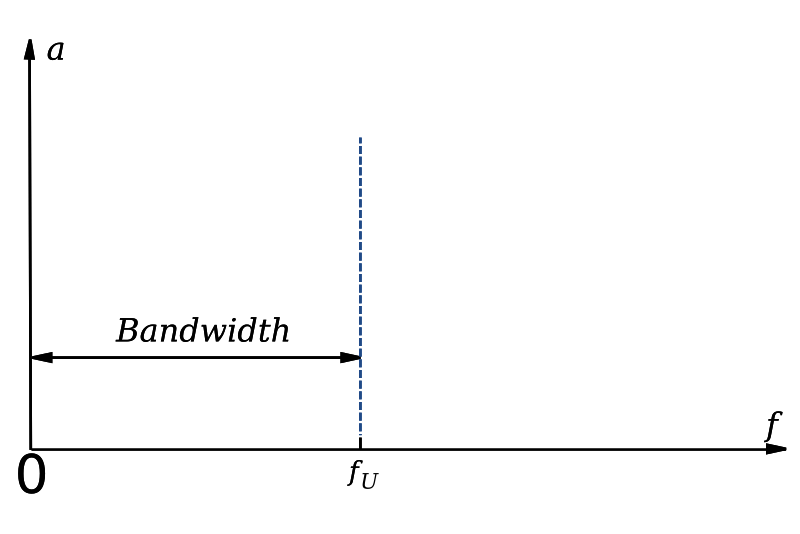
signal bandwidth
difference between the upper and lower frequencies passed by a filter, communication channel, or signal spectrum

digital signal processing
mathematical signal manipulation by computers
television channel
terrestrial frequency or virtual number over which a television station or television network is distributed
channel
physical or logical connection used for transmission of information
quantization
process of mapping a continuous set to a countable set
Nyquist–Shannon sampling theorem
theorem in signal processing describing discrete samples of a continuous signal
frequency mixer
nonlinear electrical circuit that creates new frequencies from two signals applied to it
round-trip delay time
time required to receive a response to a query across a communication system

crosstalk
In electronics, crosstalk (XT) is a phenomenon by which a signal transmitted on one circuit or channel of a transmission system creates an undesired effect in another circuit or channel. Crosstalk is usually caused by undesired capacitive, inductive, or conductive coupling from one circuit or channel to another.
channel capacity
tight upper bound on the rate at which information can be reliably transmitted over a communications channel
full width at half maximum
concept in statistics and wave theory
detection theory
analyzed the detection of difficult to detect signals and provides a measure of the quality of the detection
filter
signal processing device or process that removes unwanted components or features from a signal, or enhances wanted ones, or both

availability
In reliability engineering, the term availability has the following meanings:
Shannon–Hartley theorem
theorem that tells the maximum rate at which information can be transmitted
reflection coefficient
measure of wave reflectivity
Noisy-channel coding theorem
limit on data transfer rate
spectral efficiency
information rate that can be transmitted over a given bandwidth
Trellis modulation
modulation scheme in telecommunication
intersymbol interference
a form of distortion affecting communication reliability
phase noise
frequency domain representation of rapid, short-term, random fluctuations in the phase of a waveform, caused by time domain instabilities
Center frequency
The channel between upper and lower cutoff frequencies of a band system
matched filter
form of filter

propagation coefficient
complex measure of the attenuation (real part) and phase angle (imaginary part) along the path travelled by a plane wave
isochronous
events occurring regularly, or at equal time intervals
Nyquist rate
twice the bandwidth of a bandlimited function or channel
Raised-cosine filter
spectrally efficient pulse-shaping filter satisfying the Nyquist property, commonly used in communication systems
Electrical length
Parameter characterizing an AC conductor

Carson bandwidth rule
Rule in telecommunications
semantic interoperability
ability of computer systems to exchange data with unambiguous, shared meaning
spectral width
wavelength interval over which the magnitude of all spectral components is equal to or greater than a specified fraction of the magnitude of the component having the maximum value
phase fired controllers
term in physics
user
person, organization, or other entity that employs the services provided by a telecommunication system
Nyquist ISI criterion
condition to avoid intersymbol interference
Root-raised-cosine filter
linear filter in the time domain
Hilbert–Huang transform
signal analysis tool