File:Baseband.svg · Wikimedia Commons · See Wikimedia Commons
signal bandwidth
Sign in to saveAlso known as analog bandwidth, frequency bandwidth, bandwidth (signal processing)
difference between the upper and lower frequencies passed by a filter, communication channel, or signal spectrum
Described at
ANALOG BANDWIDTH BASICS – Wavelength Electronics
teamwavelength.com →The range of frequencies that a system passes through or rejects is given by the system bandwidth. For example, a system, as defined by the following graph, passes DC and other increasing frequencies, and then starts rejecting frequencies gradually until it rejects higher frequencies consistently. To measure the bandwidth of a driver, put in a sinusoidal setpoint that peaks at one volt, then increase the frequency of the sinewave until only half a volt of equivalent setpoint comes out. That’s the 3dB bandwidth. A square wave is formed by overlaying several sinusoidal frequencies of varying strength. If we overlay the main signal and its odd harmonics, a rough square wave is formed. The more harmonics that are used, the more distinct the square wave becomes. When system bandwidth is overlaid with the setpoint input square wave frequencies, the upper harmonics are lost. The output current will lose the square edges when setpoint frequency is increased, as shown in Figure 4 and Figure 5 . The shape of the output depends also on the system rise / fall times. The output current will follow a step input at its specified rise time maximum rate. Circuits are often given a bandwidth specification. This indicates that the circuit will not pass all frequencies in a time varying setpoint signal. Sinewaves through this system will be attenuated; square waves and others represented by summations of frequencies will change shape as the base frequency increases. Rise and fall times can also limit how fast a driver can deliver changing current to the load. Evaluation of output current frequency response can be critical to the practical success of a project.
Excerpt from a page describing this subject · 5,547 chars · not written by Vinony
Wikidata facts
- Subclass of
- frequency
- Image
- Bandwidth 2.svg
Show 4 more facts
- different from
- bandwidth
- characteristic of
- signal
- described by source
- Keysight Technologies
- described at URL
- www.teamwavelength.com/bandwidth-basics
Sources (3)
via Wikidata · CC0
~14 min read
Encyclopedic overview
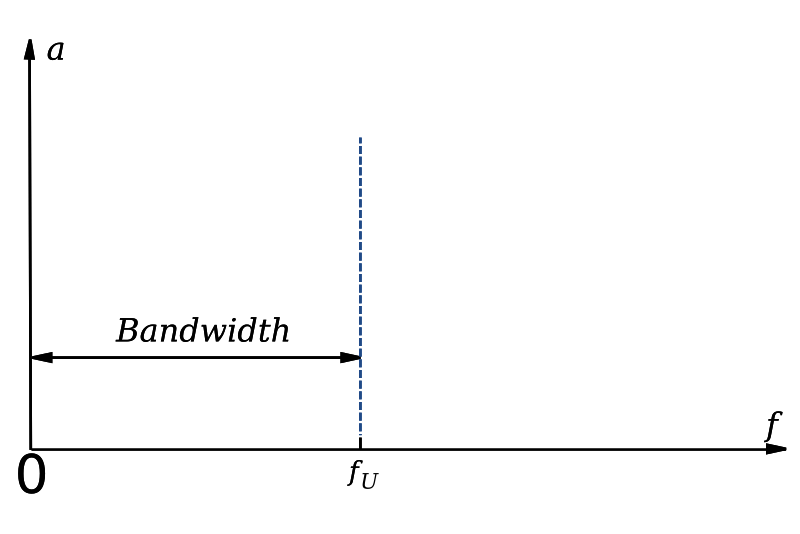
Amplitude (a) vs. frequency (f) graph illustrating baseband bandwidth. Here the bandwidth equals the upper frequency.
Bandwidth is the difference between the upper and lower frequencies in a continuous band of frequencies. It is typically measured in unit of hertz (symbol Hz).
Excerpted from Wikipedia’s “signal bandwidth” article, available under the CC BY-SA 4.0 licence.