Category
page 1The Holocaust

The Holocaust
The Holocaust, known in Hebrew as the Shoah, was the genocide of European Jews during World War II. From 1941 to 1945, Nazi Germany and its collaborators systematically murdered around six million Jews across German-occupied Europe, approximately two-thirds of Europe's Jewish population. The murders were committed primarily through mass shootings across Eastern Europe and poison gas chambers in extermination camps, chiefly Auschwitz-Birkenau, Treblinka, Belzec, Sobibor, Chełmno and Majdanek death camps in occupied Poland. Concurrent Nazi persecutions killed millions of other non-Jewish civilians and prisoners of war (POWs); the term Holocaust is sometimes used to include the murder and persecution of non-Jewish groups, such as the Romani and Soviet POWs.

Nazism
thumb|The Nazi dictator Adolf Hitler (here pictured in 1938) titled himself [[Führer and ruled Germany from 1933 to 1945.]]

Auschwitz
German network of concentration and extermination camps in occupied Poland during World War II

Gestapo
The ' (, , abbreviated Gestapo' ), was the official secret police of Nazi Germany and in German-occupied Europe.

Schutzstaffel
The Schutzstaffel (; ; SS; also stylised with SS runes as ᛋᛋ) was a major paramilitary organisation under Adolf Hitler and the Nazi Party in Nazi Germany, and later throughout German-occupied Europe during World War II.
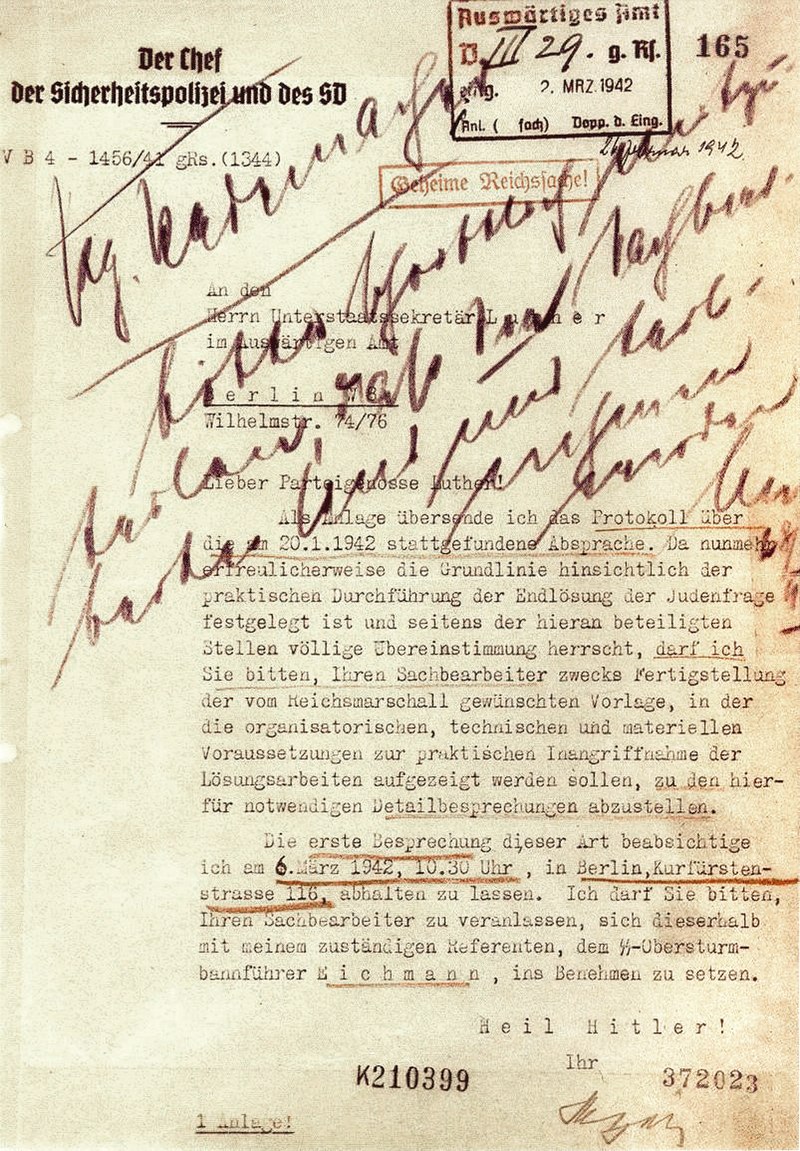
Final Solution
Nazi plan for the genocide or extermination of the Jews, resulted in the genocide known as 'Holocaust' or 'Shoah'

Sobibór Extermination Camp
Nazi extermination camp in south-eastern Poland

Holocaust denial
negation, distortion or minimization of the Holocaust

Aktion T4
Nazi Germany's programme of euthanasia which claimed 275,000–300,000 victims
Generalplan Ost
Nazi racial plan of enslavement and genocide of peoples of Central and Eastern Europe, mainly Jews, Slavs & Roma
yellow badge
badge forced on Jews by Nazis, Christians, and Muslims at varying times in history
Jewish question
debate in European society pertaining to the appropriate status and treatment of Jews in society

SS-Totenkopfverbände
' (SS-TV'; or 'SS Death's Head Battalions') was a major branch of the Nazi Party's paramilitary (SS) organisation. It was responsible for administering the concentration camps and extermination camps of Nazi Germany, among similar duties. It was both the successor and expanded organisation to the (guard units) formed in 1933. While the was the universal cap badge of the SS, the SS-TV also wore this insignia on the right collar tab to distinguish itself from other SS formations.
Nuremberg Code
set of research ethics principles for human experimentation
death march
Forcible movements of prisoners between Nazi camps

Judenfrei
thumb|"Whoever wears this sign is an enemy of our people" – Parole der Woche, 1 July 1942 showing a [[yellow badge used by the Nazis to identify Jews]]
thumb|Synagogue in Occupation of Poland (1939–1945)|German-occupied [[Bydgoszcz, Poland, September 1939. The inscription in German reads: "This city is free of Jews!"]]
thumb|German map showing the number of Jewish executions carried out by Einsatzgruppe A in: [[Estonia (declared judenfrei), Latvia, Lithuania, Belarus, and Russia]]
thumb|Advertisement for a café in Tübingen, describing itself as judenfrei
Judenfrei (, "free of Jews") and

Wannsee
Wannsee () is a locality in the southwestern Berlin borough of Steglitz-Zehlendorf, Germany. It is the westernmost locality of Berlin. In the quarter there are two lakes, the larger Großer Wannsee (Greater Wannsee) and the Kleiner Wannsee (Little Wannsee), located on the Havel and separated by the Wannsee Bridge. The larger of the two lakes covers an area of and has a maximum depth of .
Vilna Ghetto
Nazi ghetto in occupied Lithuania
collaboration with Nazi Germany and Fascist Italy
alliance with the Axis powers during World War II by various citizens and organizations
German crimes against Poles
WWII war crimes
extermination through labor
killing prisoners by means of forced labour
relations between Nazi Germany and the Arab world
relationship between Nazi Germany (1933–1945) and the leadership of the Arab world
Będzin Ghetto
Nazi ghetto for Polish Jews in occupied southwestern Poland
Nazi concentration camp badge
cloth emblems; part of the system of identification in Nazi concentration camps
The Holocaust in the Independent State of Croatia
mass murder of the Jews in Croatia, part of the Holocaust
Action 14f13
campaign of the Third Reich to murder Nazi concentration camp prisoners
Jewish partisans
anti-Nazi and anti-German fighting groups of Jews in World War II
Reserve Police Battalion 101
infamous paramilitary unit of Ordnungspolizei with criminal activity in German-occupied Poland during WWII, a unit of the German Order Police
SS Cavalry Brigade
military unit
The Holocaust in the Netherlands
the extermination of Dutch Jews during World War II

Bandenbekämpfung
thumb|250px|Heinrich Himmler's report Number 51 from 1 October 1942 to 1 December 1942 detailing the murder of "bandits" and Jews in [[Southern Russia, Ukraine, and the Bialystok District]]
In German military history, ' (), also referred to as Nazi security warfare' during World War II, refers to the concept and military doctrine of countering resistance or insurrection in the rear area during wartime with extreme brutality. The doctrine provided a rationale for disregarding the established laws of war and for targeting any number of groups, from armed guerrillas to civilians, as "bandits" or
timeline of the Holocaust
Wikimedia timeline article
Kanada
Warehouses in the Auschwitz concentration camp, occupied Poland, that stored looted prisoners' property
history of the Jews during World War II
history
Persecution of Jehovah's Witnesses in Nazi Germany
Nazi persecution

SS Deutschland
German ocean liner steamship (1923-45)
Hungarian Gold Train
german-operated train during World War II
The Lost Train
Train transporting Nazi prisoners in 1945
Lagerordnung
Operation Atlas (Mandatory Palestine)
1944 SS operation
SS Panzer Brigade Gross
military unit
Zdzięcioł Ghetto
Nazi ghetto in occupied Belarus
Holocaust tourism
Tourism around destinations associated with The Holocaust
2 SS Infantry Brigade
military unit
Kraljevo massacre
Massacre commited by Nazi Soldiers in WW2 against Yugoslavia
Good German
term for being passive in the face of atrocity
Holocaust theology
body of thought concerning the role of God in the Holocaust
Sanitätswesen
The Sanitätswesen ("medical corps") was one of the five divisions of a Nazi concentration or extermination camp organization during the Holocaust. The other divisions were the command center, the administration department, the Politische Abteilung and the protective detention camp.
Sambor Ghetto
Nazi ghetto in occupied Ukraine
emigration of Jews from Nazi Germany and German-occupied Europe
emigration of Jews from Nazi Germany
Humor related the Holocaust
Various aspects of humor related to the Holocaust
wir haben es nicht gewußt
the extent to which the Holocaust was known contemporaneously
genocide education
education about patterns and trends in the phenomenon of genocide and/or about the causes, nature and impact of particular instances of genocide
Kommandostab Reichsführer-SS
Nazi paramilitary controlled by Himmler
International response to the Holocaust
Responses of international organizations and governments to the Holocaust
Evidence for the Holocaust
evidence for the genocide of Jews in World War II
Ozarichi death camp
complex of Nazi German death camps near the city of Mazyr in Belarus
Jews outside Europe under Axis occupation
1 SS Infantry Brigade
military unit
Arab rescue efforts during the Holocaust
Jews sheltered by Arab and Muslim population