Category
page 1Theatre
.jpg)
theatre
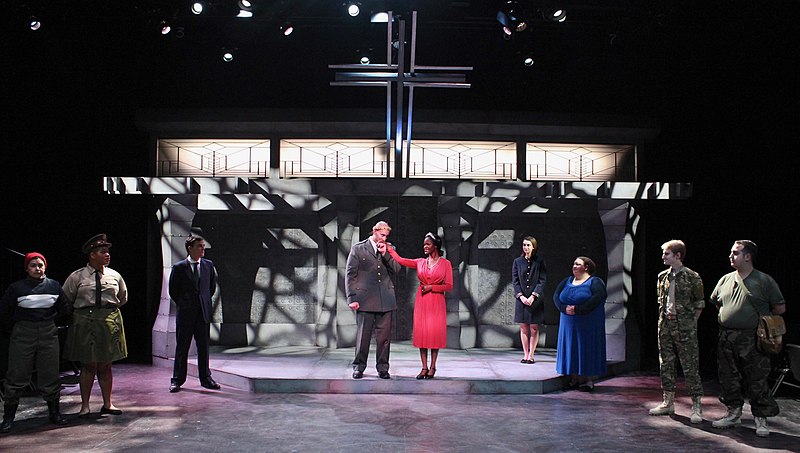
Theatre or theater is a collaborative form of performing art that uses live performers, usually actors, to present experiences of a real or imagined event before a live audience in a specific place, often a stage. The performers may communicate this experience to the audience through combinations of gesture, speech, song, music, and dance. It is the oldest form of drama, though live theatre has now been joined by modern recorded forms. Elements of art, such as painted scenery and stagecraft such as lighting are used to enhance the physicality, presence and immediacy of the experience. Places,

opera
280px|thumb|Macbeth (Verdi)|Macbeth at the [[Savonlinna Opera Festival in St. Olaf's Castle, Savonlinna, Finland, in 2007]]
thumb|280px|La Scala of Milan
thumb|280px|Palais Garnier of the [[Paris Opéra]]
Opera is a form of Western theatre in which music is a fundamental component and dramatic roles are taken by singers. Such a "work" (the literal translation of the Italian word "opera") is typically a collaboration between a composer and a librettist and incorporates a number of the performing arts, such as acting, scenery, costume, and sometimes dance or ballet. The performance is typically g
play
theatrical dramatic work intended to be performed by actors (in theatre, radio or recorded for TV)

audience
thumb|An audience in Tel Aviv, Israel, waiting to see the [[Batsheva Dance Company]]
thumb|Audiences at the 2013 World Championships in Athletics in Moscow, Russia
An audience is a group of people who participate in a show or encounter a work of art, literature (in which they are called "readers"), theatre, music (in which they are called "listeners"), video games (in which they are called "players"), or academics in any medium. Audience members participate in different ways in different kinds of art. Some events invite overt audience participation and others allow only modest clapping and cri

performance art
art using the actions of an artist or other participants (not to be confused with performing arts)

improvisation
Improvisation or improvization (often shortened to improv) is the activity of making or doing something not planned beforehand, using whatever can be found. The origin of the word itself is in the Latin "improvisus", which literally means un-foreseen. Improvisation in the performing arts is a very spontaneous performance without specific or scripted preparation. The skills of improvisation can apply to many different faculties across all artistic, scientific, physical, cognitive, academic, and non-academic disciplines; see Applied improvisation.
.jpg)
première
thumb|300px|Film premiere for Flatliners, [[Grauman's Chinese Theatre, Hollywood, 1990]]
A premiere, also spelled première, (from , ) is the debut (first public presentation) of a work, i.e. play, film, dance, musical composition, or even a performer in that work.

mimesis
Mimesis (; , mīmēsis) is a term used in literary criticism and philosophy that carries a wide range of meanings, including imitatio, imitation, similarity, receptivity, representation, mimicry, the act of expression, the act of resembling, and the presentation of the self.
.jpg)
puppet
thumb|A puppet, from Punch and Judy show, England, late 19th century
A puppet is an object, often resembling a human, animal or mythical figure, that is animated or manipulated by a person called a puppeteer. Puppetry is an ancient form of theatre which dates back to the 5th century BC in ancient Greece.

dramaturgy
Dramaturgy (conventional, text-based) is the study of dramatic composition and the representation of the main elements of drama on the stage. The role of a dramaturg working on text in the field of modern dramaturgy is to help realize the multifaceted world of the play for a production using information from the script, playwright, the context in which the play was written, and the context in which it is staged. It is a dramaturg's job to assist the director and playwright, especially if the culture of the play is not fully experienced by these people.
casting
pre-production process for selecting actors, dancers, singers, or extras for roles or parts in a script, screenplay, or teleplay
Portal:Theatre
Wikimedia portal

audition
thumb|350px|right|Sketches by artist Marguerite Martyn of women trying out for the chorus at the Delmar Theater in St. Louis in May 1906, with quotations from some of those pictured
thumb|right|250px|A singer performing a live audition in front of judges on TV for Fox's American Idol reality television series.
An audition is a sample performance by an actor, singer, musician, dancer or other performer. It typically involves the performer displaying their talent through a previously memorized and rehearsed solo piece or by performing a work or piece given to the performer at the audition or sho
%20retuschiert.jpg)
rehearsal
thumb|right|300px|Marco Ricci's "Prove per un'opera" ("Rehearsal of an Opera") depicts [[Pyrrhus and Demetrius being rehearsed at the Haymarket Theatre in 1709.]]
method acting
training and rehearsal techniques
repertoire
Repertory or repertoire () is the list or set of works a person or company is accustomed to performing. Whether the English or French spelling is used has no bearing, but it was the French word, with an accent on the first e, , that first took hold, in 1847, derived from the late Latin word repertorium. The readiness or preparedness of persons or companies to perform certain works gives rise to an identifiable "standard repertory" in theatre, ballet, opera, choral music, chamber music, guitar recitals, piano recitals, organ recitals, orchestral music and indeed all other "performing arts" form

puppeteer
thumb|Puppeteer Nikolai Zykov with hand puppets.
A puppeteer is a person who manipulates an inanimate object called a puppet to create the illusion that the puppet is alive. The puppet is often shaped like a human, animal, or legendary creature. The puppeteer may be visible to or hidden from the audience.
street performance
practice of performing in public places, for gratuities
classical unities
narration theory
living statue
craft

entr'acte
''' (or , ; and ', , and ) means 'between the acts'. It can mean a pause between two parts of a stage production, synonymous to an intermission (this is nowadays the more common meaning in French), but it more often (in English) indicates a piece of music performed between acts of a theatrical production. But despite this, an entr'acte is often paired with a longer intermission, as an intermission is usually "between acts." However, there can also be an entr'acte on its own, usually between the two acts without an intermission.
multimedia translation
Translation of multimodal and multimedial texts
theatrical make-up
makeup used to assist in creating the appearance of the characters
blocking
theatre term that refers to the precise movement and positioning of actors on a stage
closet drama
play not intended to be performed onstage, but read by a solitary reader or, sometimes, aloud in a small group
supporting character
character in a narrative that is not the focus of the primary story but plays a crucial role
drama therapy
use of theatre techniques to promote mental health
spectacle
In general, spectacle refers to an event that is memorable for the appearance it creates. Derived in Middle English from c. 1340 as "specially prepared or arranged display" it was borrowed from Old French spectacle, itself a reflection of the Latin spectaculum "a show" from spectare "to view, watch" frequentative form of specere "to look at." The word spectacle has also been a term of art in theater dating from the 17th century in English drama.
Naturalism
movement in European drama and theatre
opera glasses
small, usually compact, binoculars intended for indoor use
Forum theatre
type of theatre created by Augusto Boal
The gods
seating area in a theater
Paper Theatre
Small stage made of paper on which the technical diversity of a human stage can be imitated or tested in model form.
grammelot
Grammelot (or gromalot or galimatias) is an imitation of language used in satirical theatre, an ad hoc gibberish that uses prosody along with macaronic and onomatopoeic elements to convey emotional and other meaning, and used in association with mime and mimicry. The satirical use of such a format may date back to the 16th-century commedia dell'arte; the group of cognate terms appears to belong to the 20th century.
vignette
short impressionistic scene that focuses on one moment or character
sylvan theater
outdoor theatre in a sylvan or otherwise green surrounding
youth theatre
theatre for an audience of children and adolescents
repertory theatre
theatre in which a resident company presents works from a specified repertoire
theatrical adaptation
play adapted from work in another medium or from another play
theatrical blood
substitute for blood in a theatrical or cinematic performance
Cornelian dilemma
dilemma named after dramatist Pierre Corneille
offscreen
The terms off-screen, off-camera, and off-stage refer to fictional events in theatre, television, or film which are not seen on stage or in frame, but are merely heard by the audience, or described (or implied) by the characters or narrator. Off-screen action often leaves much to the audience's imagination. As a narrative mode and stylistic device, it may be used for a number of dramatic effects. It may also be used to save time in storytelling, to circumvent technical or financial constraints of a production, or to meet content rating standards.
theatrical production
production consisting of a series of quasi-identical performances of the same theatrical work
2.5D musical
Japanese type of musical based on anime, manga or video games
applied drama
umbrella type of theatre
break a leg
English idiom used in theatre to wish a performer "good luck"
Likay
thumb|Snippet from a likay performance at Wat Khung Taphao, Uttaradit Province
Toi toi toi
phrase
combination company
touring theater company which performed only one play