Category
page 1Theoretical computer science

algorithm
thumb|Flowchart of using successive subtractions to find the greatest common divisor of number r and s|alt=In a loop, subtract the larger number against the smaller number. Halt the loop when the subtraction will make a number negative. Assess two numbers, whether one of them is equal to zero or not. If yes, take the other number as the greatest common divisor. If no, put the two numbers in the subtraction loop again.
In mathematics and computer science, an algorithm () is a finite sequence of mathematically rigorous instructions, typically used to solve a class of specific problems or to perf
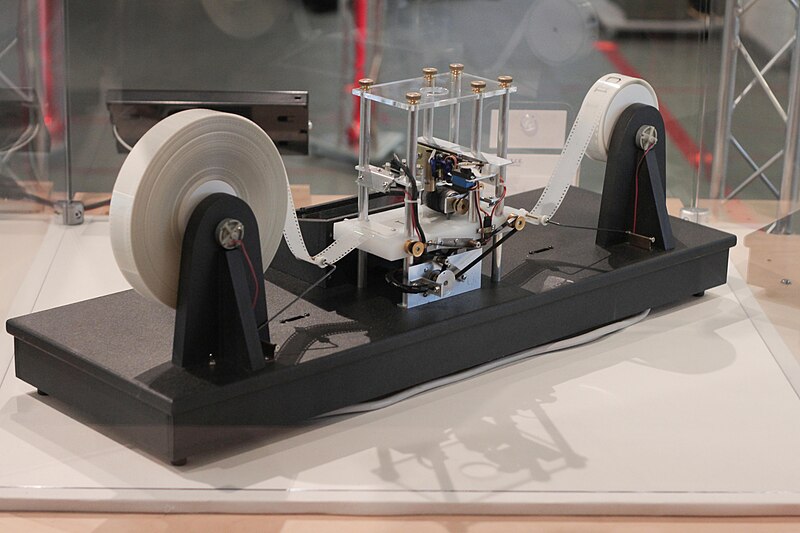
Turing machine
abstract computation model; mathematical model of computation that defines an abstract machine which manipulates symbols on a strip of tape according to a table of rules
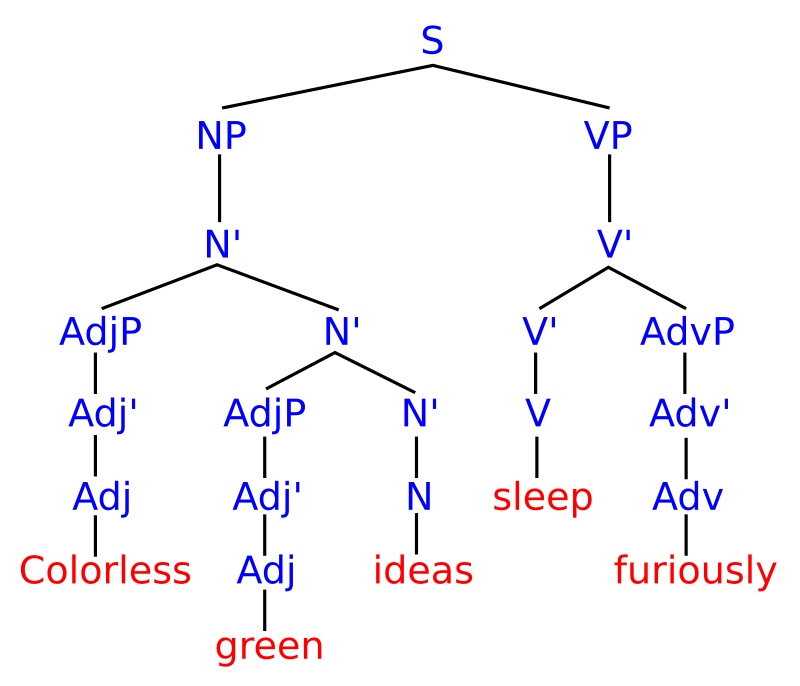
formal language
set of strings of symbols that may be constrained by rules that are specific to it; words whose letters are taken from an alphabet and are well-formed according to a specific set of rules

lambda calculus
formal system in mathematical logic

quantum computing
study of a model of computation
theoretical computer science
subfield of computer science and mathematics

spintronics
Spintronics (a portmanteau of spin transport electronics), also known as spin electronics, is the study of the intrinsic spin of the electron and its associated magnetic moment, in addition to its fundamental electronic charge, in solid-state devices. The field of spintronics concerns spin-charge coupling in metallic systems. The analogous effects in insulators fall into the field of multiferroics.
.jpg)
idempotence
thumb|On/Off buttons of a train's destination sign control panel. Pressing the On button (green) is an idempotent operation, since it has the same effect whether done once or multiple times. Likewise, pressing Off is idempotent.
Idempotence (, ) is the property of certain operations in mathematics and computer science whereby they can be applied multiple times without changing the result beyond the initial application. The concept of idempotence arises in a number of places in abstract algebra (in particular, in the theory of projectors and closure operators) and functional programming (in whi
recursion
algorithmic technique in computer science of solving a problem by reducing it to a smaller instance of the same problem
computation
A computation is any type of arithmetic or non-arithmetic calculation that is well-defined. Common examples of computation are mathematical equation solving and the execution of computer algorithms.
formal methods
mathematical program specification intended to allow correctness proofs, including algorithmically

self-reference
thumb|The ancient symbol Ouroboros, a dragon that continually consumes itself, denotes self-reference.
quantum algorithm
algorithms run on quantum computers, typically relying on superposition and/or entanglement
complexity class
set of problems in computational complexity theory of related resource-based complexity
formal verification
act of proving or disproving the correctness of intended algorithms
Gödel Prize
award for outstanding papers in the area of theoretical computer science
automated reasoning
subfield of computer science and logic
Knuth Prize
prize given by ACM and IEEE for outstanding contributions to the foundations of computer science
combinatorial optimization
subset of mathematical optimization
Institut National de Recherche en Informatique et en Automatique
French research institution in computer science
recursive definition
defining the elements in a set in terms of other elements in the set
quantum machine learning
Quantum Machine Learning combines quantum computing and ML to enhance algorithms, leveraging unique quantum properties, like superposition and entanglement , for efficient problem-solving.
computational problem
problem of finding an effective algorithm which solves a given problem
correctness
quality of an algorithm being correct with respect to a specification
motion planning
robotics problem
pseudorandomness
A pseudorandom sequence of numbers is one that appears to be statistically random, despite having been produced by a completely deterministic and repeatable process. Pseudorandom number generators are often used in computer programming, as traditional sources of randomness available to humans (such as rolling dice) rely on physical processes not readily available to computer programs, although developments in hardware random number generator technology have challenged this.
π-calculus
In theoretical computer science, the -calculus (or pi-calculus) is a process calculus. The -calculus allows channel names to be communicated along the channels themselves, and in this matter, it is able to describe concurrent computations whose network configuration may change during the computation.
lowest common ancestor
term in computer science
European Association for Theoretical Computer Science
organization
quantum complexity theory
computational complexity of quantum algorithms
machine learning in physics
applications of machine learning to quantum physics

categorical logic
branch of category theory within mathematics, adjacent to mathematical logic but more notable for its connections to theoretical computer science.
bisimulation
In theoretical computer science, a bisimulation is a binary relation between state transition systems, associating systems that behave in the same way in that one system simulates the other and vice versa.

chemical computer
unconventional computer based on a semi-solid chemical
Reed–Muller code
error-correcting codes used in wireless communication
natural computing
terminology introduced to encompass three classes of methods
bio-inspired computing
field of study
least-squares spectral analysis
frequency-domain analysis method
Transcriptor
A transcriptor is a transistor-like device composed of DNA and RNA rather than a semiconducting material such as silicon. Prior to its invention in 2013, the transcriptor was considered an important component to build biological computers.
corecursion
In computer science, corecursion is a type of operation that is dual to (structural) recursion. Whereas recursion consumes a data structure by first handling the topmost layer before descending into its inner parts, corecursion produces a data structure by first defining the topmost layer before defining its inner parts. Corecursion is a particularly important in total languages, as it allows encoding potentially non-terminating computations in a context where every function must terminate. It is supported by theorem provers Agda and Rocq.
rough set
formal approximation of a crisp (i.e. conventional) set
exact cover
disjoint family of sets, drawn from a larger collection, with the same union as the whole collection
coinduction
In computer science, coinduction is a technique for defining and proving properties of systems of concurrent interacting objects.
Tree automaton
state machine for tree structures
Hindley–Milner
type system supporting type inference
Language Of Temporal Ordering Specification
Formal specification language in computer science
manifold hypothesis
posits ability to interpolate within latent manifolds