Category
page 1Thorax (human anatomy)

thorax
The thorax (: thoraces or thoraxes) or chest is a part of the anatomy of mammals and other tetrapod animals located between the neck and the abdomen.

esophagus
The esophagus (American English) or oesophagus (British English) () is an organ in vertebrates through which food passes, aided by peristaltic contractions, from the pharynx to the stomach. The esophagus is a fibromuscular tube, about long in adult humans, that travels behind the trachea and heart, passes through the diaphragm, and empties into the uppermost region of the stomach. During swallowing, the epiglottis tilts backwards to prevent food from going down the larynx and lungs. The word esophagus is from Ancient Greek οἰσοφάγος (oisophágos), from οἴσω (oísō), future form of φέρω (phérō, "

rib
In vertebrate anatomy, ribs () are the long curved bones which form the rib cage, part of the axial skeleton. In most tetrapods, ribs surround the thoracic cavity, enabling the lungs to expand and thus facilitate breathing by expanding the thoracic cavity. They serve to protect the lungs, heart, and other vital organs of the thorax. In some animals, especially snakes, ribs may provide support and protection for the entire body.

trachea
The trachea (: tracheae or tracheas), also known as the windpipe, is a cartilaginous tube that connects the larynx to the bronchi of the lungs, allowing the passage of air, and so is present in almost all land vertebrate animals' lungs. The trachea extends from the larynx and branches into the two primary bronchi. At the top of the trachea, the cricoid cartilage attaches it to the larynx. The trachea is formed by a number of horseshoe-shaped rings, joined together vertically by overlying ligaments, and by the trachealis muscle at their ends. The epiglottis closes the opening to the larynx duri
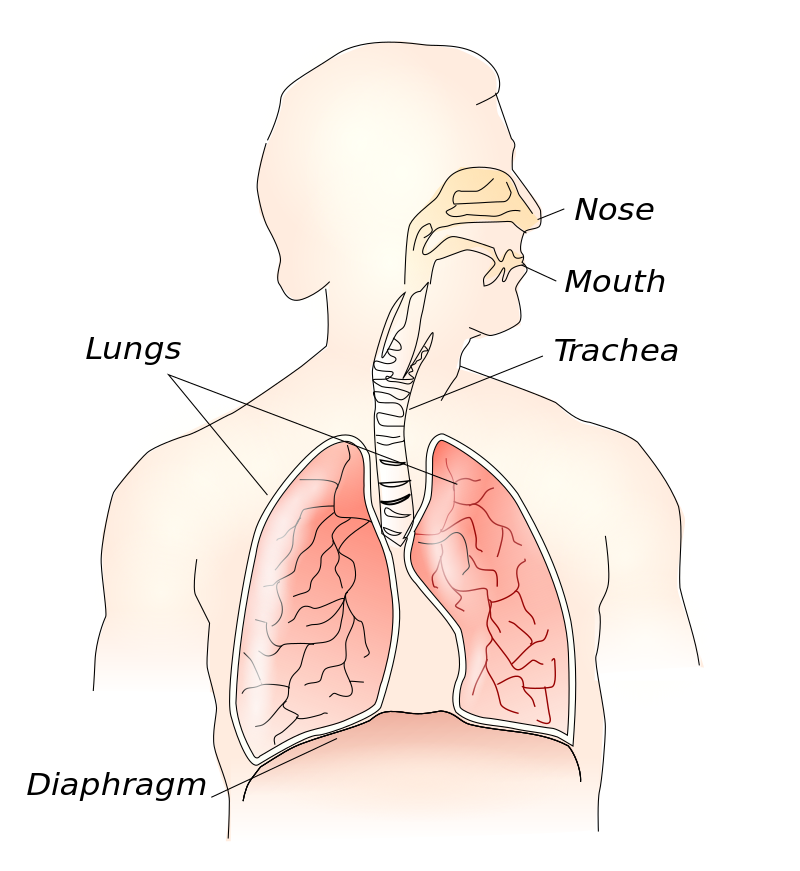
thoracic diaphragm
sheet of internal skeletal muscle

bronchus
A bronchus ( ; : bronchi, ) is a passage or airway in the lower respiratory tract that conducts air into the lungs. The first or primary bronchi to branch from the trachea at the carina are the right main bronchus and the left main bronchus. These are the widest bronchi, and enter the right lung, and the left lung at each hilum. The main bronchi branch into narrower secondary bronchi or lobar bronchi, and these branch into narrower tertiary bronchi or segmental bronchi. Further divisions of the segmental bronchi are known as 4th order, 5th order, and 6th order segmental bronchi, or grouped tog

vagus nerve
tenth cranial nerve
chest radiograph
projection X-ray of the chest
serratus posterior superior muscle
thin back muscle
Template:Lower respiratory system anatomy
Wikimedia template

gastralium
thumb|250px|Crocodile|Crocodiles are among the few modern animals with gastralia
250px|thumb|Tyrannosaurus gastralia
Gastralia (: gastralium) are dermal bones found in the ventral body wall of modern crocodilians and tuatara, and many prehistoric tetrapods. They are found between the sternum and pelvis (collectively forming the gastral basket), and do not articulate with the vertebrae. In these reptiles, gastralia provide support for the abdomen and attachment sites for abdominal muscles.
thumb|Diagram of the dinosaur Torvosaurus, with the gastral basket labelled "20"
The possession of gastra
sternoclavicular articulation
costal cartilage
bars of hyaline cartilage that serve to prolong the ribs forward and contribute to the elasticity of the walls of the thorax

mediastinitis
Mediastinitis is inflammation of the tissues in the mid-chest, or mediastinum. It can be either acute or chronic. It is thought to be due to four different etiologies:
direct contamination
hematogenous or lymphatic spread
extension of infection from the neck or retroperitoneum
extension from the lung or pleura
Acute mediastinitis is usually caused by bacteria and is most often due to perforation of the esophagus. As the infection can progress rapidly, this is considered a serious condition.
intercostal space
anatomic space between two ribs
sternalis muscle
muscle
clavipectoral fascia
fascia above the axillary facia
thoracic wall
outer margins of the thorax
thoracolumbar fascia
anatomical Feature
superior thoracic aperture
Template:Thoracic cavity
Wikimedia template
Traube's space
Space on the left side of the human body
Pleuron
lateral portion of a segment of an insect thorax
sternocostal joints
joints in the human ribs
Endothoracic fascia
layer of connective tissue of the thorax
situs solitus
normal arrangement (position) of internal (thoracic and abdominal) organs: heart is on the left with the pulmonary atrium on the right and the systemic atrium on the left along with the cardiac apex
costotransverse joint
Joint between a rib and the spine