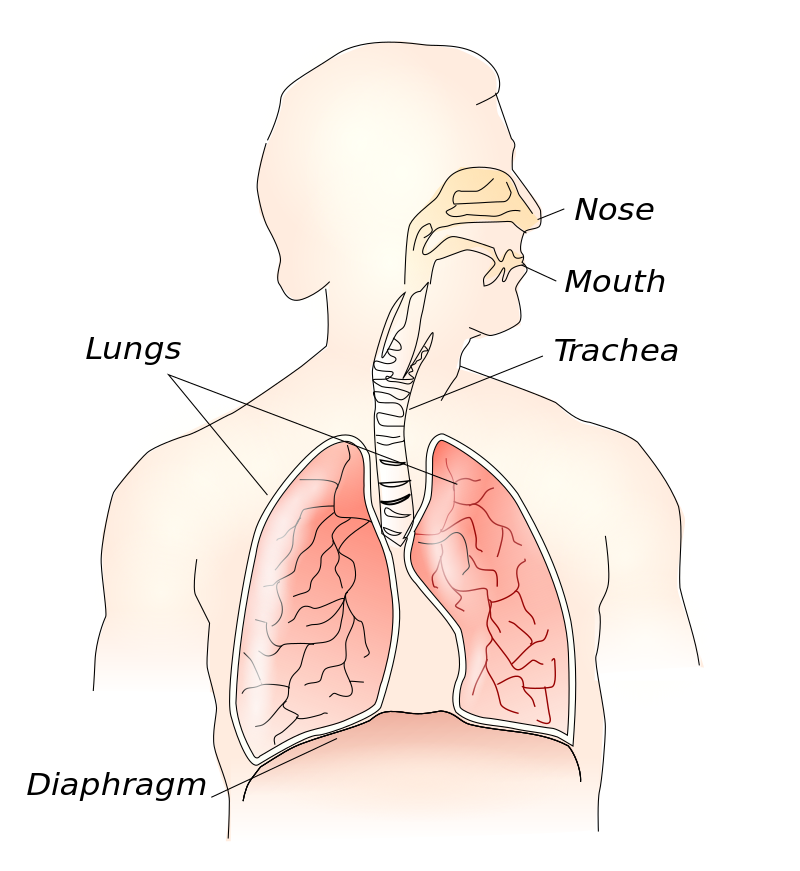
File:Respiratory_system.svg · Wikimedia Commons · See Wikimedia Commons
thoracic diaphragm
Sign in to saveAlso known as diaphragm, respiratory diaphragm, diaphragm muscle
sheet of internal skeletal muscle
The thoracic diaphragm is a sheet of muscle located inside your chest that separates your lungs from your abdominal organs below. It's your body's main breathing muscle, contracting and relaxing to pull air into and push air out of your lungs.
AI-generated from the Wikipedia summary — may contain errors.
Research
44,556 papers- Network of breathing. Multifunctional role of the diaphragm: a review.ReviewAdvances in respiratory medicine · 2017Kocjan J, Adamek M, Gzik-Zroska B et al.DOI: 10.5603/ARM.2017.0037
- Thoracic surgery may alter body static balance via diaphragm dysfunction.PloS one · 2022Kocjan J, Gzik-Zroska B, Nowakowska-Lipiec K et al.DOI: 10.1371/journal.pone.0273641
- Thoracoscopic diaphragm plication.Interactive cardiovascular and thoracic surgery · 2015Dunning JDOI: 10.1093/icvts/ivv018
- Preface. Thoracic anatomy: pleura and pleural spaces, mediastinum, diaphragm, and esophagus.Thoracic surgery clinics · 2011Deslauriers JDOI: 10.1016/j.thorsurg.2011.01.008
- Thoracoscopic diaphragm plication.Multimedia manual of cardiothoracic surgery : MMCTS · 2020Kocher G, Al-Hurani M, Dorn P et al.DOI: 10.1510/mmcts.2020.054
- Diaphragm reconstruction by GORE DUALMESH in patients undergoing resection for thoracic malignancies.Journal of cardiothoracic surgery · 2021Sano A, Azuma Y, Sakai T et al.DOI: 10.1186/s13019-021-01449-3
- Thoracic splenosis.ReviewThorax · 1994Madjar S, Weissberg DDOI: 10.1136/thx.49.10.1020
- Porous diaphragm syndromes.ReviewChest surgery clinics of North America · 1998Kirschner PA
via PubMed
Wikidata facts
- Image
- Human diaphragm.png
Show 7 more facts
- Commons category
- Thoracic diaphragm
- arterial supply
- pericardiacophrenic artery
- venous drainage
- superior phrenic vein
- Commons gallery
- Thoracic diaphragm
- innervated by
- phrenic nerve
- muscle insertion
- thoracic vertebra
- NCI Thesaurus ID
- C12702
Sources (6)
via Wikidata · CC0
~17 min read
Encyclopedic overview
Structure of diaphragm shown using a 3D medical animation still shot The thoracic diaphragm, or simply the diaphragm (/ˈdaɪəfræm/; Ancient Greek: διάφραγμα, romanized: diáphragma, lit. 'partition'), is a sheet of internal skeletal muscle in humans and other mammals that extends across the bottom of the thoracic cavity. The diaphragm is the most important muscle of respiration, and separates the thoracic cavity, containing the heart and lungs, from the abdominal cavity: as the diaphragm contracts, the volume of the thoracic cavity increases, creating a negative pressure there, which draws air into the lungs. Its high oxygen consumption is noted by the many mitochondria and capillaries present; more than in any other skeletal muscle.
The term diaphragm in anatomy, created by Gerard of Cremona, can refer to other flat structures such as the urogenital diaphragm or pelvic diaphragm, but "the diaphragm" generally refers to the thoracic diaphragm. In humans, the diaphragm is slightly asymmetric—its right half is higher up (superior) to the left half, since the large liver rests beneath the right half of the diaphragm.
Excerpted from Wikipedia’s “thoracic diaphragm” article, available under the CC BY-SA 4.0 licence.
Gallery (7)
Available in 87 languages
- Español
- Français
- Deutsch
- 中文
- 日本語
- Русский
- Português
- Italiano
- العربية
- हिन्दी
- Afrikaans
- Albanian
- Albanian
- Aramaic
- Armenian
- Azerbaijani
- Bahasa Indonesia
- Bangla
Show 68 more
- Basque
- be_x_old
- Belarusian
- Bosnian
- Breton
- Bulgarian
- Catalan
- Central Kurdish
- Chuvash
- Croatian
- Czech
- Danish
- Esperanto
- Estonian
- Filipino
- Finnish
- fiu_vro
- Galician
- Georgian
- Greek
- Haitian Creole
- Hakka Chinese
- Hebrew
- Hungarian
- Interlingua
- Irish
- Kannada
- Kazakh
- Kikuyu
- Kurdish
- Kyrgyz
- Latin
- Latvian
- Limburgish
- Lingua Franca Nova
- Lithuanian
- Luxembourgish
- Macedonian
- Malay
- Nederlands
- Newari
- Norwegian
- Norwegian Nynorsk
- Polski
- Romanian
- Serbian
- Serbian (Latin)
- simple
- Slovak
- Slovenian
- Svenska
- Tajik
- Tamil
- Telugu
- Tiếng Việt
- Türkçe
- Ukrainian
- Urdu
- Uzbek
- Waray
- Welsh
- Wu Chinese
- Yakut
- zh_min_nan
- zh_yue
- فارسی
- ไทย
- 한국어
via Wikidata sitelinks · CC0