Category
page 1Thought
.jpg)
thought
thumb|The Thinker by [[Auguste Rodin (1840–1917) in the garden of the Musée Rodin, Paris]]
In their most common sense, thought and thinking refer to cognitive processes that occur independently of direct sensory stimulation. Core forms include judging, reasoning, concept formation, problem solving, and deliberation. Other processes, such as entertaining an idea, memory, or imagination, are also frequently considered types of thought. Unlike perception, these activities can occur without immediate input from the sensory organs. In a broader sense, any mental event—including perception and uncon

paradox
A paradox is a logically self-contradictory statement or a statement that runs contrary to one's expectation. It is a statement that, despite apparently valid reasoning from true or apparently true premises, leads to a seemingly self-contradictory or a logically unacceptable conclusion. A paradox usually involves contradictory-yet-interrelated elements that exist simultaneously and persist over time. They result in "persistent contradiction between interdependent elements" leading to a lasting "unity of opposites".

creativity
thumb|upright=0.7|alt=graphic of a lightbulb|A picture of an incandescent light bulb, a symbol associated with the formation of an [[idea, an example of creativity]]

abstraction
Abstraction is the process of generalizing rules and concepts from specific examples, literal (real or concrete) signifiers, first principles, or other methods. The result of the process, an abstraction, is a concept that acts as a common noun for all subordinate concepts and connects any related concepts as a group, field, or category.

intellectual
thumb|Prominent contemporary public intellectuals include (left to right): Yuval Noah Harari|Harari, Chomsky, Žižek

critical thinking
analysis of facts, with certain levels of rigor and problem-solving abilities, to form a judgment
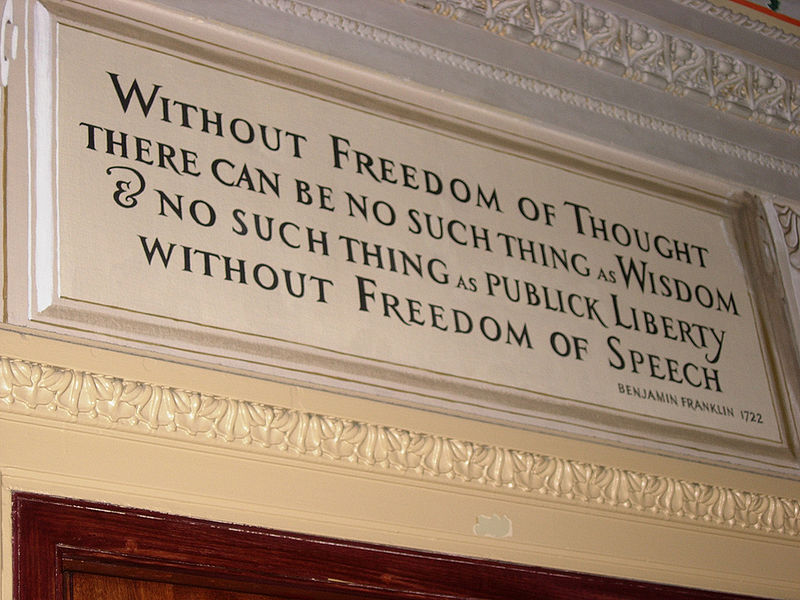
freedom of thought
freedom of an individual to hold or consider a fact, viewpoint, or thought, independent of others' viewpoints
inference
Inferences are steps in logical reasoning, moving from premises to logical consequences; etymologically, the word infer means to "carry forward". Inference is theoretically traditionally divided into deduction and induction, a distinction that dates at least to Aristotle (300s BC). Deduction is inference deriving logical conclusions from premises known or assumed to be true, with the laws of valid inference being studied in logic. Induction is inference from particular evidence to a universal conclusion. A third type of inference is sometimes distinguished, notably by Charles Sanders Peirce, c
understanding
Understanding is a cognitive process related to an abstract or physical object, such as a person, situation, or message whereby one is able to use concepts to model that object. Understanding is a relation between the knower and an object of understanding. Understanding implies abilities and dispositions with respect to an object of knowledge that are sufficient to support intelligent behavior.
transcendence
concept designating the extra-categorical attributes of beings
introspection
Introspection is the examination of one's own conscious thoughts and feelings. In psychology, the process of introspection relies on the observation of one's mental state, while in a spiritual context it may refer to the examination of one's soul. Introspection is closely related to human self-reflection and self-discovery and is contrasted with external observation.
intention
An intention is a mental state in which a person commits themselves to a course of action. Having the plan to visit the zoo tomorrow is an example of an intention. The action plan is the content of the intention while the commitment is the attitude towards this content. Other mental states can have action plans as their content, as when one admires a plan, but differ from intentions since they do not involve a practical commitment to realizing this plan. Successful intentions bring about the intended course of action while unsuccessful intentions fail to do so. Intentions, like many other ment
.svg)
judgment
thumb|Illustration of a judge evaluating evidence in court to make a judgement

qualia
upright=0.65|thumb|The "redness" of red is an example of a quale.

intellect
thumb|right|300px|The intellect comprises the rational and the [[logical aspects of the human mind.]]
noosphere
The noosphere (alternate spelling noösphere) is a philosophical concept developed and popularized by the biogeochemist Vladimir Vernadsky and philosopher and Jesuit priest Pierre Teilhard de Chardin. Vernadsky defined the noosphere as the new state of the biosphere, and described it as the planetary "sphere of reason". The noosphere represents the highest stage of biospheric development, that of humankind's rational activities.

intellectualism
Intellectualism is the mental perspective that emphasizes the use, development, and exercise of the intellect, and is identified with the life of the mind of the intellectual. In the field of philosophy, the term intellectualism indicates one of two ways of critically thinking about the character of the world: (i) rationalism, which is knowledge derived solely from reason; and (ii) empiricism, which is knowledge derived solely from sense experience. Each intellectual approach attempts to eliminate fallacies that ignore, mistake, or distort evidence about "what ought to be" instead of "what is"
lateral thinking
manner of solving problems using an indirect and creative approach via reasoning that is not immediately obvious or attainable using only traditional step-by-step logic
expectation
future event or consequence that is considered or anticipated to be the most likely to happen

scholar
thumb|upright=1.1|The Scholar and His Books by Gerbrand van den Eeckhout
A scholar is a person who is a researcher or has expertise in an academic discipline. A scholar can also be an academic, who works as a professor, teacher, or researcher at a university. An academic usually holds an advanced degree or a terminal degree, such as a master's degree or a doctorate. Independent scholars and public intellectuals work outside the academy yet may publish in academic journals and participate in scholarly public discussion.
time perception
perception of the passing of time

Thinking, Fast and Slow
2011 non-fiction work by Daniel Kahneman
educational assessment
systematic process of documenting and using empirical data on the knowledge, skill, attitudes, and beliefs to refine programs and improve student learning
dianoia
In Platonism, dianoia (Greek: διάνοια) is the human cognitive faculty associated with the BC portion of the analogy of the divided line and related to discursive thinking about mathematical and technical subjects. It stands in contrast to the immediate, cognitive process of intuitive apprehension or noesis.
practical reason
the use of reason to decide how to act
thoughts and prayers
English language phrase used when offering condolences

Freedom for the Thought That We Hate
2007 non-fiction book
Vertical thinking
Solving problems through a direct and thoroughly analytical approach using old logic
Portal:Contents/Philosophy and thinking
Wikimedia portal
synthetic thinking
form of thinking that uses the function of a phenomenon within a larger system to explain it
figure of thought
Rhetorical device