Category
page 1Timurid architecture

Registan
thumb|300px|The Registan and its three madrasas (from left to right): the [[Ulugh Beg Madrasa, the Tilakari Madrasa and the Sherdar Madrasa]]
The Registan (from ; ) is a historic public square in the city of Samarkand, now in Uzbekistan, famed for its ensemble of three madrasas (Islamic schools): the Ulugh Beg Madrasa of the Timurid period, and the Sherdar Madrasa and Tilakari Madrasa, built later under the Janid dynasty.

Gur-e Amir
The Gūr-i Amīr or Guri Amir (, ) is a mausoleum of the Turco-Mongol conqueror Timur (also known as Tamerlane) in Samarkand, Uzbekistan. It occupies an important place in the history of Turkestan's architecture as the precursor for and had influence on later Mughal architecture tombs, including Gardens of Babur in Kabul, Humayun's Tomb in Delhi and the Taj Mahal in Agra, built by Timur's Indian descendants, Mughals that followed Indian culture with Central Asian influences. Mughals established the ruling Mughal dynasty of the Indian subcontinent. The mausoleum has been heavily restored over the

Mausoleum of Khoja Ahmed Yasawi
mausoleum in the city of Turkistan, Kazakhstan
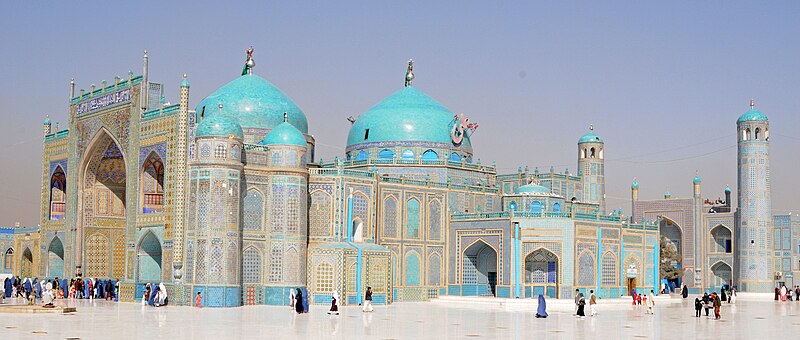
Blue Mosque
mosque and mausoleum in Mazar-i-Sharif, Afghanistan

Ulugh Beg Observatory
observatory in Samarkand, Uzbekistan, built in the 1420s
Imam Reza Shrine
shrine in Mashhad, Iranian national heritage site

Shah-i-Zinda
Shah-i-Zinda (from ; ) is a necropolis in the north-eastern part of Samarkand, Uzbekistan.
Ulugh Beg Madrasa
religious educational institution in Samarkand, Uzbekistan
Ak-Saray Palace
Timur's palace in Shahrisabz
Timurid architecture
architecture of the Timurid Empire
Attar Mausoleum
mausoleum in Nishapur County, Iranian national heritage site
Gawhar Shad Mausoleum
Islamic burial site in Herat, Afghanistan
Banna'i
thumb|right|Banna'i brickwork in the [[Mausoleum of Khoja Ahmed Yasavi. The blue brickwork spells out the names of Allah, Muhammad and Ali in square Kufic calligraphy.]]
In Iranian architecture, '''banna'i''' (, "builder's technique" in Persian) is an architectural decorative art in which glazed tiles are alternated with plain bricks to create geometric patterns over the surface of a wall or to spell out sacred names or pious phrases. This technique originated in Syria and Iraq in the 8th century, and matured in the Seljuq and Timurid era, as it spread to Iran, Anatolia and Central Asia.
Mir Bozorg Mausoleum
mausoleum in Amol, Iranian national heritage site
Imamzadeh Khajeh Taj al-Din
imamzadeh in Kashan, Iranian national heritage site
Shahshahan Mausoleum
mausoleum in Isfahan, Iranian national heritage site
Mausoleum of Rabiya Sultan Begim
Memorial in Turkistan, southern Kazakhstan
Ghiyasiyeh Madrasa
madrasa in Khaf County, Iranian national heritage site
Imamzadeh Husayn Reza
imamzadeh tower in Varamin, Iranian national heritage site